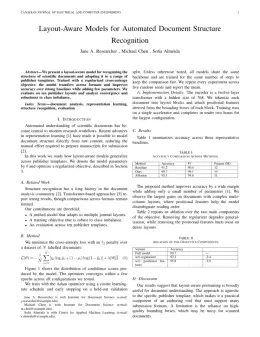
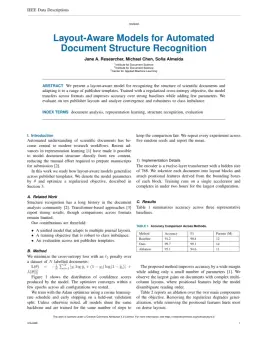
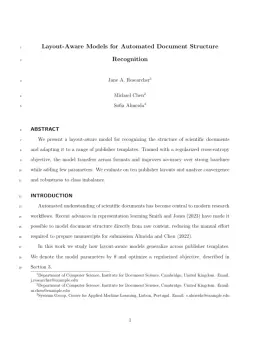
IEEE

IEEE Solid-State Circuits Letters Template

Write in a clean editor, then format for IEEE Solid-State Circuits Letters in one click — DocuGuru applies the official IEEE template with numbered references and exports a submission-ready PDF plus the editable LaTeX source. Free to start.

About the IEEE Solid-State Circuits Letters format

IEEE Solid-State Circuits Letters is a peer-reviewed journal published by IEEE, covering Radio Frequency Integrated Circuit Design, Analog and Mixed-Signal Circuit Design, Advancements in PLL and VCO Technologies. Over its lifetime it has published 834 papers, which have received 7,097 citations.

PublisherIEEE
Reference styleNumbered (IEEE)
Numbered — [1], [2] in the text
[1] A. Smith, B. Jones, and C. Lee, "A representative article title," IEEE Solid-State Circuits Letters, vol. 12, no. 3, pp. 45–58, 2023.

Formats any DOI in IEEE Solid-State Circuits Letters style. No sign-up.

Abbreviation (ISO-4)SSCL
Publishes research inRadio Frequency Integrated Circuit Design Analog and Mixed-Signal Circuit Design Advancements in PLL and VCO Technologies Advancements in Semiconductor Devices and Circuit Design Semiconductor materials and devices
ISSN2573-9603
Citation impact (2-yr)1.88
h-index35
i10-index266
Top institutions publishing hereIntel (United States)
Journal websiteieeexplore.ieee.org
You getA submission-ready PDF and the editable LaTeX source — ready to submit.

Papers published in IEEE Solid-State Circuits Letters per year

2
2017
100
2018
126
2019
144
2020
60
2021
86
2022
86
2023
91
2024
93
2025

Citation impact of IEEE Solid-State Circuits Letters by publication year

3
2017
1.4K
2018
1.4K
2019
1.8K
2020
800
2021
739
2022
457
2023
319
2024
93
2025

Citations each year’s papers have accumulated so far — the most recent years are still building up.

Most-cited papers in IEEE Solid-State Circuits Letters

A 0.083-mm<sup>2</sup> 25.2-to-29.5 GHz Multi-LC-Tank Class-F<sub>234</sub> VCO With a 189.6-dBc/Hz FOM

Hao Guo, Yong Chen, Pui‐In Mak et al. · 1 Apr 2018

A compact multi-LC-tank Class-F <sub xmlns:mml="http://www.w3.org/1998/Math/MathML" xmlns:xlink="http://www.w3.org/1999/xlink">234</sub> voltage-controlled oscillator (VCO) for mm-wave applications is reported. It features an inductive multiplier inside the positive feedback loop to suppress the effective noise factor of the MOS devices. Also, by pseudo-squaring the drain-voltage waveform of the MOS devices via 2nd, 3rd, and 4th harmonic peaking, we obtain a…

A Low-Power 1-V Supply Dynamic Comparator

Subhash Chevella, Daniel O’Hare, Ivan O’Connell · 1 Jan 2020

This letter presents a low-power dynamic comparator for ultralow power applications. The prototype is designed in a 65-nm CMOS process with a supply voltage of 1 V and is compared against the widely used double tail latch comparator in terms of power consumption and input referred rms noise. The addition of cross-coupled devices to the…

Energy-Efficient Wide-Range Voltage Level Shifters Reaching 4.2 fJ/Transition

Reza Lotfi, Mehdi Saberi, Seyed Rasool Hosseini et al. · 1 Feb 2018

This letter proposes a new level-shifting structure that can convert extremely low levels of input voltages to high output voltages while maintaining excellent delay and power dissipation. In order to reduce contention and voltage swing in the internal nodes, the proposed circuit uses a diode-connected level shifter between gate terminals of the output inverter. Using…

A Piezoelectric Energy-Harvesting System With Parallel-SSHI Rectifier and Integrated Maximum-Power-Point Tracking

Shuo Li, Abhishek Roy, Benton H. Calhoun · 5 Nov 2019

A piezoelectric energy-harvesting system, including a parallel-synchronized-switch harvesting-on-inductor (SSHI) rectifier and integrated maximum-power-point tracking (MPPT), is presented. The perturb & observe (P&O) algorithm is adopted for the MPPT of the parallel-SSHI rectifier. Furthermore, an output power evaluation algorithm for the P&O MPPT is proposed and its detailed implementation in the full analog domain is analyzed.…

A 6.1-nW Wake-Up Receiver Achieving −80.5-dBm Sensitivity Via a Passive Pseudo-Balun Envelope Detector

Po-Han Wang, Haowei Jiang, Li Gao et al. · 1 May 2018

A wake-up receiver (WuRX) that achieves −80.5-dBm sensitivity with only 6.1 nW of power is presented. High sensitivity is achieved via a passive pseudo-balun envelope detector (ED) with a high input impedance ( <inline-formula xmlns:mml="http://www.w3.org/1998/Math/MathML" xmlns:xlink="http://www.w3.org/1999/xlink"> <tex-math notation="LaTeX">$&gt; 750~\text {k}{\Omega }\;{\|}{&lt; }1.4$ </tex-math></inline-formula> pF) that enables a 30.6-dB passive voltage gain transformer while providing differential…

IEEE Solid-State Circuits Letters template — frequently asked questions

How do I write a paper in the IEEE Solid-State Circuits Letters format?
In DocuGuru you write your manuscript in a normal editor — no LaTeX setup required — and select the IEEE Solid-State Circuits Letters template. When you export, DocuGuru compiles the paper into the official IEEE format and hands you a submission-ready PDF along with the editable LaTeX source.
What reference style does IEEE Solid-State Circuits Letters use?
IEEE Solid-State Circuits Letters uses Numbered (IEEE) references, shown as numbered [1], [2] markers in the text. DocuGuru formats every in-text citation and the reference list in this exact style automatically. A reference appears like this: [1] A. Smith, B. Jones, and C. Lee, "A representative article title," IEEE Solid-State Circuits Letters, vol. 12, no. 3, pp. 45–58, 2023.
Do I need to know LaTeX to submit to IEEE Solid-State Circuits Letters?
No. DocuGuru generates the IEEEtran LaTeX class and compiles the PDF for you in the background, so you get a IEEE-ready IEEE Solid-State Circuits Letters document without writing any LaTeX. If you do want it, the LaTeX source is included in the export.
Can I import an existing draft into the IEEE Solid-State Circuits Letters template?
Yes. Paste or upload your current manuscript — Word, LaTeX, Markdown, or plain text — and DocuGuru reflows it into the IEEE Solid-State Circuits Letters format with correct headings, figures, tables, and numbered citations.
Who publishes IEEE Solid-State Circuits Letters?
IEEE Solid-State Circuits Letters is a engineering and computer science journal published by IEEE. DocuGuru's IEEE Solid-State Circuits Letters template matches IEEE's official submission format.
Can I export a submission-ready IEEE Solid-State Circuits Letters PDF?
Yes — DocuGuru produces a PDF built with the official IEEE Solid-State Circuits Letters template (the IEEEtran class) that is ready to submit to IEEE, together with the matching LaTeX source files.
How much does the IEEE Solid-State Circuits Letters template cost?
You can start writing in the IEEE Solid-State Circuits Letters template for free. Exporting the final submission-ready IEEE Solid-State Circuits Letters PDF and LaTeX source is part of DocuGuru's paid plans — see the app for current pricing.
Use the IEEE Solid-State Circuits Letters template