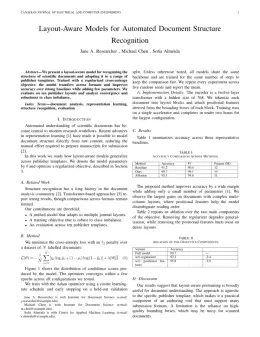
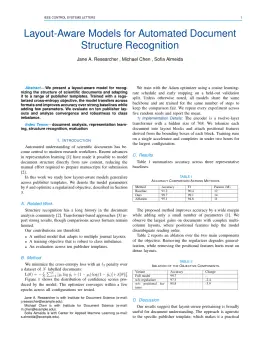
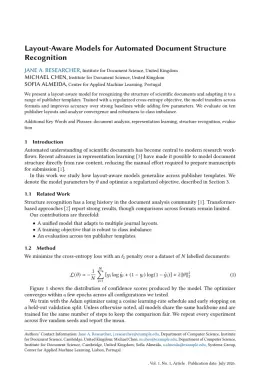
About the Journal of Lightwave Technology format
Journal of Lightwave Technology is a peer-reviewed journal published by IEEE, covering Optical Network Technologies, Photonic and Optical Devices, Advanced Photonic Communication Systems. Over its lifetime it has published 25,073 papers, which have received 702,512 citations.
| Publisher | IEEE |
|---|
| Reference style | Numbered (IEEE) Numbered — [1], [2] in the text
[1] A. Smith, B. Jones, and C. Lee, "A representative article title," Journal of Lightwave Technology, vol. 12, no. 3, pp. 45–58, 2023.
Formats any DOI in Journal of Lightwave Technology style. No sign-up.
|
|---|
| Abbreviation (ISO-4) | JLT |
|---|
| Publishes research in | Optical Network Technologies Photonic and Optical Devices Advanced Photonic Communication Systems Semiconductor Lasers and Optical Devices Advanced Fiber Optic Sensors |
|---|
| ISSN | 0733-8724 |
|---|
| Citation impact (2-yr) | 3.37 |
|---|
| h-index | 262 |
|---|
| i10-index | 13,527 |
|---|
| Top institutions publishing here | NTT (Japan) |
|---|
| Journal website | www.opticsinfobase.org |
|---|
| You get | A submission-ready PDF and the editable LaTeX source — ready to submit. |
|---|
Papers published in Journal of Lightwave Technology per year
Citation impact of Journal of Lightwave Technology by publication year
Citations each year’s papers have accumulated so far — the most recent years are still building up.
Most-cited papers in Journal of Lightwave Technology
Fiber grating sensors
A.D. Kersey, Michael A. Davis, H.J. Patrick et al. · 1 Jan 1997
We review the recent developments in the area of optical fiber grating sensors, including quasi-distributed strain sensing using Bragg gratings, systems based on chirped gratings, intragrating sensing concepts, long period-based grating sensors, fiber grating laser-based systems, and interferometric sensor systems based on grating reflectors.
Fiber grating spectra
T. Erdoğan · 1 Jan 1997
In this paper, we describe the spectral characteristics that can be achieved in fiber reflection (Bragg) and transmission gratings. Both principles for understanding and tools for designing fiber gratings are emphasized. Examples are given to illustrate the wide variety of optical properties that are possible in fiber gratings. The types of gratings considered include uniform,…
Fiber Bragg grating technology fundamentals and overview
K. O. Hill, G. Meltz · 1 Jan 1997
The historical beginnings of photosensitivity and fiber Bragg grating (FBG) technology are recounted. The basic techniques for fiber grating fabrication, their characteristics, and the fundamental properties of fiber gratings are described. The many applications of fiber grating technology are tabulated, and some selected applications are briefly described.
Optical multi-mode interference devices based on self-imaging: principles and applications
L.B. Soldano, E.C.M. Pennings · 1 Apr 1995
This paper presents an overview of integrated optics routing and coupling devices based on multimode interference. The underlying self-imaging principle in multimode waveguides is described using a guided mode propagation analysis. Special issues concerning the design and operation of multimode interference devices are discussed, followed by a survey of reported applications. It is shown that…
Capacity Limits of Optical Fiber Networks
René-Jean Essiambre, Gerhard Kramer, Peter J. Winzer et al. · 1 Feb 2010
We describe a method to estimate the capacity limit of fiber-optic communication systems (or ¿fiber channels¿) based on information theory. This paper is divided into two parts. Part 1 reviews fundamental concepts of digital communications and information theory. We treat digitization and modulation followed by information theory for channels both without and with memory. We…