IEEE

IEEE Journal of Selected Topics in Signal Processing Template

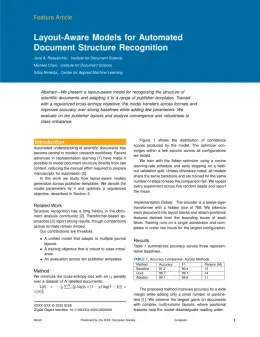
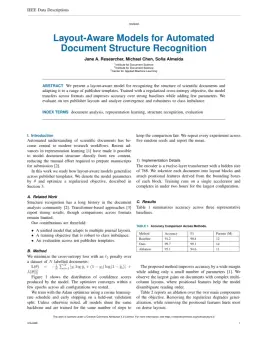
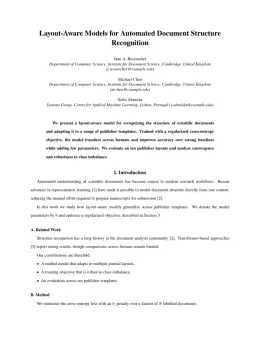
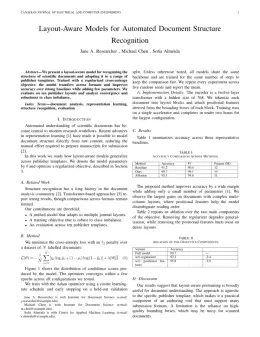
Write in a clean editor, then format for IEEE Journal of Selected Topics in Signal Processing in one click — DocuGuru applies the official IEEE template with numbered references and exports a submission-ready PDF plus the editable LaTeX source. Free to start.

About the IEEE Journal of Selected Topics in Signal Processing format

IEEE Journal of Selected Topics in Signal Processing is a peer-reviewed journal published by IEEE, covering Diverse Scientific and Economic Studies, Speech and Audio Processing, Advanced MIMO Systems Optimization. Over its lifetime it has published 2,997 papers, which have received 140,349 citations.

PublisherIEEE
Reference styleNumbered (IEEE)
Numbered — [1], [2] in the text
[1] A. Smith, B. Jones, and C. Lee, "A representative article title," IEEE Journal of Selected Topics in Signal Processing, vol. 12, no. 3, pp. 45–58, 2023.

Formats any DOI in IEEE Journal of Selected Topics in Signal Processing style. No sign-up.

Abbreviation (ISO-4)JSTSP
Publishes research inDiverse Scientific and Economic Studies Speech and Audio Processing Advanced MIMO Systems Optimization Human auditory perception and evaluation Sensor Technology and Measurement Systems
ISSN1932-4553
Citation impact (2-yr)4.18
h-index171
i10-index1,449
Top institutions publishing hereTsinghua University
You getA submission-ready PDF and the editable LaTeX source — ready to submit.

Papers published in IEEE Journal of Selected Topics in Signal Processing per year

163
2014
209
2015
204
2016
170
2017
166
2018
171
2019
138
2020
127
2021
148
2022
94
2023
165
2024
165
2025

Citation impact of IEEE Journal of Selected Topics in Signal Processing by publication year

14.2K
2014
6.6K
2015
13.3K
2016
7.3K
2017
8.1K
2018
8.6K
2019
5K
2020
3.6K
2021
7K
2022
2.6K
2023
1.3K
2024
362
2025

Citations each year’s papers have accumulated so far — the most recent years are still building up.

Most-cited papers in IEEE Journal of Selected Topics in Signal Processing

Gradient Projection for Sparse Reconstruction: Application to Compressed Sensing and Other Inverse Problems

Mário A. T. Figueiredo, Robert D. Nowak, Stephen J. Wright · 1 Dec 2007

Many problems in signal processing and statistical inference involve finding sparse solutions to under-determined, or ill-conditioned, linear systems of equations. A standard approach consists in minimizing an objective function which includes a quadratic (squared ) error term combined with a sparseness-inducing regularization term. Basis pursuit, the least absolute shrinkage and selection operator (LASSO), wavelet-based deconvolution,…

3,548 citations Cite SaveGo to paper →
An Overview of Signal Processing Techniques for Millimeter Wave MIMO Systems

Robert W. Heath, Nuria González‐Prelcic, Sundeep Rangan et al. · 8 Feb 2016

Communication at millimeter wave (mmWave) frequencies is defining a new era of wireless communication. The mmWave band offers higher bandwidth communication channels versus those presently used in commercial wireless systems. The applications of mmWave are immense: wireless local and personal area networks in the unlicensed band, 5G cellular systems, not to mention vehicular area networks,…

2,955 citations Cite SaveGo to paper →
An Overview of Massive MIMO: Benefits and Challenges

Lu Lu, Geoffrey Ye Li, A. Lee Swindlehurst et al. · 15 Apr 2014

Massive multiple-input multiple-output (MIMO) wireless communications refers to the idea equipping cellular base stations (BSs) with a very large number of antennas, and has been shown to potentially allow for orders of magnitude improvement in spectral and energy efficiency using relatively simple (linear) processing. In this paper, we present a comprehensive overview of state-of-the-art research…

2,851 citations Cite SaveGo to paper →
Channel Estimation and Hybrid Precoding for Millimeter Wave Cellular Systems

Ahmed Alkhateeb, Omar El Ayach, Geert Leus et al. · 1 Jul 2014

Millimeter wave (mmWave) cellular systems will enable gigabit-per-second data rates thanks to the large bandwidth available at mmWave frequencies. To realize sufficient link margin, mmWave systems will employ directional beamforming with large antenna arrays at both the transmitter and receiver. Due to the high cost and power consumption of gigasample mixed-signal devices, mmWave precoding will…

2,644 citations Cite SaveGo to paper →
An Interior-Point Method for Large-Scale -Regularized Least Squares

Seung-Jean Kim, Kwangmoo Koh, Michael Lustig et al. · 1 Dec 2007

Recently, a lot of attention has been paid to regularization based methods for sparse signal reconstruction (e.g., basis pursuit denoising and compressed sensing) and feature selection (e.g., the Lasso algorithm) in signal processing, statistics, and related fields. These problems can be cast as -regularized least-squares programs (LSPs), which can be reformulated as convex quadratic programs,…

2,089 citations Cite SaveGo to paper →

IEEE Journal of Selected Topics in Signal Processing template — frequently asked questions

How do I write a paper in the IEEE Journal of Selected Topics in Signal Processing format?
In DocuGuru you write your manuscript in a normal editor — no LaTeX setup required — and select the IEEE Journal of Selected Topics in Signal Processing template. When you export, DocuGuru compiles the paper into the official IEEE format and hands you a submission-ready PDF along with the editable LaTeX source.
What reference style does IEEE Journal of Selected Topics in Signal Processing use?
IEEE Journal of Selected Topics in Signal Processing uses Numbered (IEEE) references, shown as numbered [1], [2] markers in the text. DocuGuru formats every in-text citation and the reference list in this exact style automatically. A reference appears like this: [1] A. Smith, B. Jones, and C. Lee, "A representative article title," IEEE Journal of Selected Topics in Signal Processing, vol. 12, no. 3, pp. 45–58, 2023.
Do I need to know LaTeX to submit to IEEE Journal of Selected Topics in Signal Processing?
No. DocuGuru generates the IEEEtran LaTeX class and compiles the PDF for you in the background, so you get a IEEE-ready IEEE Journal of Selected Topics in Signal Processing document without writing any LaTeX. If you do want it, the LaTeX source is included in the export.
Can I import an existing draft into the IEEE Journal of Selected Topics in Signal Processing template?
Yes. Paste or upload your current manuscript — Word, LaTeX, Markdown, or plain text — and DocuGuru reflows it into the IEEE Journal of Selected Topics in Signal Processing format with correct headings, figures, tables, and numbered citations.
Who publishes IEEE Journal of Selected Topics in Signal Processing?
IEEE Journal of Selected Topics in Signal Processing is a engineering and computer science journal published by IEEE. DocuGuru's IEEE Journal of Selected Topics in Signal Processing template matches IEEE's official submission format.
Can I export a submission-ready IEEE Journal of Selected Topics in Signal Processing PDF?
Yes — DocuGuru produces a PDF built with the official IEEE Journal of Selected Topics in Signal Processing template (the IEEEtran class) that is ready to submit to IEEE, together with the matching LaTeX source files.
How much does the IEEE Journal of Selected Topics in Signal Processing template cost?
You can start writing in the IEEE Journal of Selected Topics in Signal Processing template for free. Exporting the final submission-ready IEEE Journal of Selected Topics in Signal Processing PDF and LaTeX source is part of DocuGuru's paid plans — see the app for current pricing.
Use the IEEE Journal of Selected Topics in Signal Processing template