IEEE

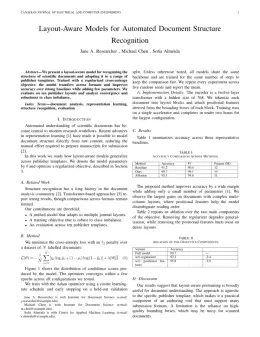
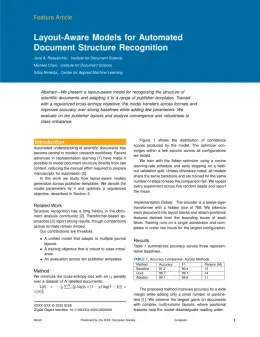
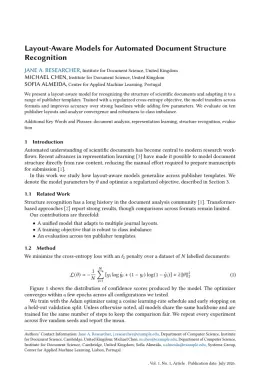
IEEE Antennas and Propagation Magazine Template

Write in a clean editor, then format for IEEE Antennas and Propagation Magazine in one click — DocuGuru applies the official IEEE template with numbered references and exports a submission-ready PDF plus the editable LaTeX source. Free to start.

About the IEEE Antennas and Propagation Magazine format

IEEE Antennas and Propagation Magazine is a peer-reviewed journal published by IEEE, covering Antenna Design and Analysis, Antenna Design and Optimization, Human auditory perception and evaluation. Over its lifetime it has published 7,840 papers, which have received 88,617 citations.

PublisherIEEE
Reference styleNumbered (IEEE)
Numbered — [1], [2] in the text
[1] A. Smith, B. Jones, and C. Lee, "A representative article title," IEEE Antennas and Propagation Magazine, vol. 12, no. 3, pp. 45–58, 2023.

Formats any DOI in IEEE Antennas and Propagation Magazine style. No sign-up.

Publishes research inAntenna Design and Analysis Antenna Design and Optimization Human auditory perception and evaluation Diverse Scientific and Economic Studies Educational Robotics and Engineering
ISSN1045-9243
Citation impact (2-yr)1.12
h-index121
i10-index1,391
Top institutions publishing hereUniversity of Connecticut
Journal websiteieeexplore.ieee.org
You getA submission-ready PDF and the editable LaTeX source — ready to submit.

Papers published in IEEE Antennas and Propagation Magazine per year

420
2014
215
2015
218
2016
234
2017
193
2018
205
2019
196
2020
202
2021
207
2022
152
2023
180
2024
171
2025

Citation impact of IEEE Antennas and Propagation Magazine by publication year

2.3K
2014
3.8K
2015
1.7K
2016
3.9K
2017
1.4K
2018
1.7K
2019
2.1K
2020
1.1K
2021
1.2K
2022
387
2023
247
2024
80
2025

Citations each year’s papers have accumulated so far — the most recent years are still building up.

Most-cited papers in IEEE Antennas and Propagation Magazine

An Overview of the Theory and Applications of Metasurfaces: The Two-Dimensional Equivalents of Metamaterials

Christopher L. Holloway, Edward F. Kuester, Joshua A. Gordon et al. · 1 Apr 2012

Metamaterials are typically engineered by arranging a set of small scatterers or apertures in a regular array throughout a region of space, thus obtaining some desirable bulk electromagnetic behavior. The desired property is often one that is not normally found naturally (negative refractive index, near-zero index, etc.). Over the past ten years, metamaterials have moved…

2,302 citations Cite SaveGo to paper →
The fast multipole method for the wave equation: a pedestrian prescription

Ronald R. Coifman, Vladimir Rokhlin, Stephen M. Wandzura · 1 Jun 1993

A practical and complete, but not rigorous, exposition of the fact multiple method (FMM) is provided. The FMM provides an efficient mechanism for the numerical convolution of the Green's function for the Helmholtz equation with a source distribution and can be used to radically accelerate the iterative solution of boundary-integral equations. In the simple single-stage…

1,475 citations Cite SaveGo to paper →
Using the matrix pencil method to estimate the parameters of a sum of complex exponentials

Tapan K. Sarkar, O.J.B. Almeida Pereira · 1 Feb 1995

The approximation of a function by a sum of complex exponentials is a problem that is at least two centuries old. Fundamentally, all techniques discussed in this article proceed from using the same sequence of data samples and vary only, but importantly, in how those samples are used in achieving the parameter estimation. All of…

1,204 citations Cite SaveGo to paper →
An overview of fractal antenna engineering research

D.H. Wqrner, Swaroop Ganguly · 1 Feb 2003

Recent efforts by several researchers around the world to combine fractal geometry with electromagnetic theory have led to a plethora of new and innovative antenna designs. In this report, we provide a comprehensive overview of recent developments in the rapidly growing field of fractal antenna engineering. Fractal antenna engineering research has been primarily focused in…

1,119 citations Cite SaveGo to paper →
The κ-μ distribution and the η-μ distribution

Michel Daoud Yacoub · 1 Feb 2007

This paper presents two general fading distributions, the kappa-mu distribution and the eta-mu distribution, for which fading models are proposed. These distributions are fully characterized in terms of measurable physical parameters. The kappa-mu distribution includes the Rice (Nakagami-n), the Nakagami-m, the Rayleigh, and the one-sided Gaussian distributions as special cases. The eta-mu distribution includes the…

IEEE Antennas and Propagation Magazine template — frequently asked questions

How do I write a paper in the IEEE Antennas and Propagation Magazine format?
In DocuGuru you write your manuscript in a normal editor — no LaTeX setup required — and select the IEEE Antennas and Propagation Magazine template. When you export, DocuGuru compiles the paper into the official IEEE format and hands you a submission-ready PDF along with the editable LaTeX source.
What reference style does IEEE Antennas and Propagation Magazine use?
IEEE Antennas and Propagation Magazine uses Numbered (IEEE) references, shown as numbered [1], [2] markers in the text. DocuGuru formats every in-text citation and the reference list in this exact style automatically. A reference appears like this: [1] A. Smith, B. Jones, and C. Lee, "A representative article title," IEEE Antennas and Propagation Magazine, vol. 12, no. 3, pp. 45–58, 2023.
Do I need to know LaTeX to submit to IEEE Antennas and Propagation Magazine?
No. DocuGuru generates the IEEEcsmag LaTeX class and compiles the PDF for you in the background, so you get a IEEE-ready IEEE Antennas and Propagation Magazine document without writing any LaTeX. If you do want it, the LaTeX source is included in the export.
Can I import an existing draft into the IEEE Antennas and Propagation Magazine template?
Yes. Paste or upload your current manuscript — Word, LaTeX, Markdown, or plain text — and DocuGuru reflows it into the IEEE Antennas and Propagation Magazine format with correct headings, figures, tables, and numbered citations.
What is IEEE Antennas and Propagation Magazine?
IEEE Antennas and Propagation Magazine, published by IEEE. It is a engineering and computer science journal, published by IEEE.
Can I export a submission-ready IEEE Antennas and Propagation Magazine PDF?
Yes — DocuGuru produces a PDF built with the official IEEE Antennas and Propagation Magazine template (the IEEEcsmag class) that is ready to submit to IEEE, together with the matching LaTeX source files.
How much does the IEEE Antennas and Propagation Magazine template cost?
You can start writing in the IEEE Antennas and Propagation Magazine template for free. Exporting the final submission-ready IEEE Antennas and Propagation Magazine PDF and LaTeX source is part of DocuGuru's paid plans — see the app for current pricing.
Use the IEEE Antennas and Propagation Magazine template