IEEE

Computer Template

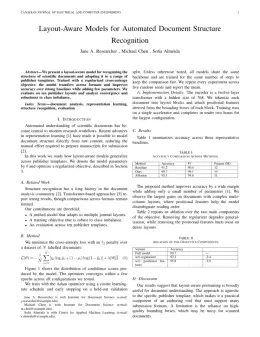
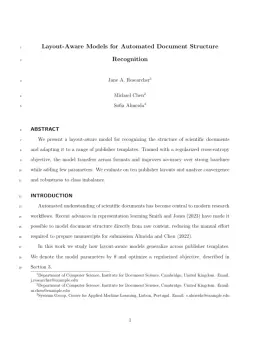
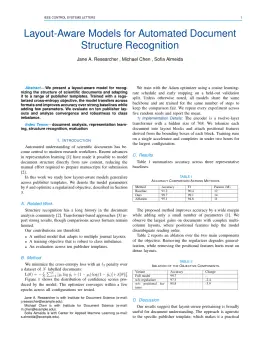
Write in a clean editor, then format for Computer in one click — DocuGuru applies the official IEEE template with numbered references and exports a submission-ready PDF plus the editable LaTeX source. Free to start.

About the Computer format

Computer is a peer-reviewed journal published by IEEE, covering Diverse Scientific and Economic Studies, Human auditory perception and evaluation, Educational Robotics and Engineering. Over its lifetime it has published 18,108 papers, which have received 447,542 citations.

PublisherIEEE
Reference styleNumbered (IEEE)
Numbered — [1], [2] in the text
[1] A. Smith, B. Jones, and C. Lee, "A representative article title," Computer, vol. 12, no. 3, pp. 45–58, 2023.

Formats any DOI in Computer style. No sign-up.

Publishes research inDiverse Scientific and Economic Studies Human auditory perception and evaluation Educational Robotics and Engineering Parallel Computing and Optimization Techniques Distributed and Parallel Computing Systems
ISSN0018-9162
Citation impact (2-yr)1.12
h-index281
i10-index4,178
Top institutions publishing hereCalifornia State University System
You getA submission-ready PDF and the editable LaTeX source — ready to submit.

Papers published in Computer per year

343
2014
358
2015
382
2016
380
2017
346
2018
361
2019
393
2020
395
2021
418
2022
436
2023
477
2024
561
2025

Citation impact of Computer by publication year

3.7K
2014
5K
2015
6.4K
2016
12.1K
2017
5.1K
2018
2.9K
2019
2.6K
2020
1.6K
2021
2.2K
2022
1.5K
2023
1K
2024
352
2025

Citations each year’s papers have accumulated so far — the most recent years are still building up.

Most-cited papers in Computer

Matrix Factorization Techniques for Recommender Systems

Yehuda Koren, Robert Bell, Chris Volinsky · 1 Aug 2009

As the Netflix Prize competition has demonstrated, matrix factorization models are superior to classic nearest neighbor techniques for producing product recommendations, allowing the incorporation of additional information such as implicit feedback, temporal effects, and confidence levels.

11,754 citations Cite SaveGo to paper →
The vision of autonomic computing

Jeffrey O. Kephart, David M. Chess · 1 Jan 2003

A 2001 IBM manifesto observed that a looming software complexity crisis -caused by applications and environments that number into the tens of millions of lines of code - threatened to halt progress in computing. The manifesto noted the almost impossible difficulty of managing current and planned computing systems, which require integrating several heterogeneous environments into…

6,451 citations Cite SaveGo to paper →
Role-based access control models

Ravi Sandhu, Edward J. Coyne, H.L. Feinstein et al. · 1 Jan 1996

Security administration of large systems is complex, but it can be simplified by a role-based access control approach. This article explains why RBAC is receiving renewed attention as a method of security administration and review, describes a framework of four reference models developed to better understand RBAC and categorizes different implementations, and discusses the use…

5,839 citations Cite SaveGo to paper →
Artificial neural networks: a tutorial

Abhishek Jain, Jianchang Mao, Khalid Mohiuddin · 1 Mar 1996

Artificial neural nets (ANNs) are massively parallel systems with large numbers of interconnected simple processors. The article discusses the motivations behind the development of ANNs and describes the basic biological neuron and the artificial computational model. It outlines network architectures and learning processes, and presents some of the most commonly used ANN models. It concludes…

4,954 citations Cite SaveGo to paper →
Networks on chips: a new SoC paradigm

Luca Benini, Giovanni De Micheli · 1 Jan 2002

On-chip micronetworks, designed with a layered methodology, will meet the distinctive challenges of providing functionally correct, reliable operation of interacting system-on-chip components. A system on chip (SoC) can provide an integrated solution to challenging design problems in the telecommunications, multimedia, and consumer electronics domains. Much of the progress in these fields hinges on the designers'…

3,754 citations Cite SaveGo to paper →

Computer template — frequently asked questions

How do I write a paper in the Computer format?
In DocuGuru you write your manuscript in a normal editor — no LaTeX setup required — and select the Computer template. When you export, DocuGuru compiles the paper into the official IEEE format and hands you a submission-ready PDF along with the editable LaTeX source.
What reference style does Computer use?
Computer uses Numbered (IEEE) references, shown as numbered [1], [2] markers in the text. DocuGuru formats every in-text citation and the reference list in this exact style automatically. A reference appears like this: [1] A. Smith, B. Jones, and C. Lee, "A representative article title," Computer, vol. 12, no. 3, pp. 45–58, 2023.
Do I need to know LaTeX to submit to Computer?
No. DocuGuru generates the IEEEcsmag LaTeX class and compiles the PDF for you in the background, so you get a IEEE-ready Computer document without writing any LaTeX. If you do want it, the LaTeX source is included in the export.
Can I import an existing draft into the Computer template?
Yes. Paste or upload your current manuscript — Word, LaTeX, Markdown, or plain text — and DocuGuru reflows it into the Computer format with correct headings, figures, tables, and numbered citations.
What is Computer?
Computer, an IEEE Computer Society magazine. It is a engineering and computer science journal, published by IEEE.
Can I export a submission-ready Computer PDF?
Yes — DocuGuru produces a PDF built with the official Computer template (the IEEEcsmag class) that is ready to submit to IEEE, together with the matching LaTeX source files.
How much does the Computer template cost?
You can start writing in the Computer template for free. Exporting the final submission-ready Computer PDF and LaTeX source is part of DocuGuru's paid plans — see the app for current pricing.
Use the Computer template