IEEE

IEEE BITS the Information Theory Magazine Template

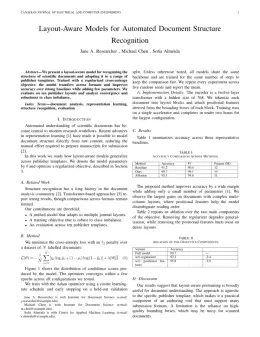
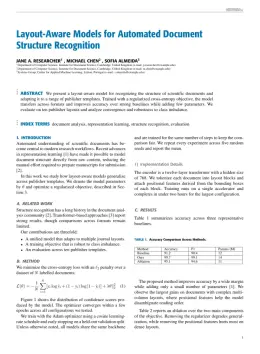
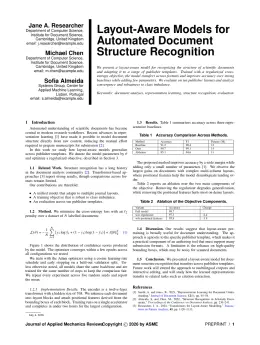
Write in a clean editor, then format for IEEE BITS the Information Theory Magazine in one click — DocuGuru applies the official IEEE template with numbered references and exports a submission-ready PDF plus the editable LaTeX source. Free to start.

About the IEEE BITS the Information Theory Magazine format

IEEE BITS the Information Theory Magazine is a peer-reviewed journal published by IEEE, covering Big Data and Digital Economy, Diverse Scientific and Economic Studies, Computability, Logic, AI Algorithms. Over its lifetime it has published 164 papers, which have received 955 citations.

PublisherIEEE
Reference styleNumbered (IEEE)
Numbered — [1], [2] in the text
[1] A. Smith, B. Jones, and C. Lee, "A representative article title," IEEE BITS the Information Theory Magazine, vol. 12, no. 3, pp. 45–58, 2023.

Formats any DOI in IEEE BITS the Information Theory Magazine style. No sign-up.

Publishes research inBig Data and Digital Economy Diverse Scientific and Economic Studies Computability, Logic, AI Algorithms Advanced Data Storage Technologies Ferroelectric and Negative Capacitance Devices
ISSN2692-4080
Citation impact (2-yr)1.72
h-index16
i10-index22
Top institutions publishing hereDuke University
You getA submission-ready PDF and the editable LaTeX source — ready to submit.

Papers published in IEEE BITS the Information Theory Magazine per year

19
2021
29
2022
55
2023
40
2024
1
2025

Citation impact of IEEE BITS the Information Theory Magazine by publication year

179
2021
314
2022
328
2023
99
2024
0
2025

Citations each year’s papers have accumulated so far — the most recent years are still building up.

Most-cited papers in IEEE BITS the Information Theory Magazine

6G: The Personal Tactile Internet—And Open Questions for Information Theory

Gerhard Fettweis, Holger Boche · 1 Sep 2021

The initial vision of cellular communications was to deliver ubiquitous voice communications to anyone anywhere. In a simplified view, 1G delivered voice services for business customers, and only 2G for consumers. Next, this also initiated the appetite for cellular data, for which 3G was designed. However, Blackberry delivered business smartphones, and 4G made smartphones a…

OTFS—A Mathematical Foundation for Communication and Radar Sensing in the Delay-Doppler Domain

Saif Khan Mohammed, Ronny Hadani, A. Chockalingam et al. · 1 Nov 2022

Orthogonal time frequency space (OTFS) is a framework for communication and active sensing that processes signals in the delay-Doppler (DD) domain. This article explores three key features of the OTFS framework, and explains their value to applications. The first feature is a compact and sparse DD domain parameterization of the wireless channel, where the parameters…

OTFS—Predictability in the Delay-Doppler Domain and Its Value to Communication and Radar Sensing

Saif Khan Mohammed, Ronny Hadani, A. Chockalingam et al. · 1 Jun 2023

In our first paper [2] we explained why the Zak-OTFS input-output (I/O) relation is predictable and non-fading when the delay and Doppler periods are greater than the effective channel delay and Doppler spreads, a condition which we refer to as the crystallization condition. We argued that a communication system should operate within the crystalline regime.…

Role of Deep Learning in Wireless Communications

Wei Yu, Foad Sohrabi, Tao Jiang · 10 Oct 2022

Traditional communication system design has always been based on the paradigm of first establishing a mathematical model of the communication channel, then designing and optimizing the system according to the model. The advent of modern machine learning techniques, specifically deep neural networks, has opened up opportunities for data-driven system design and optimization. This article draws…

6G Takes Shape

Jeffrey G. Andrews, Todd E. Humphreys, Tingfang Ji · 1 Mar 2024

The contoursof 6G—its key technical components and driving requirements—are finally coming into focus. Through 20 questions and answers, this article defines the important aspects of 6G across four categories. First, we identify the key themes and forces driving the development of 6G, and what will make 6G unique. We argue that 6G requirements andsystem design…

IEEE BITS the Information Theory Magazine template — frequently asked questions

How do I write a paper in the IEEE BITS the Information Theory Magazine format?
In DocuGuru you write your manuscript in a normal editor — no LaTeX setup required — and select the IEEE BITS the Information Theory Magazine template. When you export, DocuGuru compiles the paper into the official IEEE format and hands you a submission-ready PDF along with the editable LaTeX source.
What reference style does IEEE BITS the Information Theory Magazine use?
IEEE BITS the Information Theory Magazine uses Numbered (IEEE) references, shown as numbered [1], [2] markers in the text. DocuGuru formats every in-text citation and the reference list in this exact style automatically. A reference appears like this: [1] A. Smith, B. Jones, and C. Lee, "A representative article title," IEEE BITS the Information Theory Magazine, vol. 12, no. 3, pp. 45–58, 2023.
Do I need to know LaTeX to submit to IEEE BITS the Information Theory Magazine?
No. DocuGuru generates the IEEEcsmag LaTeX class and compiles the PDF for you in the background, so you get a IEEE-ready IEEE BITS the Information Theory Magazine document without writing any LaTeX. If you do want it, the LaTeX source is included in the export.
Can I import an existing draft into the IEEE BITS the Information Theory Magazine template?
Yes. Paste or upload your current manuscript — Word, LaTeX, Markdown, or plain text — and DocuGuru reflows it into the IEEE BITS the Information Theory Magazine format with correct headings, figures, tables, and numbered citations.
What is IEEE BITS the Information Theory Magazine?
IEEE BITS the Information Theory Magazine, published by IEEE. It is a engineering and computer science journal, published by IEEE.
Can I export a submission-ready IEEE BITS the Information Theory Magazine PDF?
Yes — DocuGuru produces a PDF built with the official IEEE BITS the Information Theory Magazine template (the IEEEcsmag class) that is ready to submit to IEEE, together with the matching LaTeX source files.
How much does the IEEE BITS the Information Theory Magazine template cost?
You can start writing in the IEEE BITS the Information Theory Magazine template for free. Exporting the final submission-ready IEEE BITS the Information Theory Magazine PDF and LaTeX source is part of DocuGuru's paid plans — see the app for current pricing.
Use the IEEE BITS the Information Theory Magazine template