SAGE

Journal of Elastomers & Plastics Template

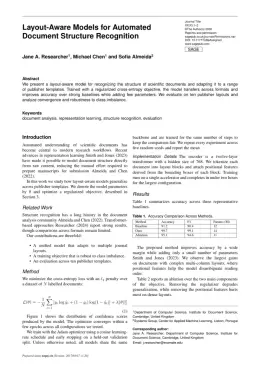
Write in a clean editor, then format for Journal of Elastomers & Plastics in one click — DocuGuru applies the official SAGE template with author–year references and exports a submission-ready PDF plus the editable LaTeX source. Free to start.

About the Journal of Elastomers & Plastics format

Journal of Elastomers & Plastics is a peer-reviewed journal published by SAGE, covering Polymer Nanocomposites and Properties, Polymer crystallization and properties, Polymer composites and self-healing.

PublisherSAGE
Reference styleAuthor–year (Harvard)
Author–year — (Smith, 2023) in the text
Smith, A., Jones, B. and Lee, C. (2023) 'A representative article title', Journal of Elastomers & Plastics, 12(3), pp. 45–58.

Formats any DOI in Journal of Elastomers & Plastics style. No sign-up.

Publishes research inPolymer Nanocomposites and Properties Polymer crystallization and properties Polymer composites and self-healing biodegradable polymer synthesis and properties Natural Fiber Reinforced Composites
ISSN0095-2443
Citation impact (2-yr)2.27
h-index43
i10-index504
Total citations14,623
Top institutions publishing hereIndian Institute of Technology Kharagpur
Journal websitewww.sagepub.com
You getA submission-ready PDF and the editable LaTeX source — ready to submit.

Papers published in Journal of Elastomers & Plastics per year

32
2014
43
2015
45
2016
45
2017
51
2018
46
2019
43
2020
58
2021
63
2022
55
2023
57
2024
83
2025

Citation impact of Journal of Elastomers & Plastics by publication year

264
2014
598
2015
498
2016
406
2017
894
2018
647
2019
454
2020
559
2021
363
2022
276
2023
274
2024
118
2025

Citations each year’s papers have accumulated so far — the most recent years are still building up.

Most-cited papers in Journal of Elastomers & Plastics

Review on modification strategies of polyethylene/polypropylene immiscible thermoplastic polymer blends for enhancing their mechanical behavior

Antimo Graziano, Shaffiq A. Jaffer, Mohini Sain · 26 Jun 2018

Blends of polyethylene (PE) and polypropylene (PP) have always been the subject of intense reasearch for encouraging polymer waste recycling while producing new materials for specific applications in a sustainable way. However, being thermodynamically immiscible, these polyolefins form a binary system usually exhibiting lower performances compared with those of the homopolymers. Many studies have been…

A critical review on the utilization of various reinforcement modifiers in filled rubber composites

Kumarjyoti Roy, Subhas Chandra Debnath, Pranut Potiyaraj · 12 Mar 2019

Presently, the development of high-performance filled rubber composites offers a new era in the industrial field of polymer research. This article reviews the utilization of various reinforcement modifiers on the successive property enhancement of rubber composites containing different commonly used fillers like silica, nanoclay, carbon nanotube, natural fibers, and so on. The practical importance of…

Polymer Concrete from Marble Wastes and Recycled Poly(ethylene terephthalate)

Magda E. Tawfik, Samir B. Eskander · 14 Dec 2005

A polymer concrete (PC) was synthesized by mixing styrenated polyester (SP) and marble wastes as fillers. The unsaturated polyester (UP) used was prepared from the reaction of oligomers obtained from the depolymerization of polyethylene terephthalate (PET) soft drink bottles with maleic anhydride and adipic acid. The UP was then mixed with the styrene monomers at…

Characterization and thermal kinetic analysis of pineapple leaf fibers and their reinforcement in epoxy

Jyoti Jain, Shorab Jain, Shishir Sinha · 4 Jul 2018

The progress in the development of composites with natural fibers for various applications in different sectors witnesses remarkable success worldwide in the last decade. Among the various natural fibers existing worldwide, pineapple leaf fibers (PALFs) possess remarkable mechanical properties because of the maximum content of cellulose (∼80%) among all natural fibers. In spite of having…

Extruded Starch/PVA Composites: Water Resistance, Thermal Properties, and Morphology

Guoxiang Zou, Ping-Qu Jin, Liang-Zou Xin · 1 Oct 2008

Poor processability and strong hydrophilicity are the main disadvantages of starch/PVA (SP) composites. Thermoplastic SP composites are prepared by a single-screw extruder in this study. The influence of the formulation on the hydrophilicity of SP composites is studied by an orthogonal array and the analysis of variance (ANOVA). The results of ANOVA show that the…

Journal of Elastomers & Plastics template — frequently asked questions

How do I write a paper in the Journal of Elastomers & Plastics format?
In DocuGuru you write your manuscript in a normal editor — no LaTeX setup required — and select the Journal of Elastomers & Plastics template. When you export, DocuGuru compiles the paper into the official SAGE format and hands you a submission-ready PDF along with the editable LaTeX source.
What reference style does Journal of Elastomers & Plastics use?
Journal of Elastomers & Plastics uses Author–year (Harvard) references, shown as author–year markers such as (Smith, 2023) in the text. DocuGuru formats every in-text citation and the reference list in this exact style automatically. A reference appears like this: Smith, A., Jones, B. and Lee, C. (2023) 'A representative article title', Journal of Elastomers & Plastics, 12(3), pp. 45–58.
Do I need to know LaTeX to submit to Journal of Elastomers & Plastics?
No. DocuGuru generates the sagej LaTeX class and compiles the PDF for you in the background, so you get a SAGE-ready Journal of Elastomers & Plastics document without writing any LaTeX. If you do want it, the LaTeX source is included in the export.
Can I import an existing draft into the Journal of Elastomers & Plastics template?
Yes. Paste or upload your current manuscript — Word, LaTeX, Markdown, or plain text — and DocuGuru reflows it into the Journal of Elastomers & Plastics format with correct headings, figures, tables, and author–year citations.
Who publishes Journal of Elastomers & Plastics?
Journal of Elastomers & Plastics is a multidisciplinary journal published by SAGE. DocuGuru's Journal of Elastomers & Plastics template matches SAGE's official submission format.
Can I export a submission-ready Journal of Elastomers & Plastics PDF?
Yes — DocuGuru produces a PDF built with the official Journal of Elastomers & Plastics template (the sagej class) that is ready to submit to SAGE, together with the matching LaTeX source files.
How much does the Journal of Elastomers & Plastics template cost?
You can start writing in the Journal of Elastomers & Plastics template for free. Exporting the final submission-ready Journal of Elastomers & Plastics PDF and LaTeX source is part of DocuGuru's paid plans — see the app for current pricing.

Use the Journal of Elastomers & Plastics template