
1,041 citations
Cite
SaveGo to paper →
SAGE
International Nonwovens Journal Template
Write in a clean editor, then format for International Nonwovens Journal in one click — DocuGuru applies the official SAGE template with author–year references and exports a submission-ready PDF plus the editable LaTeX source. Free to start.
About the International Nonwovens Journal format
International Nonwovens Journal is a peer-reviewed journal published by SAGE, covering Textile materials and evaluations, Diverse Scientific and Economic Studies, Human auditory perception and evaluation.
| Publisher | SAGE |
|---|---|
| Reference style | Author–year (Harvard) Author–year — (Smith, 2023) in the text Smith, A., Jones, B. and Lee, C. (2023) 'A representative article title', International Nonwovens Journal, 12(3), pp. 45–58.
Formats any DOI in International Nonwovens Journal style. No sign-up. |
| Publishes research in | Textile materials and evaluations Diverse Scientific and Economic Studies Human auditory perception and evaluation Material Properties and Processing Educational Robotics and Engineering |
| ISSN | 1527-2494 |
| h-index | 21 |
| i10-index | 49 |
| Total citations | 2,563 |
| Top institutions publishing here | North Carolina State University |
| You get | A submission-ready PDF and the editable LaTeX source — ready to submit. |
Papers published in International Nonwovens Journal per year
Citation impact of International Nonwovens Journal by publication year
Citations each year’s papers have accumulated so far — the most recent years are still building up.
Most-cited papers in International Nonwovens Journal
Nanofiber is a broad phrase generally referring to a fiber with a diameter less than 1 micron. While glass fibers have existed in the sub-micron range for some time and polymeric meltblown fibers are just beginning to break the micron barrier, 0.25 micron diameter electrospun nanofibers have been manufactured and used commercially for air filtration…
118 citations
Cite
SaveGo to paper →
Composite materials and layered structures based on natural plant fibers are increasingly regarded as an alternative to glass fiber reinforced parts. One of their major field of application can be found in structural components for the automotive industry. Product examples are door trim panels or instrument panels. For such applications an utmost impact strength is…
70 citations
Cite
SaveGo to paper →
Experimental measurements are presented to provide phenomenological insight into the commercial melt blowing process. In particular, we discuss the following experimental measurements obtained at various die-collector locations: fiber diameter, fiber velocity, air velocity, fiber acceleration, fiber entanglement, fiber temperature, birefringence, wide-angle x-ray diffraction and small-angle x-ray scattering. Our discussion focuses on how these measurements provide…
59 citations
Cite
SaveGo to paper →
57 citations
Cite
SaveGo to paper →
Related journal templates
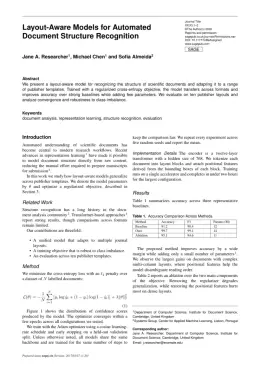
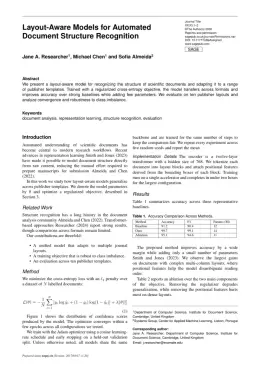
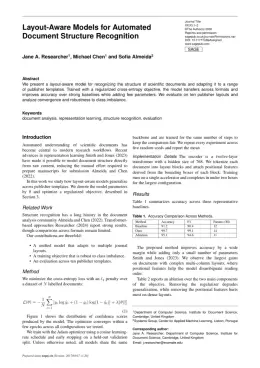
International Nonwovens Journal template — frequently asked questions
How do I write a paper in the International Nonwovens Journal format?
In DocuGuru you write your manuscript in a normal editor — no LaTeX setup required — and select the International Nonwovens Journal template. When you export, DocuGuru compiles the paper into the official SAGE format and hands you a submission-ready PDF along with the editable LaTeX source.
What reference style does International Nonwovens Journal use?
International Nonwovens Journal uses Author–year (Harvard) references, shown as author–year markers such as (Smith, 2023) in the text. DocuGuru formats every in-text citation and the reference list in this exact style automatically. A reference appears like this: Smith, A., Jones, B. and Lee, C. (2023) 'A representative article title', International Nonwovens Journal, 12(3), pp. 45–58.
Do I need to know LaTeX to submit to International Nonwovens Journal?
No. DocuGuru generates the sagej LaTeX class and compiles the PDF for you in the background, so you get a SAGE-ready International Nonwovens Journal document without writing any LaTeX. If you do want it, the LaTeX source is included in the export.
Can I import an existing draft into the International Nonwovens Journal template?
Yes. Paste or upload your current manuscript — Word, LaTeX, Markdown, or plain text — and DocuGuru reflows it into the International Nonwovens Journal format with correct headings, figures, tables, and author–year citations.
Who publishes International Nonwovens Journal?
International Nonwovens Journal is a multidisciplinary journal published by SAGE. DocuGuru's International Nonwovens Journal template matches SAGE's official submission format.
Can I export a submission-ready International Nonwovens Journal PDF?
Yes — DocuGuru produces a PDF built with the official International Nonwovens Journal template (the sagej class) that is ready to submit to SAGE, together with the matching LaTeX source files.
How much does the International Nonwovens Journal template cost?
You can start writing in the International Nonwovens Journal template for free. Exporting the final submission-ready International Nonwovens Journal PDF and LaTeX source is part of DocuGuru's paid plans — see the app for current pricing.