IEEE

IRE Transactions on Electron Devices Template

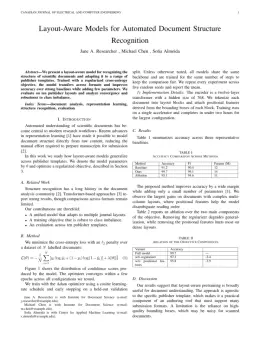
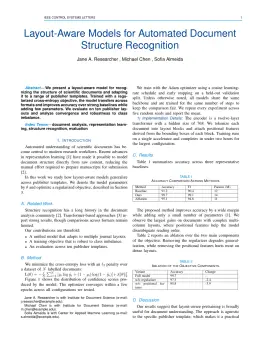
Write in a clean editor, then format for IRE Transactions on Electron Devices in one click — DocuGuru applies the official IEEE template with numbered references and exports a submission-ready PDF plus the editable LaTeX source. Free to start.

About the IRE Transactions on Electron Devices format

IRE Transactions on Electron Devices is a peer-reviewed journal published by IEEE, covering Gyrotron and Vacuum Electronics Research, Particle accelerators and beam dynamics, Advancements in Semiconductor Devices and Circuit Design.

PublisherIEEE
Reference styleNumbered (IEEE)
Numbered — [1], [2] in the text
[1] A. Smith, B. Jones, and C. Lee, "A representative article title," IRE Transactions on Electron Devices, vol. 12, no. 3, pp. 45–58, 2023.

Formats any DOI in IRE Transactions on Electron Devices style. No sign-up.

Publishes research inGyrotron and Vacuum Electronics Research Particle accelerators and beam dynamics Advancements in Semiconductor Devices and Circuit Design Semiconductor Quantum Structures and Devices Semiconductor materials and devices
ISSN0096-2430
h-index32
i10-index129
Total citations5,444
Top institutions publishing hereRCA (United States)
Journal websiteieeexplore.ieee.org
You getA submission-ready PDF and the editable LaTeX source — ready to submit.

Papers published in IRE Transactions on Electron Devices per year

36
1955
100
1956
126
1957
126
1958
143
1959
116
1960
181
1961
191
1962
1
2022

Citation impact of IRE Transactions on Electron Devices by publication year

311
1955
493
1956
399
1957
493
1958
444
1959
685
1960
929
1961
1.7K
1962
7
2022

Citations each year’s papers have accumulated so far — the most recent years are still building up.

Most-cited papers in IRE Transactions on Electron Devices

A theory of transistor cutoff frequency (f<sub>T</sub>) falloff at high current densities

Charles Kirk · 1 Mar 1962

It is shown that the observed falloff in the f <inf xmlns:mml="http://www.w3.org/1998/Math/MathML" xmlns:xlink="http://www.w3.org/1999/xlink">T</inf> of a transistor at high currents is due to the spreading of the neutral base layer into the collector region of the device at high current densities. The base layer spreading mechanism derives from an analysis of the effect of the current-dependent…

The Ubitron, a high-power traveling-wave tube based on a periodic beam interaction in unloaded waveguide

R. Phillips · 1 Oct 1960

The Ubitron is a high-power traveling-wave tube which makes use of the interaction between a magnetically undulated periodic electron beam and the TE <inf xmlns:mml="http://www.w3.org/1998/Math/MathML" xmlns:xlink="http://www.w3.org/1999/xlink">01</inf> mode in unloaded waveguide. The electron-wave interaction exhibits the same type of first-order axial beam bunching characteristic of the conventional slow-wave traveling-wave tube; hence, it can be used in…

A high-efficiency klystron with distributed interaction

M. Chodorow, Tore Wessel-Berg · 1 Jan 1961

This paper describes a theoretical and experimental investigation of a special form of a three-cavity klystron amplifier having shorted sections of a slow-wave structure as resonators. Although the behavior basically is similar to that of a narrow-gap klystron, improved performance is obtained due to distributed interaction and higher cavity characteristic impedance. Higher efficiency and larger…

Plasma frequency reduction factors in electron beams

G.M. Branch, T.G. Mihran · 1 Apr 1955

The electron plasma frequency reduction factor has proved to be a fundamental design parameter in all types of microwave tubes employing long electron beams. This factor is here calculated for a variety of beam shapes and drift-tube cross sections, and the results are presented in a series of graphs. One interesting result is that the…

Effect of surface recombination and channel on P-N junction and transistor characteristics

Chih‐Tang Sah · 1 Jan 1962

The current flowing in a semiconductor junction may be divided into four components according to the location of the recombination and generation of electrons and holes. These are: 1) the bulk recombination-generation or the diffusion current, 2) the bulk recombination-generation current in the transition region, 3) the surface recombination-generation current in the transition region, and…

IRE Transactions on Electron Devices template — frequently asked questions

How do I write a paper in the IRE Transactions on Electron Devices format?
In DocuGuru you write your manuscript in a normal editor — no LaTeX setup required — and select the IRE Transactions on Electron Devices template. When you export, DocuGuru compiles the paper into the official IEEE format and hands you a submission-ready PDF along with the editable LaTeX source.
What reference style does IRE Transactions on Electron Devices use?
IRE Transactions on Electron Devices uses Numbered (IEEE) references, shown as numbered [1], [2] markers in the text. DocuGuru formats every in-text citation and the reference list in this exact style automatically. A reference appears like this: [1] A. Smith, B. Jones, and C. Lee, "A representative article title," IRE Transactions on Electron Devices, vol. 12, no. 3, pp. 45–58, 2023.
Do I need to know LaTeX to submit to IRE Transactions on Electron Devices?
No. DocuGuru generates the IEEEtran LaTeX class and compiles the PDF for you in the background, so you get a IEEE-ready IRE Transactions on Electron Devices document without writing any LaTeX. If you do want it, the LaTeX source is included in the export.
Can I import an existing draft into the IRE Transactions on Electron Devices template?
Yes. Paste or upload your current manuscript — Word, LaTeX, Markdown, or plain text — and DocuGuru reflows it into the IRE Transactions on Electron Devices format with correct headings, figures, tables, and numbered citations.
Who publishes IRE Transactions on Electron Devices?
IRE Transactions on Electron Devices is a engineering and computer science journal published by IEEE. DocuGuru's IRE Transactions on Electron Devices template matches IEEE's official submission format.
Can I export a submission-ready IRE Transactions on Electron Devices PDF?
Yes — DocuGuru produces a PDF built with the official IRE Transactions on Electron Devices template (the IEEEtran class) that is ready to submit to IEEE, together with the matching LaTeX source files.
How much does the IRE Transactions on Electron Devices template cost?
You can start writing in the IRE Transactions on Electron Devices template for free. Exporting the final submission-ready IRE Transactions on Electron Devices PDF and LaTeX source is part of DocuGuru's paid plans — see the app for current pricing.

Use the IRE Transactions on Electron Devices template