IEEE

IEEE Transactions on Circuits and Systems for Artificial Intelligence Template

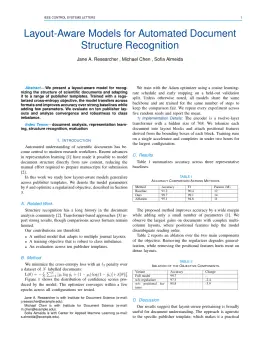
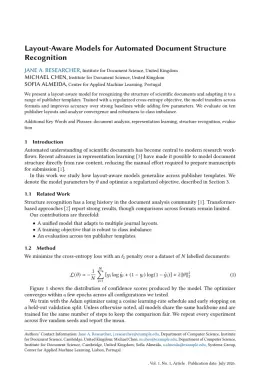
Write in a clean editor, then format for IEEE Transactions on Circuits and Systems for Artificial Intelligence in one click — DocuGuru applies the official IEEE template with numbered references and exports a submission-ready PDF plus the editable LaTeX source. Free to start.

About the IEEE Transactions on Circuits and Systems for Artificial Intelligence format

IEEE Transactions on Circuits and Systems for Artificial Intelligence is a peer-reviewed journal published by IEEE, covering Advanced Memory and Neural Computing, Ferroelectric and Negative Capacitance Devices, Neural Networks and Applications. Over its lifetime it has published 126 papers, which have received 183 citations.

PublisherIEEE
Reference styleNumbered (IEEE)
Numbered — [1], [2] in the text
[1] A. Smith, B. Jones, and C. Lee, "A representative article title," IEEE Transactions on Circuits and Systems for Artificial Intelligence, vol. 12, no. 3, pp. 45–58, 2023.

Formats any DOI in IEEE Transactions on Circuits and Systems for Artificial Intelligence style. No sign-up.

Publishes research inAdvanced Memory and Neural Computing Ferroelectric and Negative Capacitance Devices Neural Networks and Applications Neural Networks and Reservoir Computing Parallel Computing and Optimization Techniques
ISSN2996-6647
Citation impact (2-yr)1.45
h-index7
i10-index3
Top institutions publishing hereDuke University
Journal websiteieeexplore.ieee.org
You getA submission-ready PDF and the editable LaTeX source — ready to submit.

Papers published in IEEE Transactions on Circuits and Systems for Artificial Intelligence per year

35
2024
53
2025
38
2026

Citation impact of IEEE Transactions on Circuits and Systems for Artificial Intelligence by publication year

125
2024
52
2025
6
2026

Citations each year’s papers have accumulated so far — the most recent years are still building up.

Most-cited papers in IEEE Transactions on Circuits and Systems for Artificial Intelligence

Towards Efficient Neuro-Symbolic AI: From Workload Characterization to Hardware Architecture

Zishen Wan, Che-Kai Liu, Hanchen Yang et al. · 1 Sep 2024

The remarkable advancements in artificial intelligence (AI), primarily driven by deep neural networks, are facing challenges surrounding unsustainable computational trajectories, limited robustness, and a lack of explainability. To develop next-generation cognitive AI systems, neuro-symbolic AI emerges as a promising paradigm, fusing neural and symbolic approaches to enhance interpretability, robustness, and trustworthiness, while facilitating learning from…

EvGNN: An Event-Driven Graph Neural Network Accelerator for Edge Vision

Yufeng Yang, Adrian Kneip, Charlotte Frenkel · 23 Dec 2024

Edge vision systems combining sensing and embedded processing promise low-latency, decentralized, and energy-efficient solutions that forgo reliance on the cloud. As opposed to conventional frame-based vision sensors, event-based cameras deliver a microsecond-scale temporal resolution with sparse information encoding, thereby outlining new opportunities for edge vision systems. However, mainstream algorithms for frame-based vision, which mostly rely…

FPGA-Based Adaptive LIF Neuron for High-Speed, Energy-Efficient Spiking Neural Network

Saras Mani Mishra, Hanumant Singh Shekhawat, Jan Pidanič et al. · 8 May 2025

Spiking Neural Networks (SNNs) have drawn attention due to their biological behaviour and low energy consumption compared to conventional neural networks. The efficiency of SNN depends on the neurons, and thus, proper selection of neurons becomes imperative for exhibiting appropriate biological behaviour. This paper realizes an adaptive <italic xmlns:mml="http://www.w3.org/1998/Math/MathML" xmlns:xlink="http://www.w3.org/1999/xlink">Leaky Integrate-and-Fire</i> (LIF) neuron, modeled using…

Neuro-Photonix: Enabling Near-Sensor Neuro-Symbolic AI Computing on Silicon Photonics Substrate

Deniz Najafi, Hamza Errahmouni Barkam, Mehrdad Morsali et al. · 4 Feb 2025

Neuro-symbolic Artificial Intelligence (AI) models, blending neural networks with symbolic AI, have facilitated transparent reasoning and context understanding without the need for explicit rule-based programming. However, implementing such models in the Internet of Things (IoT) sensor nodes presents hurdles due to computational constraints and intricacies. In this work, for the first time, we propose a…

DeltaKWS: A 65nm 36nJ/Decision Bio-Inspired Temporal-Sparsity-Aware Digital Keyword Spotting IC With 0.6V Near-Threshold SRAM

Qinyu Chen, Kwantae Kim, Chang Gao et al. · 28 Nov 2024

This paper introduces DeltaKWS, which is to the best of our knowledge, the first <inline-formula xmlns:mml="http://www.w3.org/1998/Math/MathML" xmlns:xlink="http://www.w3.org/1999/xlink"><tex-math notation="LaTeX">$\Delta$</tex-math></inline-formula>RNN-enabled, fine-grained, temporal sparsity-aware Keyword Spotting (KWS) integrated circuit (IC) designed for voice-controlled devices. The 65 nm prototype chip features a number of techniques to enhance performance, area, and power efficiencies, specifically: 1) a bio-inspired delta-gated recurrent neural…

IEEE Transactions on Circuits and Systems for Artificial Intelligence template — frequently asked questions

How do I write a paper in the IEEE Transactions on Circuits and Systems for Artificial Intelligence format?
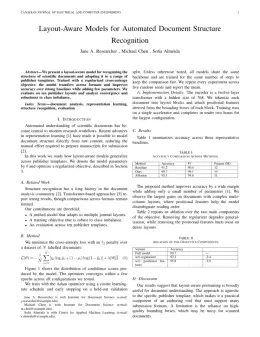
In DocuGuru you write your manuscript in a normal editor — no LaTeX setup required — and select the IEEE Transactions on Circuits and Systems for Artificial Intelligence template. When you export, DocuGuru compiles the paper into the official IEEE format and hands you a submission-ready PDF along with the editable LaTeX source.
What reference style does IEEE Transactions on Circuits and Systems for Artificial Intelligence use?
IEEE Transactions on Circuits and Systems for Artificial Intelligence uses Numbered (IEEE) references, shown as numbered [1], [2] markers in the text. DocuGuru formats every in-text citation and the reference list in this exact style automatically. A reference appears like this: [1] A. Smith, B. Jones, and C. Lee, "A representative article title," IEEE Transactions on Circuits and Systems for Artificial Intelligence, vol. 12, no. 3, pp. 45–58, 2023.
Do I need to know LaTeX to submit to IEEE Transactions on Circuits and Systems for Artificial Intelligence?
No. DocuGuru generates the IEEEtran LaTeX class and compiles the PDF for you in the background, so you get a IEEE-ready IEEE Transactions on Circuits and Systems for Artificial Intelligence document without writing any LaTeX. If you do want it, the LaTeX source is included in the export.
Can I import an existing draft into the IEEE Transactions on Circuits and Systems for Artificial Intelligence template?
Yes. Paste or upload your current manuscript — Word, LaTeX, Markdown, or plain text — and DocuGuru reflows it into the IEEE Transactions on Circuits and Systems for Artificial Intelligence format with correct headings, figures, tables, and numbered citations.
What is IEEE Transactions on Circuits and Systems for Artificial Intelligence?
IEEE Transactions on Circuits and Systems for Artificial Intelligence, published by IEEE. It is a engineering and computer science journal, published by IEEE.
Can I export a submission-ready IEEE Transactions on Circuits and Systems for Artificial Intelligence PDF?
Yes — DocuGuru produces a PDF built with the official IEEE Transactions on Circuits and Systems for Artificial Intelligence template (the IEEEtran class) that is ready to submit to IEEE, together with the matching LaTeX source files.
How much does the IEEE Transactions on Circuits and Systems for Artificial Intelligence template cost?
You can start writing in the IEEE Transactions on Circuits and Systems for Artificial Intelligence template for free. Exporting the final submission-ready IEEE Transactions on Circuits and Systems for Artificial Intelligence PDF and LaTeX source is part of DocuGuru's paid plans — see the app for current pricing.
Use the IEEE Transactions on Circuits and Systems for Artificial Intelligence template