
1,413 citations
Cite
SaveGo to paper →
IEEE
IEEE Control Systems Magazine Template
Write in a clean editor, then format for IEEE Control Systems Magazine in one click — DocuGuru applies the official IEEE template with numbered references and exports a submission-ready PDF plus the editable LaTeX source. Free to start.
About the IEEE Control Systems Magazine format
IEEE Control Systems Magazine is a peer-reviewed journal published by IEEE, covering Human auditory perception and evaluation, Diverse Scientific and Economic Studies, Educational Robotics and Engineering.
| Publisher | IEEE |
|---|---|
| Reference style | Numbered (IEEE) Numbered — [1], [2] in the text [1] A. Smith, B. Jones, and C. Lee, "A representative article title," IEEE Control Systems Magazine, vol. 12, no. 3, pp. 45–58, 2023.
Formats any DOI in IEEE Control Systems Magazine style. No sign-up. |
| Publishes research in | Human auditory perception and evaluation Diverse Scientific and Economic Studies Educational Robotics and Engineering Diverse Specialized Academic Research Earthquake and Disaster Impact Studies |
| ISSN | 0272-1708 |
| h-index | 61 |
| i10-index | 210 |
| Total citations | 18,672 |
| Top institutions publishing here | Massachusetts Institute of Technology |
| You get | A submission-ready PDF and the editable LaTeX source — ready to submit. |
Papers published in IEEE Control Systems Magazine per year
Citation impact of IEEE Control Systems Magazine by publication year
Citations each year’s papers have accumulated so far — the most recent years are still building up.
Most-cited papers in IEEE Control Systems Magazine
Techniques to detect and isolate failures in complex technological systems, such as sensor biases, actuator malfunctions, leaks, and equipment deterioration are surveyed. The methods are based on analytical redundancy afforded by a mathematical model of the system. The main components of such techniques are residual generation using the model, signature generation by statistical testing, and…
1,113 citations
Cite
SaveGo to paper →
A multilayered neural network processor is used to control a given plant. Several learning architectures are proposed for training the neural controller to provide the appropriate inputs to the plant so that a desired response is obtained. A modified error-back propagation algorithm, based on propagation of the output error through the plant, is introduced. The…
1,054 citations
Cite
SaveGo to paper →
964 citations
Cite
SaveGo to paper →
It is shown that a neural network can learn of its own accord to control a nonlinear dynamic system. An emulator, a multilayered neural network, learns to identify the system's dynamic characteristics. The controller, another multilayered neural network, next learns to control the emulator. The self-trained controller is then used to control the actual dynamic…
856 citations
Cite
SaveGo to paper →
Related journal templates
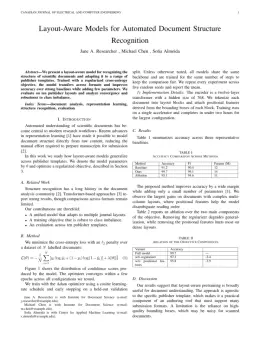
IEEE Control Systems Magazine template — frequently asked questions
How do I write a paper in the IEEE Control Systems Magazine format?
In DocuGuru you write your manuscript in a normal editor — no LaTeX setup required — and select the IEEE Control Systems Magazine template. When you export, DocuGuru compiles the paper into the official IEEE format and hands you a submission-ready PDF along with the editable LaTeX source.
What reference style does IEEE Control Systems Magazine use?
IEEE Control Systems Magazine uses Numbered (IEEE) references, shown as numbered [1], [2] markers in the text. DocuGuru formats every in-text citation and the reference list in this exact style automatically. A reference appears like this: [1] A. Smith, B. Jones, and C. Lee, "A representative article title," IEEE Control Systems Magazine, vol. 12, no. 3, pp. 45–58, 2023.
Do I need to know LaTeX to submit to IEEE Control Systems Magazine?
No. DocuGuru generates the IEEEtran LaTeX class and compiles the PDF for you in the background, so you get a IEEE-ready IEEE Control Systems Magazine document without writing any LaTeX. If you do want it, the LaTeX source is included in the export.
Can I import an existing draft into the IEEE Control Systems Magazine template?
Yes. Paste or upload your current manuscript — Word, LaTeX, Markdown, or plain text — and DocuGuru reflows it into the IEEE Control Systems Magazine format with correct headings, figures, tables, and numbered citations.
Who publishes IEEE Control Systems Magazine?
IEEE Control Systems Magazine is a engineering and computer science journal published by IEEE. DocuGuru's IEEE Control Systems Magazine template matches IEEE's official submission format.
Can I export a submission-ready IEEE Control Systems Magazine PDF?
Yes — DocuGuru produces a PDF built with the official IEEE Control Systems Magazine template (the IEEEtran class) that is ready to submit to IEEE, together with the matching LaTeX source files.
How much does the IEEE Control Systems Magazine template cost?
You can start writing in the IEEE Control Systems Magazine template for free. Exporting the final submission-ready IEEE Control Systems Magazine PDF and LaTeX source is part of DocuGuru's paid plans — see the app for current pricing.