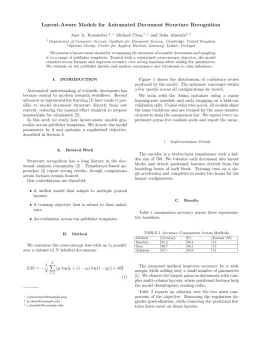
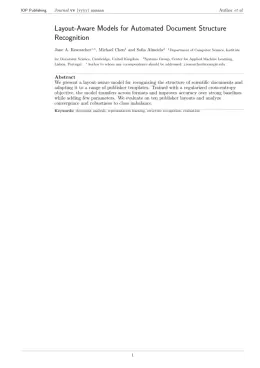
About the Reviews of Modern Physics format
Reviews of Modern Physics is a peer-reviewed journal published by American Physical Society, covering Particle physics theoretical and experimental studies, Nuclear physics research studies, Physics of Superconductivity and Magnetism. Over its lifetime it has published 3,655 papers, which have received 1,495,993 citations.
| Publisher | American Physical Society |
|---|
| Reference style | Numbered (APS Rev. Mod. Phys.) Numbered — [1], [2] in the text
[1] A. Smith, B. Jones, and C. Lee, Reviews of Modern Physics 12, 45 (2023).
Formats any DOI in Reviews of Modern Physics style. No sign-up.
|
|---|
| Publishes research in | Particle physics theoretical and experimental studies Nuclear physics research studies Physics of Superconductivity and Magnetism Quantum Chromodynamics and Particle Interactions Atomic and Molecular Physics |
|---|
| ISSN | 0034-6861 |
|---|
| Citation impact (2-yr) | 30.96 |
|---|
| h-index | 614 |
|---|
| i10-index | 3,032 |
|---|
| Top institutions publishing here | Massachusetts Institute of Technology |
|---|
| Journal website | rmp.aps.org |
|---|
| You get | A submission-ready PDF and the editable LaTeX source — ready to submit. |
|---|
Papers published in Reviews of Modern Physics per year
Citation impact of Reviews of Modern Physics by publication year
Citations each year’s papers have accumulated so far — the most recent years are still building up.
Most-cited papers in Reviews of Modern Physics
The electronic properties of graphene
A. H. Castro Neto, F. Guinea, N. M. R. Peres et al. · 14 Jan 2009
This article reviews the basic theoretical aspects of graphene, a one-atom-thick allotrope of carbon, with unusual two-dimensional Dirac-like electronic excitations. The Dirac electrons can be controlled by application of external electric and magnetic fields, or by altering sample geometry and/or topology. The Dirac electrons behave in unusual ways in tunneling, confinement, and the integer quantum…
Statistical mechanics of complex networks
Réka Albert, Albert-Ĺaszló Barabási · 30 Jan 2002
Complex networks describe a wide range of systems in nature and society. Frequently cited examples include the cell, a network of chemicals linked by chemical reactions, and the Internet, a network of routers and computers connected by physical links. While traditionally these systems have been modeled as random graphs, it is increasingly recognized that the…
<i>Colloquium</i>: Topological insulators
M. Zahid Hasan, C. L. Kane · 8 Nov 2010
Topological insulators are electronic materials that have a bulk band gap like an ordinary insulator but have protected conducting states on their edge or surface. These states are possible due to the combination of spin-orbit interactions and time-reversal symmetry. The two-dimensional (2D) topological insulator is a quantum spin Hall insulator, which is a close cousin…
Topological insulators and superconductors
Xiao-Liang Qi, Shou-Cheng Zhang · 14 Oct 2011
Topological insulators are new states of quantum matter which cannot be adiabatically connected to conventional insulators and semiconductors. They are characterized by a full insulating gap in the bulk and gapless edge or surface states which are protected by time-reversal symmetry. These topological materials have been theoretically predicted and experimentally observed in a variety of…
Spintronics: Fundamentals and applications
Igor Žutić, Jaroslav Fabian, S. Das Sarma · 23 Apr 2004
Spintronics, or spin electronics, involves the study of active control and manipulation of spin degrees of freedom in solid-state systems. This article reviews the current status of this subject, including both recent advances and well-established results. The primary focus is on the basic physical principles underlying the generation of carrier spin polarization, spin dynamics, and…