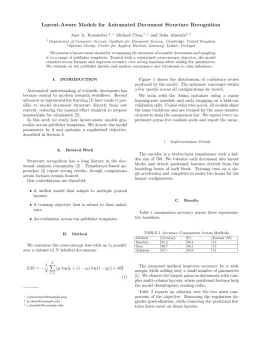
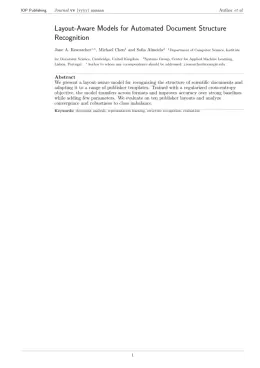
American Physical Society

Physical Review Materials Template

Write in a clean editor, then format for Physical Review Materials in one click — DocuGuru applies the official American Physical Society template with numbered references and exports a submission-ready PDF plus the editable LaTeX source. Free to start.

About the Physical Review Materials format

Physical Review Materials is a peer-reviewed journal published by American Physical Society, covering Magnetic and transport properties of perovskites and related materials, Advanced Condensed Matter Physics, 2D Materials and Applications. Over its lifetime it has published 6,290 papers, which have received 95,085 citations.

PublisherAmerican Physical Society
Reference styleNumbered (APS)
Numbered — [1], [2] in the text
[1] A. Smith, B. Jones, and C. Lee, Physical Review Materials 12, 45 (2023).

Formats any DOI in Physical Review Materials style. No sign-up.

Publishes research inMagnetic and transport properties of perovskites and related materials Advanced Condensed Matter Physics 2D Materials and Applications Electronic and Structural Properties of Oxides Topological Materials and Phenomena
ISSN2475-9953
Citation impact (2-yr)2.85
h-index94
i10-index2,793
Top institutions publishing hereCentre National de la Recherche Scientifique
Journal websitejournals.aps.org
You getA submission-ready PDF and the editable LaTeX source — ready to submit.

Papers published in Physical Review Materials per year

357
2017
717
2018
783
2019
746
2020
725
2021
699
2022
630
2023
627
2024
661
2025

Citation impact of Physical Review Materials by publication year

10.8K
2017
19.5K
2018
20.1K
2019
13.9K
2020
11K
2021
8.7K
2022
5.8K
2023
3.4K
2024
1K
2025

Citations each year’s papers have accumulated so far — the most recent years are still building up.

Most-cited papers in Physical Review Materials

SISSO: A compressed-sensing method for identifying the best low-dimensional descriptor in an immensity of offered candidates

Runhai Ouyang, Stefano Curtarolo, Emre Ahmetcik et al. · 7 Aug 2018

The lack of reliable methods for identifying descriptors---the sets of parameters capturing the underlying mechanisms of a material's property---is one of the key factors hindering efficient materials development. Here, we propose a systematic approach for discovering descriptors for materials' properties, within the framework of compressed-sensing-based dimensionality reduction. The sure independence screening and sparsifying operator (SISSO)…

New kagome prototype materials: discovery of <mml:math xmlns:mml="http://www.w3.org/1998/Math/MathML"><mml:mrow><mml:msub><mml:mi>KV</mml:mi><mml:mn>3</mml:mn></mml:msub><mml:msub><mml:mi>Sb</mml:mi><mml:mn>5</mml:mn></mml:msub><mml:mo>,</mml:mo><mml:msub><mml:mi>RbV</mml:mi><mml:mn>3</mml:mn></mml:msub><mml:msub><mml:mi>Sb</mml:mi><mml:mn>5</mml:mn></mml:msub></mml:mrow></mml:math>, and <mml:math xmlns:mml="http://www.w3.org/1998/Math/MathML"><mml:mrow><mml:msub><mml:mi>CsV</mml:mi><mml:mn>3</mml:mn></mml:msub><mml:msub><mml:mi>Sb</mml:mi><mml:mn>5</mml:mn></mml:msub></mml:mrow></mml:math>

Brenden R. Ortiz, Lídia C. Gomes, Jennifer R. Morey et al. · 16 Sep 2019

In this work, we present our discovery and characterization of a new kagome prototype structure, ${\mathrm{KV}}_{3}{\mathrm{Sb}}_{5}$. We also present the discovery of the isostructural compounds ${\mathrm{RbV}}_{3}{\mathrm{Sb}}_{5}$ and ${\mathrm{CsV}}_{3}{\mathrm{Sb}}_{5}$. All materials exhibit a structurally perfect two-dimensional kagome net of vanadium. Density-functional theory calculations indicate that the materials are metallic, with the Fermi level in close proximity…

Active learning of uniformly accurate interatomic potentials for materials simulation

Linfeng Zhang, De-Ye Lin, Han Wang et al. · 25 Feb 2019

An active learning procedure called deep potential generator (DP-GEN) is proposed for the construction of accurate and transferable machine learning-based models of the potential energy surface (PES) for the molecular modeling of materials. This procedure consists of three main components: exploration, generation of accurate reference data, and training. Application to the sample systems of Al,…

Superconductivity in the <mml:math xmlns:mml="http://www.w3.org/1998/Math/MathML"><mml:msub><mml:mi mathvariant="double-struck">Z</mml:mi><mml:mn>2</mml:mn></mml:msub></mml:math> kagome metal <mml:math xmlns:mml="http://www.w3.org/1998/Math/MathML"><mml:mrow><mml:msub><mml:mi>KV</mml:mi><mml:mn>3</mml:mn></mml:msub><mml:msub><mml:mi>Sb</mml:mi><mml:mn>5</mml:mn></mml:msub></mml:mrow></mml:math>

Brenden R. Ortiz, Paul M. Sarte, Eric M. Kenney et al. · 2 Mar 2021

Here we report the observation of bulk superconductivity in single crystals of the two-dimensional kagome metal ${\mathrm{KV}}_{3}{\mathrm{Sb}}_{5}$. Magnetic susceptibility, resistivity, and heat capacity measurements reveal superconductivity below ${T}_{c}=0.93\phantom{\rule{0.28em}{0ex}}\mathrm{K}$, and density functional theory (DFT) calculations further characterize the normal state as a ${\mathbb{Z}}_{2}$ topological metal. Our results demonstrate that the recent observation of superconductivity within the…

Local lattice distortion in high-entropy alloys

Hongquan Song, Fuyang Tian, Qing‐Miao Hu et al. · 19 Jul 2017

The severe local lattice distortion, induced mainly by the large atomic size mismatch of the alloy components, is one of the four core effects responsible for the unprecedented mechanical behaviors of high-entropy alloys (HEAs). In this work, we propose a supercell model, in which every lattice site has similar local atomic environment, to describe the…

Physical Review Materials template — frequently asked questions

How do I write a paper in the Physical Review Materials format?
In DocuGuru you write your manuscript in a normal editor — no LaTeX setup required — and select the Physical Review Materials template. When you export, DocuGuru compiles the paper into the official American Physical Society format and hands you a submission-ready PDF along with the editable LaTeX source.
What reference style does Physical Review Materials use?
Physical Review Materials uses Numbered (APS) references, shown as numbered [1], [2] markers in the text. DocuGuru formats every in-text citation and the reference list in this exact style automatically. A reference appears like this: [1] A. Smith, B. Jones, and C. Lee, Physical Review Materials 12, 45 (2023).
Do I need to know LaTeX to submit to Physical Review Materials?
No. DocuGuru generates the revtex4-2 LaTeX class and compiles the PDF for you in the background, so you get a American Physical Society-ready Physical Review Materials document without writing any LaTeX. If you do want it, the LaTeX source is included in the export.
Can I import an existing draft into the Physical Review Materials template?
Yes. Paste or upload your current manuscript — Word, LaTeX, Markdown, or plain text — and DocuGuru reflows it into the Physical Review Materials format with correct headings, figures, tables, and numbered citations.
What is Physical Review Materials?
American Physical Society journal (REVTeX 4.2). It is a physics journal, published by American Physical Society.
Can I export a submission-ready Physical Review Materials PDF?
Yes — DocuGuru produces a PDF built with the official Physical Review Materials template (the revtex4-2 class) that is ready to submit to American Physical Society, together with the matching LaTeX source files.
How much does the Physical Review Materials template cost?
You can start writing in the Physical Review Materials template for free. Exporting the final submission-ready Physical Review Materials PDF and LaTeX source is part of DocuGuru's paid plans — see the app for current pricing.
Use the Physical Review Materials template