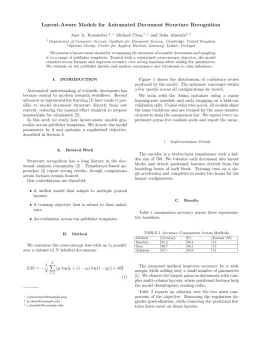
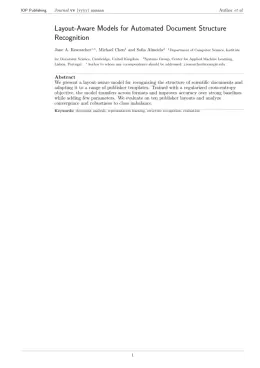
About the Physical Review Research format
Physical Review Research is a peer-reviewed journal published by American Physical Society, covering Quantum Information and Cryptography, Topological Materials and Phenomena, Quantum many-body systems. Over its lifetime it has published 10,302 papers, which have received 142,099 citations.
| Publisher | American Physical Society |
|---|
| Reference style | Numbered (APS) Numbered — [1], [2] in the text
[1] A. Smith, B. Jones, and C. Lee, Physical Review Research 12, 45 (2023).
Formats any DOI in Physical Review Research style. No sign-up.
|
|---|
| Publishes research in | Quantum Information and Cryptography Topological Materials and Phenomena Quantum many-body systems Quantum Computing Algorithms and Architecture Quantum and electron transport phenomena |
|---|
| ISSN | 2643-1564 |
|---|
| Citation impact (2-yr) | 3.82 |
|---|
| h-index | 108 |
|---|
| i10-index | 4,141 |
|---|
| Article processing charge | $2,625 |
|---|
| Open access | Yes — indexed in DOAJ |
|---|
| Top institutions publishing here | Centre National de la Recherche Scientifique |
|---|
| Journal website | journals.aps.org |
|---|
| You get | A submission-ready PDF and the editable LaTeX source — ready to submit. |
|---|
Papers published in Physical Review Research per year
Citation impact of Physical Review Research by publication year
Citations each year’s papers have accumulated so far — the most recent years are still building up.
Most-cited papers in Physical Review Research
Dedalus: A flexible framework for numerical simulations with spectral methods
Keaton J. Burns, Geoffrey M. Vasil, Jeffrey S. Oishi et al. · 23 Apr 2020
This paper describes Dedalus, an open-source Python code for simulating partial differential equations from all areas of physics. Dedalus translates plain-text equations into efficient and parallelized solvers using global spectral methods. Here the authors detail the numerical methods enabling this translation and describe the code's design and implementation. They also illustrate its capabilities with diverse…
<i>Ab initio</i> solution of the many-electron Schrödinger equation with deep neural networks
David Pfau, James S. Spencer, Alexander G. D. G. Matthews et al. · 16 Sep 2020
Given access to accurate solutions of the many-electron Schrdinger equation, nearly all chemistry could be derived from first principles. Exact wave functions of interesting chemical systems are out of reach because they are NP-hard to compute in general, but approximations can be found using polynomially scaling algorithms.
Surrogate models for precessing binary black hole simulations with unequal masses
Vijay Varma, Scott E. Field, Mark A. Scheel et al. · 10 Oct 2019
This paper presents two surrogate models for simulations of binary black holes. These models are trained on previous results and produce an interpolation between them. The final outcome is shown to match the accuracy of numerical relativity simulations without some of the computational expense.
Reciprocal skin effect and its realization in a topolectrical circuit
Tobias Hofmann, Tobias Helbig, Frank Schindler et al. · 2 Jun 2020
This work explores a non-Hermitian system displaying a reciprocal variant of the skin effect, which is characterized by an extensive anomalous localization of all Hamiltonian eigenmodes in a one-dimensional geometry. The authors experimentally demonstrate the reciprocal skin effect in a passive RLC circuit and suggest alternative implementations in optical, acoustic, mechanical, and related platforms.
Continuous-variable quantum neural networks
Nathan Killoran, Thomas R. Bromley, Juan Miguel Arrazola et al. · 31 Oct 2019
Neural networks and quantum computers are both key technologies for the next generation of computing. This paper demonstrates that these two types of computation can be executed with the same physical platform, based on photonics. This provides a natural extension of classical machine learning algorithms into the quantum realm.