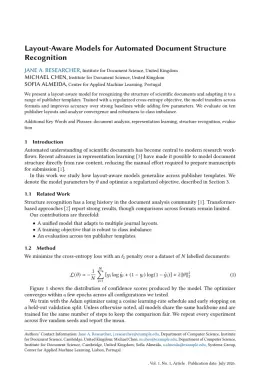
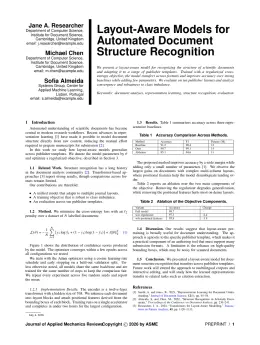
About the ACM Transactions on Programming Languages and Systems format
ACM Transactions on Programming Languages and Systems is a peer-reviewed journal published by ACM, covering Logic, programming, and type systems, Formal Methods in Verification, Parallel Computing and Optimization Techniques. Over its lifetime it has published 1,296 papers, which have received 109,021 citations.
| Publisher | ACM |
|---|
| Reference style | Numbered (ACM) Numbered — [1], [2] in the text
[1] Ada Smith, Ben Jones, and Cara Lee. 2023. A representative article title. ACM Transactions on Programming Languages and Systems 12, 3, Article 45 (2023).
Formats any DOI in ACM Transactions on Programming Languages and Systems style. No sign-up.
|
|---|
| Publishes research in | Logic, programming, and type systems Formal Methods in Verification Parallel Computing and Optimization Techniques Distributed systems and fault tolerance Software Testing and Debugging Techniques |
|---|
| ISSN | 0164-0925 |
|---|
| Citation impact (2-yr) | 1.47 |
|---|
| h-index | 141 |
|---|
| i10-index | 918 |
|---|
| Top institutions publishing here | Carnegie Mellon University |
|---|
| Journal website | toplas.acm.org |
|---|
| You get | A submission-ready PDF and the editable LaTeX source — ready to submit. |
|---|
Papers published in ACM Transactions on Programming Languages and Systems per year
Citation impact of ACM Transactions on Programming Languages and Systems by publication year
Citations each year’s papers have accumulated so far — the most recent years are still building up.
Most-cited papers in ACM Transactions on Programming Languages and Systems
The Byzantine Generals Problem
Leslie Lamport, Robert E. Shostak, Marshall C. Pease · 1 Jul 1982
Reliable computer systems must handle malfunctioning components that give conflicting information to different parts of the system. This situation can be expressed abstractly in terms of a group of generals of the Byzantine army camped with their troops around an enemy city. Communicating only by messenger, the generals must agree upon a common battle plan.…
Automatic verification of finite-state concurrent systems using temporal logic specifications
E. M. Clarke, E. Allen Emerson, A. Prasad Sistla · 1 Apr 1986
We give an efficient procedure for verifying that a finite-state concurrent system meets a specification expressed in a (propositional, branching-time) temporal logic. Our algorithm has complexity linear in both the size of the specification and the size of the global state graph for the concurrent system. We also show how this approach can be adapted…
Linearizability: a correctness condition for concurrent objects
Maurice Herlihy, Jeannette M. Wing · 1 Jul 1990
A concurrent object is a data object shared by concurrent processes. Linearizability is a correctness condition for concurrent objects that exploits the semantics of abstract data types. It permits a high degree of concurrency, yet it permits programmers to specify and reason about concurrent objects using known techniques from the sequential domain. Linearizability provides the…
The program dependence graph and its use in optimization
Jeanne Ferrante, Karl J. Ottenstein, Joe Warren · 1 Jul 1987
In this paper we present an intermediate program representation, called the program dependence graph ( PDG ), that makes explicit both the data and control dependences for each operation in a program. Data dependences have been used to represent only the relevant data flow relationships of a program. Control dependences are introduced to analogously represent…
Virtual time
David Jefferson · 1 Jul 1985
Virtual time is a new paradigm for organizing and synchronizing distributed systems which can be applied to such problems as distributed discrete event simulation and distributed database concurrency control. Virtual time provides a flexible abstraction of real time in much the same way that virtual memory provides an abstraction of real memory. It is implemented…