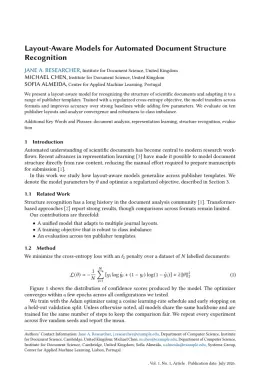
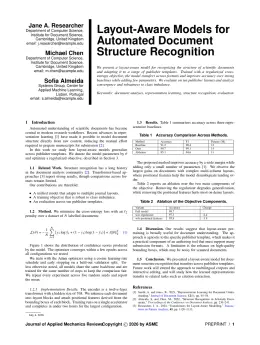
About the ACM Transactions on Social Computing format
ACM Transactions on Social Computing is a peer-reviewed journal published by ACM, covering Social Media and Politics, Misinformation and Its Impacts, Hate Speech and Cyberbullying Detection. Over its lifetime it has published 126 papers, which have received 1,903 citations.
| Publisher | ACM |
|---|
| Reference style | Numbered (ACM) Numbered — [1], [2] in the text
[1] Ada Smith, Ben Jones, and Cara Lee. 2023. A representative article title. ACM Transactions on Social Computing 12, 3, Article 45 (2023).
Formats any DOI in ACM Transactions on Social Computing style. No sign-up.
|
|---|
| Publishes research in | Social Media and Politics Misinformation and Its Impacts Hate Speech and Cyberbullying Detection Complex Network Analysis Techniques Mobile Crowdsensing and Crowdsourcing |
|---|
| ISSN | 2469-7818 |
|---|
| Citation impact (2-yr) | 2.16 |
|---|
| h-index | 24 |
|---|
| i10-index | 50 |
|---|
| Top institutions publishing here | University of Washington |
|---|
| You get | A submission-ready PDF and the editable LaTeX source — ready to submit. |
|---|
Papers published in ACM Transactions on Social Computing per year
Citation impact of ACM Transactions on Social Computing by publication year
Citations each year’s papers have accumulated so far — the most recent years are still building up.
Most-cited papers in ACM Transactions on Social Computing
Quantifying Controversy on Social Media
Kiran Garimella, Gianmarco De Francisci Morales, Aristides Gionis et al. · 18 Jan 2018
Which topics spark the most heated debates on social media? Identifying those topics is not only interesting from a societal point of view but also allows the filtering and aggregation of social media content for disseminating news stories. In this article, we perform a systematic methodological study of controversy detection by using the content and…
Gender and Age Influences on Interpretation of Emoji Functions
Susan C. Herring, Ashley R. Dainas · 26 Apr 2020
An online survey, the Understanding Emoji Survey , was conducted to assess how English-speaking social media users interpret the pragmatic functions of emoji in examples adapted from public Facebook comments, based on a modified version of [15]’s taxonomy of functions. Of the responses received (N = 519; 351 females, 120 males, 48 “other”; 354 under…
Identifying Framing Bias in Online News
Fred Morstatter, Liang Wu, Uraz Yavanoğlu et al. · 27 Jun 2018
It has been observed that different media outlets exert bias in the way they report the news, which seamlessly influences the way that readers’ knowledge is built through filtering what we read. Therefore, understanding bias in news media is fundamental for obtaining a holistic view of a news story. Traditional work has focused on biases…
Augmented Virtual Reality Meditation
Simo Järvelä, Benjamin Ultan Cowley, Mikko Salminen et al. · 21 May 2021
In a novel experimental setting, we augmented a variation of traditional compassion meditation with our custom-built VR environment for multiple concurrent users. The presence of another user’s avatar in shared virtual space supports social interactions and provides an active target for evoked compassion. The system incorporates respiration and brainwave-based biofeedback to enable closed-loop interaction of…
Danmaku
Qunfang Wu, Yisi Sang, Yun Huang · 20 Jun 2019
Danmaku is a new commentary design for online videos. Unlike traditional forums where comments are displayed asynchronously below a video screen in order of when the comments are posted, danmaku comments are overlaid on the screen and displayed along with the video. This new design creates a pseudo-synchronous effect by displaying asynchronous comments with certain…