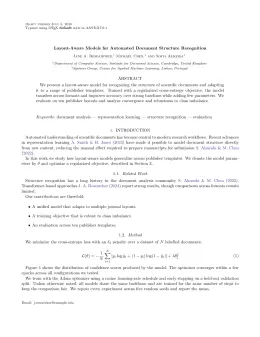
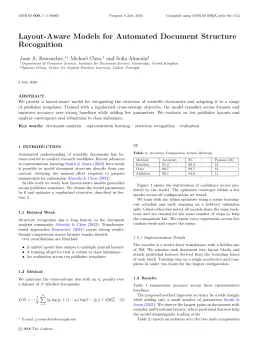
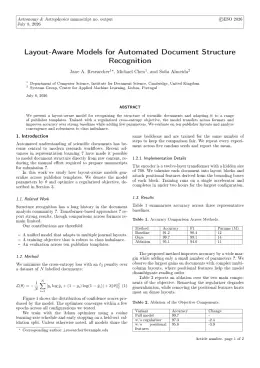
American Astronomical Society

The Astrophysical Journal Letters Template

Write in a clean editor, then format for The Astrophysical Journal Letters in one click — DocuGuru applies the official American Astronomical Society template with author–year references and exports a submission-ready PDF plus the editable LaTeX source. Free to start.

About the The Astrophysical Journal Letters format

The Astrophysical Journal Letters is a peer-reviewed journal published by American Astronomical Society, covering Stellar, planetary, and galactic studies, Astrophysics and Star Formation Studies, Astronomy and Astrophysical Research. Over its lifetime it has published 11,435 papers, which have received 555,945 citations.

PublisherAmerican Astronomical Society
Reference styleAuthor–year (AAS)
Author–year — (Smith, 2023) in the text
Smith, A., Jones, B., & Lee, C. 2023, The Astrophysical Journal Letters, 12, 45

Formats any DOI in The Astrophysical Journal Letters style. No sign-up.

Publishes research inStellar, planetary, and galactic studies Astrophysics and Star Formation Studies Astronomy and Astrophysical Research Gamma-ray bursts and supernovae Galaxies: Formation, Evolution, Phenomena
ISSN2041-8205
Citation impact (2-yr)8.2
h-index244
i10-index8,465
Article processing charge$2,400
Open accessYes — indexed in DOAJ
Top institutions publishing hereCentre National de la Recherche Scientifique
Journal websiteiopscience.iop.org
You getA submission-ready PDF and the editable LaTeX source — ready to submit.

Papers published in The Astrophysical Journal Letters per year

674
2014
607
2015
578
2016
558
2017
578
2018
663
2019
724
2020
657
2021
628
2022
715
2023
722
2024
971
2025

Citation impact of The Astrophysical Journal Letters by publication year

39.2K
2014
36.8K
2015
35K
2016
46.4K
2017
31.6K
2018
43.3K
2019
29.7K
2020
24.3K
2021
22.9K
2022
26.1K
2023
11K
2024
6.2K
2025

Citations each year’s papers have accumulated so far — the most recent years are still building up.

Most-cited papers in The Astrophysical Journal Letters

First M87 Event Horizon Telescope Results. I. The Shadow of the Supermassive Black Hole

Kazunori Akiyama, A. Alberdi, W. Alef et al. · 9 Apr 2019

Abstract When surrounded by a transparent emission region, black holes are expected to reveal a dark shadow caused by gravitational light bending and photon capture at the event horizon. To image and study this phenomenon, we have assembled the Event Horizon Telescope, a global very long baseline interferometry array observing at a wavelength of 1.3…

4,196 citations Cite SaveGo to paper →
Multi-messenger Observations of a Binary Neutron Star Merger<sup>*</sup>

B. P. Abbott, R. Abbott, T. D. Abbott et al. · 16 Oct 2017

Abstract On 2017 August 17 a binary neutron star coalescence candidate (later designated GW170817) with merger time 12:41:04 UTC was observed through gravitational waves by the Advanced LIGO and Advanced Virgo detectors. The Fermi Gamma-ray Burst Monitor independently detected a gamma-ray burst (GRB 170817A) with a time delay of <mml:math xmlns:mml="http://www.w3.org/1998/Math/MathML" overflow="scroll"> <mml:mo>∼</mml:mo> <mml:mn>1.7</mml:mn> <mml:mspace…

3,682 citations Cite SaveGo to paper →
Gravitational Waves and Gamma-Rays from a Binary Neutron Star Merger: GW170817 and GRB 170817A

B. P. Abbott, R. Abbott, T. D. Abbott et al. · 16 Oct 2017

Abstract On 2017 August 17, the gravitational-wave event GW170817 was observed by the Advanced LIGO and Virgo detectors, and the gamma-ray burst (GRB) GRB 170817A was observed independently by the Fermi Gamma-ray Burst Monitor, and the Anti-Coincidence Shield for the Spectrometer for the International Gamma-Ray Astrophysics Laboratory . The probability of the near-simultaneous temporal and…

3,549 citations Cite SaveGo to paper →
A Comprehensive Measurement of the Local Value of the Hubble Constant with 1 km s<sup>−1</sup> Mpc<sup>−1</sup> Uncertainty from the Hubble Space Telescope and the SH0ES Team

Adam G. Riess, Wenlong Yuan, Lucas M. Macri et al. · 1 Jul 2022

Abstract We report observations from the Hubble Space Telescope (HST) of Cepheid variables in the host galaxies of 42 Type Ia supernovae (SNe Ia) used to calibrate the Hubble constant ( H 0 ). These include the complete sample of all suitable SNe Ia discovered in the last four decades at redshift z ≤ 0.01,…

2,177 citations Cite SaveGo to paper →
First Sagittarius A* Event Horizon Telescope Results. I. The Shadow of the Supermassive Black Hole in the Center of the Milky Way

Kazunori Akiyama, A. Alberdi, W. Alef et al. · 1 May 2022

Abstract We present the first Event Horizon Telescope (EHT) observations of Sagittarius A* (Sgr A*), the Galactic center source associated with a supermassive black hole. These observations were conducted in 2017 using a global interferometric array of eight telescopes operating at a wavelength of λ = 1.3 mm. The EHT data resolve a compact emission…

1,809 citations Cite SaveGo to paper →

The Astrophysical Journal Letters template — frequently asked questions

How do I write a paper in the The Astrophysical Journal Letters format?
In DocuGuru you write your manuscript in a normal editor — no LaTeX setup required — and select the The Astrophysical Journal Letters template. When you export, DocuGuru compiles the paper into the official American Astronomical Society format and hands you a submission-ready PDF along with the editable LaTeX source.
What reference style does The Astrophysical Journal Letters use?
The Astrophysical Journal Letters uses Author–year (AAS) references, shown as author–year markers such as (Smith, 2023) in the text. DocuGuru formats every in-text citation and the reference list in this exact style automatically. A reference appears like this: Smith, A., Jones, B., & Lee, C. 2023, The Astrophysical Journal Letters, 12, 45
Do I need to know LaTeX to submit to The Astrophysical Journal Letters?
No. DocuGuru generates the aastex701 LaTeX class and compiles the PDF for you in the background, so you get a American Astronomical Society-ready The Astrophysical Journal Letters document without writing any LaTeX. If you do want it, the LaTeX source is included in the export.
Can I import an existing draft into the The Astrophysical Journal Letters template?
Yes. Paste or upload your current manuscript — Word, LaTeX, Markdown, or plain text — and DocuGuru reflows it into the The Astrophysical Journal Letters format with correct headings, figures, tables, and author–year citations.
What is The Astrophysical Journal Letters?
ApJL, AAS journal for rapid publication of significant astrophysical results.
Can I export a submission-ready The Astrophysical Journal Letters PDF?
Yes — DocuGuru produces a PDF built with the official The Astrophysical Journal Letters template (the aastex701 class) that is ready to submit to American Astronomical Society, together with the matching LaTeX source files.
How much does the The Astrophysical Journal Letters template cost?
You can start writing in the The Astrophysical Journal Letters template for free. Exporting the final submission-ready The Astrophysical Journal Letters PDF and LaTeX source is part of DocuGuru's paid plans — see the app for current pricing.
Use the The Astrophysical Journal Letters template