Taylor & Francis

Ichnos/Ichnos : an international journal for plant and animal traces Template

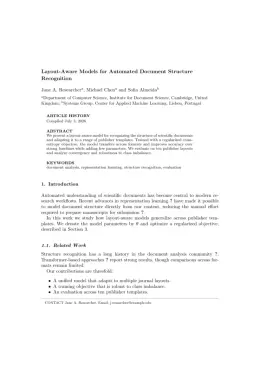
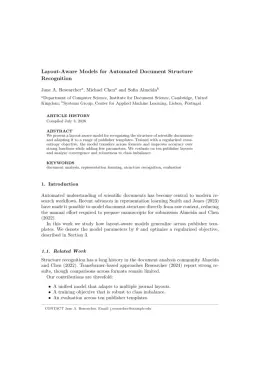
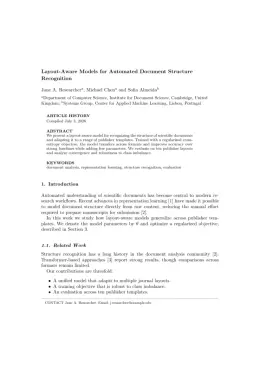
Write in a clean editor, then format for Ichnos/Ichnos : an international journal for plant and animal traces in one click — DocuGuru applies the official Taylor & Francis template with author–year references and exports a submission-ready PDF plus the editable LaTeX source. Free to start.

About the Ichnos/Ichnos : an international journal for plant and animal traces format

Ichnos/Ichnos : an international journal for plant and animal traces is a peer-reviewed journal published by Taylor & Francis, covering Geological formations and processes, Paleontology and Evolutionary Biology, Evolution and Paleontology Studies.

PublisherTaylor & Francis
Reference styleAuthor–year (Chicago, T&F)
Author–year — (Smith, 2023) in the text
Smith, Ada, Ben Jones, and Cara Lee. 2023. "A Representative Article Title." Ichnos/Ichnos : an international journal for plant and animal traces 12 (3): 45–58.

Formats any DOI in Ichnos/Ichnos : an international journal for plant and animal traces style. No sign-up.

Publishes research inGeological formations and processes Paleontology and Evolutionary Biology Evolution and Paleontology Studies Geology and Paleoclimatology Research Paleontology and Stratigraphy of Fossils
ISSN1026-7999
Citation impact (2-yr)1.44
h-index60
i10-index487
Total citations18,098
Top institutions publishing hereUniversity of Colorado Denver
Journal websitewww.tandfonline.com
You getA submission-ready PDF and the editable LaTeX source — ready to submit.

Papers published in Ichnos/Ichnos : an international journal for plant and animal traces per year

23
2014
25
2015
43
2016
31
2017
18
2018
24
2019
32
2020
26
2021
15
2022
26
2023
15
2024
25
2025

Citation impact of Ichnos/Ichnos : an international journal for plant and animal traces by publication year

440
2014
370
2015
639
2016
487
2017
147
2018
202
2019
193
2020
71
2021
77
2022
186
2023
44
2024
34
2025

Citations each year’s papers have accumulated so far — the most recent years are still building up.

Most-cited papers in Ichnos/Ichnos : an international journal for plant and animal traces

The paleoenvironmental and paleoecological significance of the lacustrine <i>Mermia</i> ichnofacies: An archetypical subaqueous nonmarine trace fossil assemblage

Luís A. Buatois, M. Gabriela Mángano · 1 Aug 1995

Although nonmarine environments commonly are considered as diverse and varied as marine settings, only a single recurrent and archetypical ichnofacies, the Scoyenia ichnofacies, has been formally defined. However, recent research proposed the terrestrial Termitichnus ichnofacies as a subset of the Scoyenia ichnofacies. The Mermia ichnofacies is formally defined herein to include nonmarine, fully aquatic trace…

A comparison of crayfish burrow morphologies: Triassic and Holocene fossil, paleo‐ and neo‐ichnological evidence, and the identification of their burrowing signatures

Stephen T. Hasiotis, Charles E. Mitchell · 1 Aug 1993

The architectural and surficial morphologies of crayfish burrows from the Upper Triassic Chinle Formation and Holocene sediments were compared in order to determine: 1) if Triassic burrows could truly be attributed to crayfish activity; 2) how comparable the burrowing mechanisms are; and 3) whether or not a common set of burrowing signatures could be identified…

Commentary

Dave Keighley, Ron K. Pickerill · 1 Jan 1995

Planolites, although strictly a junior synonym of Palaeophycus, can be retained as a valid ichnotaxon on the basis of stability of nomenclature. As emended by Pemberton and Frey (1982) and consistently adopted by later authors, Planolites is diagnosed primarily on the basis that it is an unlined simple burrow, whereas Palaeophycus is a lined burrow.…

Formation and Taphonomy of Human Footprints in Microbial Mats of Present-Day Tidal-flat Environments: Implications for the Study of Fossil Footprints

Daniel Marty, André Strasser, Christian A. Meyer · 6 Jan 2009

This study concerns the formation, taphonomy, and preservation of human footprints in microbial mats of present-day tidal-flat environments. Due to differences in water content and nature of the microbial mats and the underlying sediment, a wide range of footprint morphologies was produced by the same trackmaker. Most true tracks are subjected to modification due to…

Tetrapod Ichnofacies: A New Paradigm

Adrian P. Hunt, Spencer G. Lucas · 15 Dec 2006

We recognize three fundamental terms in ichnology: (1) ichnoassemblage, which is an assemblage of ichnofossils conceptually equivalent to an assemblage of body fossils; (2) ichnocoenosis, which is a trace fossil assemblage produced by a biological community that can be characterized by morphological criteria; and (3) ichnofacies, which refers to recurrent ichnocoenoses that represent a significant…

Ichnos/Ichnos : an international journal for plant and animal traces template — frequently asked questions

How do I write a paper in the Ichnos/Ichnos : an international journal for plant and animal traces format?
In DocuGuru you write your manuscript in a normal editor — no LaTeX setup required — and select the Ichnos/Ichnos : an international journal for plant and animal traces template. When you export, DocuGuru compiles the paper into the official Taylor & Francis format and hands you a submission-ready PDF along with the editable LaTeX source.
What reference style does Ichnos/Ichnos : an international journal for plant and animal traces use?
Ichnos/Ichnos : an international journal for plant and animal traces uses Author–year (Chicago, T&F) references, shown as author–year markers such as (Smith, 2023) in the text. DocuGuru formats every in-text citation and the reference list in this exact style automatically. A reference appears like this: Smith, Ada, Ben Jones, and Cara Lee. 2023. "A Representative Article Title." Ichnos/Ichnos : an international journal for plant and animal traces 12 (3): 45–58.
Do I need to know LaTeX to submit to Ichnos/Ichnos : an international journal for plant and animal traces?
No. DocuGuru generates the interact LaTeX class and compiles the PDF for you in the background, so you get a Taylor & Francis-ready Ichnos/Ichnos : an international journal for plant and animal traces document without writing any LaTeX. If you do want it, the LaTeX source is included in the export.
Can I import an existing draft into the Ichnos/Ichnos : an international journal for plant and animal traces template?
Yes. Paste or upload your current manuscript — Word, LaTeX, Markdown, or plain text — and DocuGuru reflows it into the Ichnos/Ichnos : an international journal for plant and animal traces format with correct headings, figures, tables, and author–year citations.
Who publishes Ichnos/Ichnos : an international journal for plant and animal traces?
Ichnos/Ichnos : an international journal for plant and animal traces is a multidisciplinary journal published by Taylor & Francis. DocuGuru's Ichnos/Ichnos : an international journal for plant and animal traces template matches Taylor & Francis's official submission format.
Can I export a submission-ready Ichnos/Ichnos : an international journal for plant and animal traces PDF?
Yes — DocuGuru produces a PDF built with the official Ichnos/Ichnos : an international journal for plant and animal traces template (the interact class) that is ready to submit to Taylor & Francis, together with the matching LaTeX source files.
How much does the Ichnos/Ichnos : an international journal for plant and animal traces template cost?
You can start writing in the Ichnos/Ichnos : an international journal for plant and animal traces template for free. Exporting the final submission-ready Ichnos/Ichnos : an international journal for plant and animal traces PDF and LaTeX source is part of DocuGuru's paid plans — see the app for current pricing.

Use the Ichnos/Ichnos : an international journal for plant and animal traces template