Taylor & Francis

Catalysis Structure & Reactivity Template

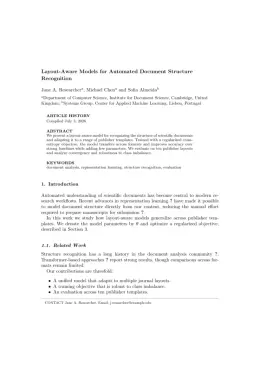
Write in a clean editor, then format for Catalysis Structure & Reactivity in one click — DocuGuru applies the official Taylor & Francis template with author–year references and exports a submission-ready PDF plus the editable LaTeX source. Free to start.

About the Catalysis Structure & Reactivity format

Catalysis Structure & Reactivity is a peer-reviewed journal published by Taylor & Francis, covering Catalytic Processes in Materials Science, Catalysis and Oxidation Reactions, Catalysis and Hydrodesulfurization Studies.

PublisherTaylor & Francis
Reference styleAuthor–year (Chicago, T&F)
Author–year — (Smith, 2023) in the text
Smith, Ada, Ben Jones, and Cara Lee. 2023. "A Representative Article Title." Catalysis Structure & Reactivity 12 (3): 45–58.

Formats any DOI in Catalysis Structure & Reactivity style. No sign-up.

Publishes research inCatalytic Processes in Materials Science Catalysis and Oxidation Reactions Catalysis and Hydrodesulfurization Studies Catalysts for Methane Reforming Nanomaterials for catalytic reactions
ISSN2055-074X
h-index16
i10-index24
Total citations851
Open accessYes
Top institutions publishing hereResearch Complex at Harwell
Journal websitewww.tandfonline.com
You getA submission-ready PDF and the editable LaTeX source — ready to submit.

Papers published in Catalysis Structure & Reactivity per year

7
2014
17
2015
4
2016
22
2017
5
2018
1
2019

Citation impact of Catalysis Structure & Reactivity by publication year

131
2014
227
2015
200
2016
207
2017
55
2018
27
2019

Citations each year’s papers have accumulated so far — the most recent years are still building up.

Most-cited papers in Catalysis Structure & Reactivity

Some considerations related to the use of the Scherrer equation in powder X-ray diffraction as applied to heterogeneous catalysts

Justin S. J. Hargreaves · 1 Oct 2016

This short overview summarises some of the basic considerations which should be undertaken when the Scherrer equation is applied to reflection widths in X-ray diffraction patterns of heterogeneous catalysts in order to extract meaningful information. Frequently, little account has been taken of the apparent complications arising from the presence of microstructural strain and disorder such…

Catalysis in Diesel engine NO<sub><i>x</i></sub>aftertreatment: a review

Marco Piumetti, Samir Bensaid, Debora Fino et al. · 2 Oct 2015

The catalytic reduction of nitrogen oxides (NO x ) under lean-burn conditions represents an important target in catalysis research. The most relevant catalytic NO x abatement systems for Diesel engine vehicles are summarized in this short review, with focus on the main catalytic aspects and materials. Five aftertreatment technologies for Diesel NO x are reviewed:…

Determining surface structure and stability of ε-Fe<sub>2</sub>C, χ-Fe<sub>5</sub>C<sub>2</sub>, θ-Fe<sub>3</sub>C and Fe<sub>4</sub>C phases under carburization environment from combined DFT and atomistic thermodynamic studies

Shu Zhao, Xingwu Liu, Chun‐Fang Huo et al. · 3 Dec 2014

The chemical–physical environment around iron based FTS catalysts under working conditions is used to estimate the influences of carbon containing gases on the surface structures and stability of ε-Fe2C, χ-Fe5C2, θ-Fe3C and Fe4C from combined density functional theory and atomistic–thermodynamic studies. Higher carbon content gas has higher carburization ability; while higher temperature and lower pressure…

Effect of Cu content on the bimetallic Pt–Cu catalysts for propane dehydrogenation

Zixue Ma, Zhenwei Wu, Jeffrey T. Miller · 21 Feb 2017

Silica supported, 2 nm Pt and Pt–Cu catalysts with different Cu:Pt atomic ratios and similar size were evaluated for propane dehydrogenation at 550 °C. Monometallic Pt showed low propylene selectivity of 61% at 20% conversion and a TOR of 0.06 s−1. For the Pt–Cu catalysts, the dehydrogenation selectivity and TOR continuously increased with increasing Cu…

Promotional role of gold in electrochemical methanol oxidation

Samarjeet Singh Siwal, Nishu Devi, Venkata K. Perla et al. · 2 Jan 2019

Polymeric form of graphitic carbon nitride (CN) has attracted much attention in recent years because of their performance as a support material of various reactions. Here, we report the fabrication of CN and gold nanoparticle-decorated CN system for electrochemical methanol oxidation process. The microscopic, optical, thermal, and surface properties of the synthesized materials have been…

Catalysis Structure & Reactivity template — frequently asked questions

How do I write a paper in the Catalysis Structure & Reactivity format?
In DocuGuru you write your manuscript in a normal editor — no LaTeX setup required — and select the Catalysis Structure & Reactivity template. When you export, DocuGuru compiles the paper into the official Taylor & Francis format and hands you a submission-ready PDF along with the editable LaTeX source.
What reference style does Catalysis Structure & Reactivity use?
Catalysis Structure & Reactivity uses Author–year (Chicago, T&F) references, shown as author–year markers such as (Smith, 2023) in the text. DocuGuru formats every in-text citation and the reference list in this exact style automatically. A reference appears like this: Smith, Ada, Ben Jones, and Cara Lee. 2023. "A Representative Article Title." Catalysis Structure & Reactivity 12 (3): 45–58.
Do I need to know LaTeX to submit to Catalysis Structure & Reactivity?
No. DocuGuru generates the interact LaTeX class and compiles the PDF for you in the background, so you get a Taylor & Francis-ready Catalysis Structure & Reactivity document without writing any LaTeX. If you do want it, the LaTeX source is included in the export.
Can I import an existing draft into the Catalysis Structure & Reactivity template?
Yes. Paste or upload your current manuscript — Word, LaTeX, Markdown, or plain text — and DocuGuru reflows it into the Catalysis Structure & Reactivity format with correct headings, figures, tables, and author–year citations.
Who publishes Catalysis Structure & Reactivity?
Catalysis Structure & Reactivity is a multidisciplinary journal published by Taylor & Francis. DocuGuru's Catalysis Structure & Reactivity template matches Taylor & Francis's official submission format.
Can I export a submission-ready Catalysis Structure & Reactivity PDF?
Yes — DocuGuru produces a PDF built with the official Catalysis Structure & Reactivity template (the interact class) that is ready to submit to Taylor & Francis, together with the matching LaTeX source files.
How much does the Catalysis Structure & Reactivity template cost?
You can start writing in the Catalysis Structure & Reactivity template for free. Exporting the final submission-ready Catalysis Structure & Reactivity PDF and LaTeX source is part of DocuGuru's paid plans — see the app for current pricing.

Use the Catalysis Structure & Reactivity template