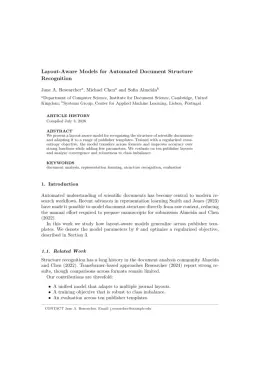
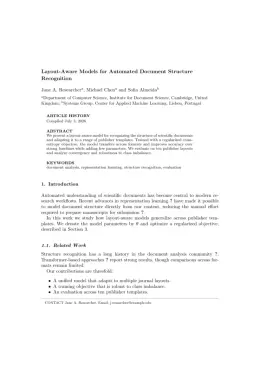
Taylor & Francis

Australian Journal of Civil Engineering Template

Write in a clean editor, then format for Australian Journal of Civil Engineering in one click — DocuGuru applies the official Taylor & Francis template with author–year references and exports a submission-ready PDF plus the editable LaTeX source. Free to start.

About the Australian Journal of Civil Engineering format

Australian Journal of Civil Engineering is a peer-reviewed journal published by Taylor & Francis, covering Concrete and Cement Materials Research, Innovative concrete reinforcement materials, Infrastructure Maintenance and Monitoring.

PublisherTaylor & Francis
Reference styleAuthor–year (Chicago, T&F)
Author–year — (Smith, 2023) in the text
Smith, Ada, Ben Jones, and Cara Lee. 2023. "A Representative Article Title." Australian Journal of Civil Engineering 12 (3): 45–58.

Formats any DOI in Australian Journal of Civil Engineering style. No sign-up.

Publishes research inConcrete and Cement Materials Research Innovative concrete reinforcement materials Infrastructure Maintenance and Monitoring Asphalt Pavement Performance Evaluation Concrete Corrosion and Durability
ISSN1448-8353
Citation impact (2-yr)1.23
h-index28
i10-index89
Total citations3,031
Top institutions publishing hereRMIT University
Journal websitewww.tandfonline.com
You getA submission-ready PDF and the editable LaTeX source — ready to submit.

Papers published in Australian Journal of Civil Engineering per year

7
2014
11
2015
8
2016
12
2017
14
2018
21
2019
37
2020
30
2021
36
2022
12
2023
12
2024
11
2025

Citation impact of Australian Journal of Civil Engineering by publication year

55
2014
202
2015
219
2016
206
2017
316
2018
414
2019
438
2020
249
2021
295
2022
49
2023
21
2024
17
2025

Citations each year’s papers have accumulated so far — the most recent years are still building up.

Most-cited papers in Australian Journal of Civil Engineering

A quantitative method of approach in designing the mix proportions of fly ash and GGBS-based geopolymer concrete

G. Mallikarjuna Rao, T. D. Gunneswara Rao · 2 Jan 2018

This paper presents a systematic approach for selecting mix proportions for fly ash and GGBS-based geopolymer concrete. Very little information is available on complete methodology in designing the fly ash and GGBS-based geopolymer mix. The fly ash and GGBS were activated using sodium silicate and sodium hydroxide as alkaline activator solution. The Na2SiO3/NaOH (alkaline activator)…

Role of recycling fine materials as filler for improving performance of concrete - a review

Paul O. Awoyera, Adeyemi Adesina, R. Gobinath · 6 Jun 2019

There are limitations that are associated with recycled aggregate concrete (RAC), with regards to strength, durability and micro scale features. These have led to the use of artificial admixtures for modifying concrete properties. This review dwells on the use of fillers to improve the mechanical and microstructural properties of RAC. Fillers are sourced naturally or…

Effects of graphene oxide in enhancing the performance of concrete exposed to high-temperature

Alyaa Mohammed, Jay Sanjayan, Ali Nazari et al. · 2 Jan 2017

Effects of incorporation of graphene oxide (GO) in normal and high strength concrete at high temperatures were experimentally investigated. The behaviour of concrete specimens was examined by comprehensive thermal analyses of heat transfer, residual mechanical strength, pore structure, mass loss and dilatometery. The results showed significant improvement of mechanical strength of the specimens with GO;…

A new model for bridge management: Part A: condition assessment and priority ranking of bridges

Maria Rashidi, Bijan Samali, P. Sharafi · 20 Dec 2015

Due to substantial role of bridges in transportation networks and in accordance with the limited funding for bridge management, remediation strategies have to be prioritised. A conservative bridge assessment will result in unnecessary actions, such as costly bridge strengthening or repairs. On the other hand, any bridge maintenance negligence and delayed actions may lead to…

Using silica mineral waste as aggregate in a green high strength concrete: workability, strength, failure mode, and morphology assessment

P. Murthi, Paul O. Awoyera, P. Selvaraj et al. · 20 Jun 2018

Environmental degradation is a major challenge in the developing countries, which are caused due to unmanaged solid waste, or improper disposal. This study investigates the effect of using silica mineral waste (eco sand) as aggregate in a green high strength concrete, in which properties such as workability, strength, failure mode, and morphology were determined. There…

Australian Journal of Civil Engineering template — frequently asked questions

How do I write a paper in the Australian Journal of Civil Engineering format?
In DocuGuru you write your manuscript in a normal editor — no LaTeX setup required — and select the Australian Journal of Civil Engineering template. When you export, DocuGuru compiles the paper into the official Taylor & Francis format and hands you a submission-ready PDF along with the editable LaTeX source.
What reference style does Australian Journal of Civil Engineering use?
Australian Journal of Civil Engineering uses Author–year (Chicago, T&F) references, shown as author–year markers such as (Smith, 2023) in the text. DocuGuru formats every in-text citation and the reference list in this exact style automatically. A reference appears like this: Smith, Ada, Ben Jones, and Cara Lee. 2023. "A Representative Article Title." Australian Journal of Civil Engineering 12 (3): 45–58.
Do I need to know LaTeX to submit to Australian Journal of Civil Engineering?
No. DocuGuru generates the interact LaTeX class and compiles the PDF for you in the background, so you get a Taylor & Francis-ready Australian Journal of Civil Engineering document without writing any LaTeX. If you do want it, the LaTeX source is included in the export.
Can I import an existing draft into the Australian Journal of Civil Engineering template?
Yes. Paste or upload your current manuscript — Word, LaTeX, Markdown, or plain text — and DocuGuru reflows it into the Australian Journal of Civil Engineering format with correct headings, figures, tables, and author–year citations.
Who publishes Australian Journal of Civil Engineering?
Australian Journal of Civil Engineering is a multidisciplinary journal published by Taylor & Francis. DocuGuru's Australian Journal of Civil Engineering template matches Taylor & Francis's official submission format.
Can I export a submission-ready Australian Journal of Civil Engineering PDF?
Yes — DocuGuru produces a PDF built with the official Australian Journal of Civil Engineering template (the interact class) that is ready to submit to Taylor & Francis, together with the matching LaTeX source files.
How much does the Australian Journal of Civil Engineering template cost?
You can start writing in the Australian Journal of Civil Engineering template for free. Exporting the final submission-ready Australian Journal of Civil Engineering PDF and LaTeX source is part of DocuGuru's paid plans — see the app for current pricing.

Use the Australian Journal of Civil Engineering template