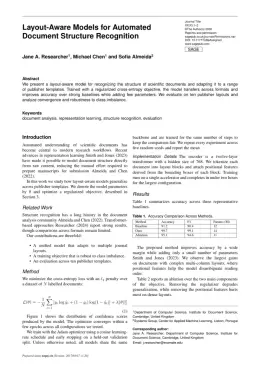
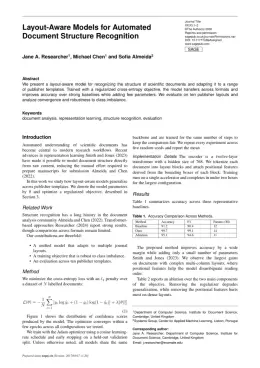
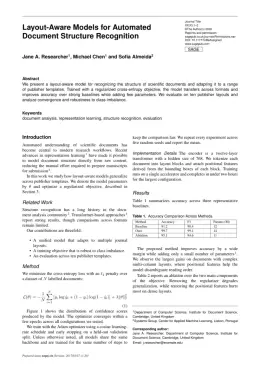
SAGE

Social Science Computer Review Template

Write in a clean editor, then format for Social Science Computer Review in one click — DocuGuru applies the official SAGE template with author–year references and exports a submission-ready PDF plus the editable LaTeX source. Free to start.

About the Social Science Computer Review format

Social Science Computer Review is a peer-reviewed journal published by SAGE, covering Social Media and Politics, Survey Methodology and Nonresponse, Impact of Technology on Adolescents.

PublisherSAGE
Reference styleAuthor–year (Harvard)
Author–year — (Smith, 2023) in the text
Smith, A., Jones, B. and Lee, C. (2023) 'A representative article title', Social Science Computer Review, 12(3), pp. 45–58.

Formats any DOI in Social Science Computer Review style. No sign-up.

Publishes research inSocial Media and Politics Survey Methodology and Nonresponse Impact of Technology on Adolescents E-Government and Public Services Opinion Dynamics and Social Influence
ISSN0894-4393
Citation impact (2-yr)4.1
h-index124
i10-index1,020
Total citations69,124
Top institutions publishing hereNorth Carolina State University
Journal websitewww.sagepub.com
You getA submission-ready PDF and the editable LaTeX source — ready to submit.

Papers published in Social Science Computer Review per year

66
2014
58
2015
38
2016
47
2017
66
2018
76
2019
47
2020
70
2021
98
2022
60
2023
86
2024
81
2025

Citation impact of Social Science Computer Review by publication year

4.7K
2014
3.9K
2015
2.3K
2016
2.8K
2017
3.3K
2018
3.3K
2019
2K
2020
1.6K
2021
1.2K
2022
873
2023
688
2024
135
2025

Citations each year’s papers have accumulated so far — the most recent years are still building up.

Most-cited papers in Social Science Computer Review

An Algorithm for Fast Recovery of Sparse Causal Graphs

Peter Spirtes, Clark Glymour · 1 Apr 1991

Previous asymptotically correct algorithms for recovering causal structure from sample probabilities have been limited even in sparse causal graphs to a few variables. We describe an asymptotically correct algorithm whose complexity for fixed graph connectivity increases polynomially in the number of vertices, and may in practice recover sparse graphs with several hundred variables. From sample…

The Impacts of Emoticons on Message Interpretation in Computer-Mediated Communication

Joseph B. Walther, Kyle P. D’Addario · 1 Aug 2001

Emoticons are graphic representations of facial expressions that many e-mail users embed in their messages. These symbols are widely known and commonly recognized among computer-mediated communication (CMC) users, and they are described by most observers as substituting for the nonverbal cues that are missing from CMC in comparison to face-to-face communication. Their empirical impacts, however,…

Linking Loneliness, Shyness, Smartphone Addiction Symptoms, and Patterns of Smartphone Use to Social Capital

Mengwei Bian, Louis Leung · 8 Apr 2014

The purpose of this study is to explore the roles of psychological attributes (such as shyness and loneliness) and smartphone usage patterns in predicting smartphone addiction symptoms and social capital. Data were gathered from a sample of 414 university students using online survey in Mainland China. Results from exploratory factor analysis identified five smartphone addiction…

The Relations Among Social Media Addiction, Self-Esteem, and Life Satisfaction in University Students

Nazir S. Hawi, Maya Samaha · 10 Aug 2016

The use of social media has grown exponentially to the extent of engaging close to one third of the world’s population as of January 2016. Actually, social media statistics have been reporting an average annual increase of 10% in total number of users. These extremely impressive statistics have been triggering researchers’ interest in investigating this…

Using Computers in Qualitative Research

1 Jul 1994

This work by mostly British scholars presents 11 essays on qualitative computing, one of them an overview essay by the editors. An initial section surveys a dozen software packages such as Ethno, Ethnograph, and WordCruncher and discusses the application of Nudist and a package created at the University of Edinburgh for conceptual modeling. A middle…

Social Science Computer Review template — frequently asked questions

How do I write a paper in the Social Science Computer Review format?
In DocuGuru you write your manuscript in a normal editor — no LaTeX setup required — and select the Social Science Computer Review template. When you export, DocuGuru compiles the paper into the official SAGE format and hands you a submission-ready PDF along with the editable LaTeX source.
What reference style does Social Science Computer Review use?
Social Science Computer Review uses Author–year (Harvard) references, shown as author–year markers such as (Smith, 2023) in the text. DocuGuru formats every in-text citation and the reference list in this exact style automatically. A reference appears like this: Smith, A., Jones, B. and Lee, C. (2023) 'A representative article title', Social Science Computer Review, 12(3), pp. 45–58.
Do I need to know LaTeX to submit to Social Science Computer Review?
No. DocuGuru generates the sagej LaTeX class and compiles the PDF for you in the background, so you get a SAGE-ready Social Science Computer Review document without writing any LaTeX. If you do want it, the LaTeX source is included in the export.
Can I import an existing draft into the Social Science Computer Review template?
Yes. Paste or upload your current manuscript — Word, LaTeX, Markdown, or plain text — and DocuGuru reflows it into the Social Science Computer Review format with correct headings, figures, tables, and author–year citations.
Who publishes Social Science Computer Review?
Social Science Computer Review is a multidisciplinary journal published by SAGE. DocuGuru's Social Science Computer Review template matches SAGE's official submission format.
Can I export a submission-ready Social Science Computer Review PDF?
Yes — DocuGuru produces a PDF built with the official Social Science Computer Review template (the sagej class) that is ready to submit to SAGE, together with the matching LaTeX source files.
How much does the Social Science Computer Review template cost?
You can start writing in the Social Science Computer Review template for free. Exporting the final submission-ready Social Science Computer Review PDF and LaTeX source is part of DocuGuru's paid plans — see the app for current pricing.

Use the Social Science Computer Review template