SAGE

Adaptive Behavior Template

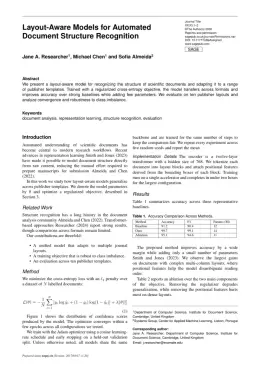
Write in a clean editor, then format for Adaptive Behavior in one click — DocuGuru applies the official SAGE template with author–year references and exports a submission-ready PDF plus the editable LaTeX source. Free to start.

About the Adaptive Behavior format

Adaptive Behavior is a peer-reviewed journal published by SAGE, covering Embodied and Extended Cognition, Neural dynamics and brain function, Evolutionary Game Theory and Cooperation.

PublisherSAGE
Reference styleAuthor–year (Harvard)
Author–year — (Smith, 2023) in the text
Smith, A., Jones, B. and Lee, C. (2023) 'A representative article title', Adaptive Behavior, 12(3), pp. 45–58.

Formats any DOI in Adaptive Behavior style. No sign-up.

Publishes research inEmbodied and Extended Cognition Neural dynamics and brain function Evolutionary Game Theory and Cooperation Action Observation and Synchronization Reinforcement Learning in Robotics
ISSN1059-7123
Citation impact (2-yr)1.48
h-index82
i10-index466
Total citations28,167
Top institutions publishing hereUniversity of Sussex
Journal websitewww.sagepub.com
You getA submission-ready PDF and the editable LaTeX source — ready to submit.

Papers published in Adaptive Behavior per year

35
2014
30
2015
29
2016
21
2017
40
2018
88
2019
44
2020
44
2021
35
2022
39
2023
24
2024
28
2025

Citation impact of Adaptive Behavior by publication year

404
2014
319
2015
716
2016
302
2017
438
2018
1.1K
2019
588
2020
226
2021
314
2022
175
2023
69
2024
27
2025

Citations each year’s papers have accumulated so far — the most recent years are still building up.

Most-cited papers in Adaptive Behavior

Ant-Based Load Balancing in Telecommunications Networks

Ruud Schoonderwoerd, Owen Holland, Janet Bruten et al. · 1 Jan 1997

This article describes a novel method of achieving load balancing in telecommunications networks. A simulated network models a typical distribution of calls between nodes; nodes carrying an excess of traffic can become congested, causing calls to be lost. In addition to calls, the network also supports a population of simple mobile agents with behaviors modeled…

Evolving Dynamical Neural Networks for Adaptive Behavior

Randall D. Beer, John C. Gallagher · 1 Jun 1992

We would like the behavior of the artificial agents that we construct to be as well-adapted to their environments as natural animals are to theirs. Unfortunately, designing controllers with these properties is a very difficult task. In this article, we demonstrate that continuous-time recurrent neural networks are a viable mechanism for adaptive agent control and…

The Dynamics of Active Categorical Perception in an Evolved Model Agent

Randall D. Beer · 1 Dec 2003

Notions of embodiment, situatedness, and dynamics are increasingly being debated in cognitive sci ence. However, these debates are often carried out in the absence of concrete examples. In order to build intuition, this paper explores a model agent to illustrate how the perspective and tools of dynam ical systems theory can be applied to the…

Defining Agency: Individuality, Normativity, Asymmetry, and Spatio-temporality in Action

Xabier E. Barandiaran, Ezequiel A. Di Paolo, Marieke Rohde · 23 Sep 2009

The concept of agency is of crucial importance in cognitive science and artificial intelligence, and it is often used as an intuitive and rather uncontroversial term, in contrast to more abstract and theoretically heavily weighted terms such as intentionality , rationality, or mind. However, most of the available definitions of agency are too loose or…

Incremental Evolution of Complex General Behavior

Faustino Gomez, Risto Miikkulainen · 1 Jan 1997

Several researchers have demonstrated how complex action sequences can be learned through neuroevolution (i.e., evolving neural networks with genetic algorithms). However, complex general behavior such as evading predators or avoiding obstacles, which is not tied to specific environments, turns out to be very difficult to evolve. Often the system discovers mechanical strategies, such as moving…

Adaptive Behavior template — frequently asked questions

How do I write a paper in the Adaptive Behavior format?
In DocuGuru you write your manuscript in a normal editor — no LaTeX setup required — and select the Adaptive Behavior template. When you export, DocuGuru compiles the paper into the official SAGE format and hands you a submission-ready PDF along with the editable LaTeX source.
What reference style does Adaptive Behavior use?
Adaptive Behavior uses Author–year (Harvard) references, shown as author–year markers such as (Smith, 2023) in the text. DocuGuru formats every in-text citation and the reference list in this exact style automatically. A reference appears like this: Smith, A., Jones, B. and Lee, C. (2023) 'A representative article title', Adaptive Behavior, 12(3), pp. 45–58.
Do I need to know LaTeX to submit to Adaptive Behavior?
No. DocuGuru generates the sagej LaTeX class and compiles the PDF for you in the background, so you get a SAGE-ready Adaptive Behavior document without writing any LaTeX. If you do want it, the LaTeX source is included in the export.
Can I import an existing draft into the Adaptive Behavior template?
Yes. Paste or upload your current manuscript — Word, LaTeX, Markdown, or plain text — and DocuGuru reflows it into the Adaptive Behavior format with correct headings, figures, tables, and author–year citations.
Who publishes Adaptive Behavior?
Adaptive Behavior is a multidisciplinary journal published by SAGE. DocuGuru's Adaptive Behavior template matches SAGE's official submission format.
Can I export a submission-ready Adaptive Behavior PDF?
Yes — DocuGuru produces a PDF built with the official Adaptive Behavior template (the sagej class) that is ready to submit to SAGE, together with the matching LaTeX source files.
How much does the Adaptive Behavior template cost?
You can start writing in the Adaptive Behavior template for free. Exporting the final submission-ready Adaptive Behavior PDF and LaTeX source is part of DocuGuru's paid plans — see the app for current pricing.
Use the Adaptive Behavior template