
7,356 citations
Cite
SaveGo to paper →
PLOS
PLOS Biology Template
Write in a clean editor, then format for PLOS Biology in one click — DocuGuru applies the official PLOS template with numbered references and exports a submission-ready PDF plus the editable LaTeX source. Free to start.
About the PLOS Biology format
PLOS Biology is a peer-reviewed journal published by PLOS, covering Neural dynamics and brain function, Neurobiology and Insect Physiology Research, RNA and protein synthesis mechanisms. Over its lifetime it has published 8,679 papers, which have received 804,466 citations.
| Publisher | PLOS |
|---|---|
| Reference style | Numbered (Vancouver) Numbered — [1], [2] in the text 1. Smith A, Jones B, Lee C. A representative article title. PLOS Biology. 2023;12(3):45–58.
Formats any DOI in PLOS Biology style. No sign-up. |
| Publishes research in | Neural dynamics and brain function Neurobiology and Insect Physiology Research RNA and protein synthesis mechanisms Evolution and Genetic Dynamics Neuroscience and Neuropharmacology Research |
| ISSN | 1544-9173 |
| Citation impact (2-yr) | 6.66 |
| h-index | 390 |
| i10-index | 5,659 |
| Article processing charge | $5,300 |
| Open access | Yes — indexed in DOAJ |
| Top institutions publishing here | Centre National de la Recherche Scientifique |
| Journal website | www.plosbiology.org |
| You get | A submission-ready PDF and the editable LaTeX source — ready to submit. |
Papers published in PLOS Biology per year
Citation impact of PLOS Biology by publication year
Citations each year’s papers have accumulated so far — the most recent years are still building up.
Most-cited papers in PLOS Biology
In phylogenetics, the unrooted model of phylogeny and the strict molecular clock model are two extremes of a continuum. Despite their dominance in phylogenetic inference, it is evident that both are biologically unrealistic and that the real evolutionary process lies between these two extremes. Fortunately, intermediate models employing relaxed molecular clocks have been described. These…
6,628 citations
Cite
SaveGo to paper →
Reproducible science requires transparent reporting. The ARRIVE guidelines (Animal Research: Reporting of In Vivo Experiments) were originally developed in 2010 to improve the reporting of animal research. They consist of a checklist of information to include in publications describing in vivo experiments to enable others to scrutinise the work adequately, evaluate its methodological rigour, and…
5,694 citations
Cite
SaveGo to paper →
Reported values in the literature on the number of cells in the body differ by orders of magnitude and are very seldom supported by any measurements or calculations. Here, we integrate the most up-to-date information on the number of human and bacterial cells in the body. We estimate the total number of bacteria in the…
5,114 citations
Cite
SaveGo to paper →
Structurally segregated and functionally specialized regions of the human cerebral cortex are interconnected by a dense network of cortico-cortical axonal pathways. By using diffusion spectrum imaging, we noninvasively mapped these pathways within and across cortical hemispheres in individual human participants. An analysis of the resulting large-scale structural brain networks reveals a structural core within posterior…
4,378 citations
Cite
SaveGo to paper →
Related journal templates
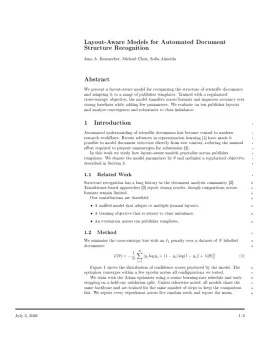
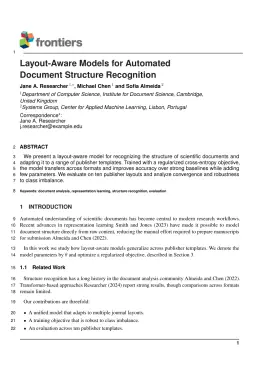
PLOS Biology template — frequently asked questions
How do I write a paper in the PLOS Biology format?
In DocuGuru you write your manuscript in a normal editor — no LaTeX setup required — and select the PLOS Biology template. When you export, DocuGuru compiles the paper into the official PLOS format and hands you a submission-ready PDF along with the editable LaTeX source.
What reference style does PLOS Biology use?
PLOS Biology uses Numbered (Vancouver) references, shown as numbered [1], [2] markers in the text. DocuGuru formats every in-text citation and the reference list in this exact style automatically. A reference appears like this: 1. Smith A, Jones B, Lee C. A representative article title. PLOS Biology. 2023;12(3):45–58.
Do I need to know LaTeX to submit to PLOS Biology?
No. DocuGuru generates the article LaTeX class and compiles the PDF for you in the background, so you get a PLOS-ready PLOS Biology document without writing any LaTeX. If you do want it, the LaTeX source is included in the export.
Can I import an existing draft into the PLOS Biology template?
Yes. Paste or upload your current manuscript — Word, LaTeX, Markdown, or plain text — and DocuGuru reflows it into the PLOS Biology format with correct headings, figures, tables, and numbered citations.
What is PLOS Biology?
PLOS Biology is a leading life science journal that champions inclusive, high-impact research across all disciplines—from molecules to ecosystems. It is a life sciences and medicine journal, published by PLOS.
Can I export a submission-ready PLOS Biology PDF?
Yes — DocuGuru produces a PDF built with the official PLOS Biology template (the article class) that is ready to submit to PLOS, together with the matching LaTeX source files.
How much does the PLOS Biology template cost?
You can start writing in the PLOS Biology template for free. Exporting the final submission-ready PLOS Biology PDF and LaTeX source is part of DocuGuru's paid plans — see the app for current pricing.