PLOS

PLOS Complex Systems Template

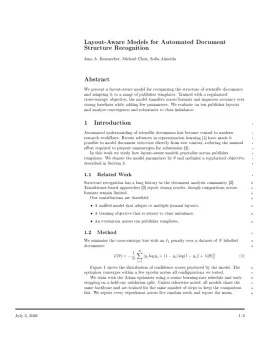
Write in a clean editor, then format for PLOS Complex Systems in one click — DocuGuru applies the official PLOS template with numbered references and exports a submission-ready PDF plus the editable LaTeX source. Free to start.

About the PLOS Complex Systems format

PLOS Complex Systems is a peer-reviewed journal published by PLOS, covering Complex Network Analysis Techniques, Opinion Dynamics and Social Influence, Neural dynamics and brain function. Over its lifetime it has published 101 papers, which have received 162 citations.

PublisherPLOS
Reference styleNumbered (Vancouver)
Numbered — [1], [2] in the text
1. Smith A, Jones B, Lee C. A representative article title. PLOS Complex Systems. 2023;12(3):45–58.

Formats any DOI in PLOS Complex Systems style. No sign-up.

Publishes research inComplex Network Analysis Techniques Opinion Dynamics and Social Influence Neural dynamics and brain function COVID-19 epidemiological studies Evolutionary Game Theory and Cooperation
ISSN2837-8830
Citation impact (2-yr)1.6
h-index5
i10-index3
Open accessYes — indexed in DOAJ
Top institutions publishing hereSanta Fe Institute
Journal websitejournals.plos.org
You getA submission-ready PDF and the editable LaTeX source — ready to submit.

Papers published in PLOS Complex Systems per year

24
2024
56
2025
21
2026

Citation impact of PLOS Complex Systems by publication year

76
2024
76
2025
10
2026

Citations each year’s papers have accumulated so far — the most recent years are still building up.

Most-cited papers in PLOS Complex Systems

Energy landscape analysis based on the Ising model: Tutorial review

Naoki Masuda, Safiqul Islam, Si Thu Aung et al. · 9 May 2025

We review a class of energy landscape analysis method that uses the Ising model and takes multivariate time series data as input. The method allows one to capture dynamics of the data as trajectories of a ball from one basin to a different basin to yet another, constrained on the energy landscape specified by the…

Assembly Theory is an approximation to algorithmic complexity based on LZ compression that does not explain selection or evolution

Felipe S. Abrahão, Santiago Hernández-Orozco, Narsis A. Kiani et al. · 23 Sep 2024

We formally prove the equivalence between Assembly Theory (AT) and Shannon Entropy via a method based upon the principles of statistical compression that belongs to the LZ family of popular compression algorithms. Such popular lossless compression algorithms behind file formats such as ZIP and PNG have been shown to empirically reproduce the results that AT…

Pattern detection in bipartite networks: A review of terminology, applications, and methods

Zachary P. Neal, Annabell Cadieux, Diego Garlaschelli et al. · 3 Oct 2024

Rectangular association matrices with binary (0/1) entries are a common data structure in many research fields. Examples include ecology, economics, mathematics, physics, psychometrics, and others. Because their columns and rows are associated to distinct entities, these matrices can be equivalently expressed as bipartite networks that, in turn, can be projected onto pairs of unipartite networks.…

Leveraging mathematical modeling framework to guide regimen strategy for phage therapy

Zhiyuan Yu, Tiffany Luong, Selenne Bañuelos et al. · 5 Nov 2024

Bacteriophage (phage) cocktail therapy has been relied upon more and more to treat antibiotic-resistant infections. Understanding of the complex kinetics between phages, target bacteria, and the emergence of phage resistance remain hurdles to successful clinical outcomes. Building upon previous mathematical concepts, we develop biologically-motivated nonlinear ordinary differential equation models to explore single, cocktail, and sequential…

Well-connectedness and community detection

Minhyuk Park, Yasamin Tabatabaee, Vikram Ramavarapu et al. · 5 Nov 2024

Community detection methods help reveal the meso-scale structure of complex networks. Integral to detecting communities is the expectation that communities in a network are edge-dense and “well-connected”. Surprisingly, we find that five different community detection methods–the Leiden algorithm optimizing the Constant Potts Model, the Leiden algorithm optimizing modularity, Infomap, Markov Cluster (MCL), and Iterative k-core…

PLOS Complex Systems template — frequently asked questions

How do I write a paper in the PLOS Complex Systems format?
In DocuGuru you write your manuscript in a normal editor — no LaTeX setup required — and select the PLOS Complex Systems template. When you export, DocuGuru compiles the paper into the official PLOS format and hands you a submission-ready PDF along with the editable LaTeX source.
What reference style does PLOS Complex Systems use?
PLOS Complex Systems uses Numbered (Vancouver) references, shown as numbered [1], [2] markers in the text. DocuGuru formats every in-text citation and the reference list in this exact style automatically. A reference appears like this: 1. Smith A, Jones B, Lee C. A representative article title. PLOS Complex Systems. 2023;12(3):45–58.
Do I need to know LaTeX to submit to PLOS Complex Systems?
No. DocuGuru generates the article LaTeX class and compiles the PDF for you in the background, so you get a PLOS-ready PLOS Complex Systems document without writing any LaTeX. If you do want it, the LaTeX source is included in the export.
Can I import an existing draft into the PLOS Complex Systems template?
Yes. Paste or upload your current manuscript — Word, LaTeX, Markdown, or plain text — and DocuGuru reflows it into the PLOS Complex Systems format with correct headings, figures, tables, and numbered citations.
What is PLOS Complex Systems?
PLOS Complex Systems brings together researchers across disciplines, providing a platform for theoretical, modeling, and applied research that advances our understanding of complex systems. It is a life sciences and medicine journal, published by PLOS.
Can I export a submission-ready PLOS Complex Systems PDF?
Yes — DocuGuru produces a PDF built with the official PLOS Complex Systems template (the article class) that is ready to submit to PLOS, together with the matching LaTeX source files.
How much does the PLOS Complex Systems template cost?
You can start writing in the PLOS Complex Systems template for free. Exporting the final submission-ready PLOS Complex Systems PDF and LaTeX source is part of DocuGuru's paid plans — see the app for current pricing.
Use the PLOS Complex Systems template