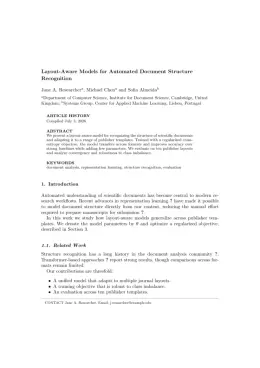
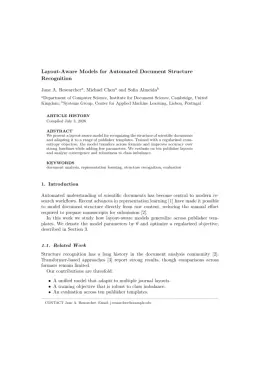
About the Briefings in Bioinformatics format
Briefings in Bioinformatics is a peer-reviewed journal published by Oxford University Press, covering Bioinformatics and Genomic Networks, Gene expression and cancer classification, Genomics and Phylogenetic Studies. Over its lifetime it has published 5,863 papers, which have received 281,578 citations.
| Publisher | Oxford University Press |
|---|
| Reference style | Numbered (OUP) Numbered — [1], [2] in the text
[1] A. Smith, B. Jones, and C. Lee, A representative article title, Briefings in Bioinformatics 12 (2023) 45–58.
Formats any DOI in the closest standard style — Briefings in Bioinformatics has no published style definition, so this is an approximation. No sign-up.
|
|---|
| Publishes research in | Bioinformatics and Genomic Networks Gene expression and cancer classification Genomics and Phylogenetic Studies Machine Learning in Bioinformatics Computational Drug Discovery Methods |
|---|
| ISSN | 1467-5463 |
|---|
| Citation impact (2-yr) | 6.5 |
|---|
| h-index | 210 |
|---|
| i10-index | 3,337 |
|---|
| Article processing charge | $4,011 |
|---|
| Open access | Yes — indexed in DOAJ |
|---|
| Top institutions publishing here | Chinese Academy of Sciences |
|---|
| Journal website | bib.oxfordjournals.org |
|---|
| You get | A submission-ready PDF and the editable LaTeX source — ready to submit. |
|---|
Papers published in Briefings in Bioinformatics per year
Citation impact of Briefings in Bioinformatics by publication year
Citations each year’s papers have accumulated so far — the most recent years are still building up.
Most-cited papers in Briefings in Bioinformatics
MEGA3: Integrated software for Molecular Evolutionary Genetics Analysis and sequence alignment
Sudhir Kumar · 1 Jan 2004
With its theoretical basis firmly established in molecular evolutionary and population genetics, the comparative DNA and protein sequence analysis plays a central role in reconstructing the evolutionary histories of species and multigene families, estimating rates of molecular evolution, and inferring the nature and extent of selective forces shaping the evolution of genes and genomes. The…
Integrative Genomics Viewer (IGV): high-performance genomics data visualization and exploration
Helga Thorvaldsdóttir, James Robinson, Jill P. Mesirov · 19 Apr 2012
Data visualization is an essential component of genomic data analysis. However, the size and diversity of the data sets produced by today's sequencing and array-based profiling methods present major challenges to visualization tools. The Integrative Genomics Viewer (IGV) is a high-performance viewer that efficiently handles large heterogeneous data sets, while providing a smooth and intuitive…
MAFFT online service: multiple sequence alignment, interactive sequence choice and visualization
Kazutaka Katoh, John Rozewicki, Kazunori Yamada · 7 Aug 2017
This article describes several features in the MAFFT online service for multiple sequence alignment (MSA). As a result of recent advances in sequencing technologies, huge numbers of biological sequences are available and the need for MSAs with large numbers of sequences is increasing. To extract biologically relevant information from such data, sophistication of algorithms is…
Recent developments in the MAFFT multiple sequence alignment program
Kazutaka Katoh, Hidehiro Toh · 27 Mar 2008
The accuracy and scalability of multiple sequence alignment (MSA) of DNAs and proteins have long been and are still important issues in bioinformatics. To rapidly construct a reasonable MSA, we developed the initial version of the MAFFT program in 2002. MSA software is now facing greater challenges in both scalability and accuracy than those of…
MEGA: A biologist-centric software for evolutionary analysis of DNA and protein sequences
Sudhir Kumar, M Nei, Joel T. Dudley et al. · 27 Mar 2008
The Molecular Evolutionary Genetics Analysis (MEGA) software is a desktop application designed for comparative analysis of homologous gene sequences either from multigene families or from different species with a special emphasis on inferring evolutionary relationships and patterns of DNA and protein evolution. In addition to the tools for statistical analysis of data, MEGA provides many…