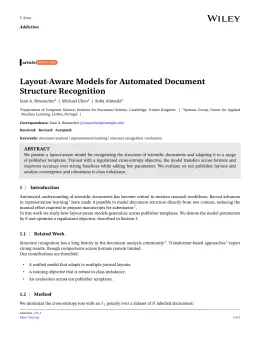
About the Clinical Infectious Diseases format
Clinical Infectious Diseases is a peer-reviewed journal published by Oxford University Press, covering Pneumonia and Respiratory Infections, HIV/AIDS Research and Interventions, Antimicrobial Resistance in Staphylococcus. Over its lifetime it has published 37,454 papers, which have received 2,163,559 citations.
| Publisher | Oxford University Press |
|---|
| Reference style | Numbered (OUP) Numbered — [1], [2] in the text
[1] A. Smith, B. Jones, and C. Lee, A representative article title, Clinical Infectious Diseases 12 (2023) 45–58.
Formats any DOI in the closest standard style — Clinical Infectious Diseases has no published style definition, so this is an approximation. No sign-up.
|
|---|
| Publishes research in | Pneumonia and Respiratory Infections HIV/AIDS Research and Interventions Antimicrobial Resistance in Staphylococcus HIV/AIDS drug development and treatment Respiratory viral infections research |
|---|
| ISSN | 1058-4838 |
|---|
| Citation impact (2-yr) | 5.32 |
|---|
| h-index | 483 |
|---|
| i10-index | 22,523 |
|---|
| Article processing charge | $4,320 |
|---|
| Top institutions publishing here | Centers for Disease Control and Prevention |
|---|
| Journal website | www.oxfordjournals.org |
|---|
| You get | A submission-ready PDF and the editable LaTeX source — ready to submit. |
|---|
Papers published in Clinical Infectious Diseases per year
Citation impact of Clinical Infectious Diseases by publication year
Citations each year’s papers have accumulated so far — the most recent years are still building up.
Most-cited papers in Clinical Infectious Diseases
Infectious Diseases Society of America/American Thoracic Society Consensus Guidelines on the Management of Community-Acquired Pneumonia in Adults
Lionel A. Mandell, Richard G. Wunderink, Antonio Anzueto et al. · 3 Feb 2007
priate starting point for consultation by specialists. Substantial overlap exists among the patients whom these guidelines address and those discussed in the recently published guidelines for health care-associated pneumonia (HCAP). Pneumonia in nonambulatory residents of nursing homes and other long-term care facilities epidemiologically mirrors hospital-acquired pneumonia and should be treated according to the HCAP guidelines.…
Dysregulation of Immune Response in Patients With Coronavirus 2019 (COVID-19) in Wuhan, China
Chuan Qin, Luo‐Qi Zhou, Ziwei Hu et al. · 6 Mar 2020
BACKGROUND: In December 2019, coronavirus 2019 (COVID-19) emerged in Wuhan and rapidly spread throughout China. METHODS: Demographic and clinical data of all confirmed cases with COVID-19 on admission at Tongji Hospital from 10 January to 12 February 2020 were collected and analyzed. The data on laboratory examinations, including peripheral lymphocyte subsets, were analyzed and compared…
Bad Bugs, No Drugs: No ESKAPE! An Update from the Infectious Diseases Society of America
Helen W. Boucher, George H. Talbot, John S. Bradley et al. · 26 Nov 2008
The Infectious Diseases Society of America (IDSA) continues to view with concern the lean pipeline for novel therapeutics to treat drug-resistant infections, especially those caused by gram-negative pathogens. Infections now occur that are resistant to all current antibacterial options. Although the IDSA is encouraged by the prospect of success for some agents currently in preclinical…
Revised Definitions of Invasive Fungal Disease from the European Organization for Research and Treatment of Cancer/Invasive Fungal Infections Cooperative Group and the National Institute of Allergy and Infectious Diseases Mycoses Study Group (EORTC/MSG) Consensus Group
Ben de Pauw, Thomas J. Walsh, J. Peter Donnelly et al. · 7 May 2008
BACKGROUND: Invasive fungal diseases are important causes of morbidity and mortality. Clarity and uniformity in defining these infections are important factors in improving the quality of clinical studies. A standard set of definitions strengthens the consistency and reproducibility of such studies. METHODS: After the introduction of the original European Organization for Research and Treatment of…
Guidelines for the Prevention of Intravascular Catheter-related Infections
Naomi P. O’Grady, Mary Alexander, Lillian A. Burns et al. · 2 Apr 2011
These guidelines have been developed for healthcare personnel who insert intravascular catheters and for persons responsible for surveillance and control of infections in hospital, outpatient, and home healthcare settings. This report was prepared by a working group comprising members from professional organizations representing the disciplines of critical care medicine, infectious diseases, healthcare infection control, surgery,…