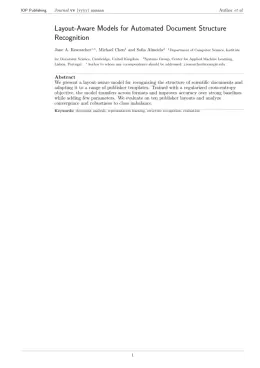
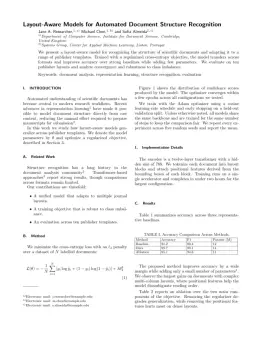
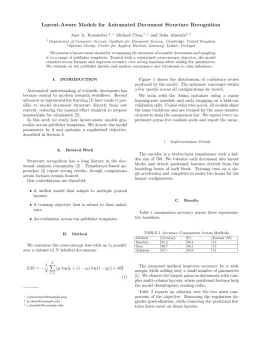
About the Classical and Quantum Gravity format
Classical and Quantum Gravity is a peer-reviewed journal published by IOP Publishing, covering Black Holes and Theoretical Physics, Cosmology and Gravitation Theories, Noncommutative and Quantum Gravity Theories. Over its lifetime it has published 16,033 papers, which have received 529,920 citations.
| Publisher | IOP Publishing |
|---|
| Reference style | Numbered (IOP) Numbered — [1], [2] in the text
[1] Smith A, Jones B and Lee C 2023 A representative article title Classical and Quantum Gravity 12 45–58
Formats any DOI in Classical and Quantum Gravity style. No sign-up.
|
|---|
| Publishes research in | Black Holes and Theoretical Physics Cosmology and Gravitation Theories Noncommutative and Quantum Gravity Theories Pulsars and Gravitational Waves Research Astrophysical Phenomena and Observations |
|---|
| ISSN | 0264-9381 |
|---|
| Citation impact (2-yr) | 3.22 |
|---|
| h-index | 242 |
|---|
| i10-index | 9,161 |
|---|
| Top institutions publishing here | Max Planck Institute for Gravitational Physics |
|---|
| Journal website | iopscience.org |
|---|
| You get | A submission-ready PDF and the editable LaTeX source — ready to submit. |
|---|
Papers published in Classical and Quantum Gravity per year
Citation impact of Classical and Quantum Gravity by publication year
Citations each year’s papers have accumulated so far — the most recent years are still building up.
Most-cited papers in Classical and Quantum Gravity
Advanced Virgo: a second-generation interferometric gravitational wave detector
F. Acernese, M. Agathos, K. Agatsuma et al. · 18 Dec 2014
Advanced Virgo is the project to upgrade the Virgo interferometric detector of gravitational waves, with the aim of increasing the number of observable galaxies (and thus the detection rate) by three orders of magnitude. The project is now in an advanced construction phase and the assembly and integration will be completed by the end of…
Advanced LIGO
J. Aasi, B. P. Abbott, R. Abbott et al. · 3 Mar 2015
The Advanced LIGO gravitational wave detectors are second-generation instruments designed and built for the two LIGO observatories in Hanford, WA and Livingston, LA, USA. The two instruments are identical in design, and are specialized versions of a Michelson interferometer with 4 km long arms. As in Initial LIGO, Fabry–Perot cavities are used in the arms…
The Einstein Telescope: a third-generation gravitational wave observatory
M. Punturo, M. R. Abernathy, F. Acernese et al. · 21 Sep 2010
Advanced gravitational wave interferometers, currently under realization, will soon permit the detection of gravitational waves from astronomical sources. To open the era of precision gravitational wave astronomy, a further substantial improvement in sensitivity is required. The future space-based Laser Interferometer Space Antenna and the third-generation ground-based observatory Einstein Telescope (ET) promise to achieve the required…
Quasinormal modes of black holes and black branes
Emanuele Berti, Vítor Cardoso, Andrei O. Starinets · 24 Jul 2009
Quasinormal modes are eigenmodes of dissipative systems. Perturbations of classical gravitational backgrounds involving black holes or branes naturally lead to quasinormal modes. The analysis and classification of the quasinormal spectra require solving non-Hermitian eigenvalue problems for the associated linear differential equations. Within the recently developed gauge-gravity duality, these modes serve as an important tool for…
TianQin: a space-borne gravitational wave detector
Jun Luo, Li-Sheng Chen, Hui-Zong Duan et al. · 12 Jan 2016
TianQin is a proposal for a space-borne detector of gravitational waves in the millihertz frequencies. The experiment relies on a constellation of three drag-free spacecraft orbiting the Earth. Inter-spacecraft laser interferometry is used to monitor the distances between the test masses. The experiment is designed to be capable of detecting a signal with high confidence…