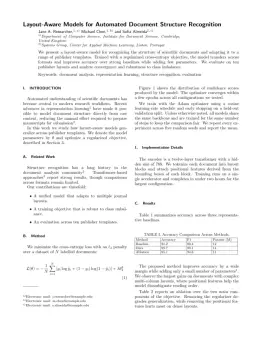
American Physical Society

Physical Review Applied Template

Write in a clean editor, then format for Physical Review Applied in one click — DocuGuru applies the official American Physical Society template with numbered references and exports a submission-ready PDF plus the editable LaTeX source. Free to start.

About the Physical Review Applied format

Physical Review Applied is a peer-reviewed journal published by American Physical Society, covering Quantum Information and Cryptography, Quantum and electron transport phenomena, Magnetic properties of thin films. Over its lifetime it has published 9,048 papers, which have received 189,757 citations.

PublisherAmerican Physical Society
Reference styleNumbered (APS)
Numbered — [1], [2] in the text
[1] A. Smith, B. Jones, and C. Lee, Physical Review Applied 12, 45 (2023).

Formats any DOI in Physical Review Applied style. No sign-up.

Publishes research inQuantum Information and Cryptography Quantum and electron transport phenomena Magnetic properties of thin films Mechanical and Optical Resonators Metamaterials and Metasurfaces Applications
ISSN2331-7019
Citation impact (2-yr)3.77
h-index134
i10-index4,759
Top institutions publishing hereCentre National de la Recherche Scientifique
Journal websitejournals.aps.org
You getA submission-ready PDF and the editable LaTeX source — ready to submit.

Papers published in Physical Review Applied per year

122
2014
208
2015
255
2016
433
2017
664
2018
927
2019
1K
2020
836
2021
929
2022
984
2023
926
2024
1.1K
2025

Citation impact of Physical Review Applied by publication year

8K
2014
11.4K
2015
12.5K
2016
17K
2017
24K
2018
31.8K
2019
27.8K
2020
17.5K
2021
15.2K
2022
13K
2023
6.8K
2024
2.7K
2025

Citations each year’s papers have accumulated so far — the most recent years are still building up.

Most-cited papers in Physical Review Applied

Recombination Kinetics in Organic-Inorganic Perovskites: Excitons, Free Charge, and Subgap States

Samuel D. Stranks, V. M. Burlakov, Tomas Leijtens et al. · 11 Sep 2014

It has been proposed that organic-inorganic perovskites may provide the ``disruptive'' technology needed to deliver widespread and affordable solar power. To reach this goal, a detailed understanding of their material properties and behavior in working devices is needed. The authors present a robust model that explains charge recombination in the presence of subgap trap states…

1,178 citations Cite SaveGo to paper →
Quantifying Losses in Open-Circuit Voltage in Solution-Processable Solar Cells

Jizhong Yao, Thomas Kirchartz, Michelle S. Vezie et al. · 28 Jul 2015

To compare and improve solar cells, merely knowing their percent efficiencies is insufficient; we need to be able to understand and quantify their different physical mechanisms of loss. The authors use the reciprocity relation between light absorption and emission to explore theoretical and practical performance limits for emerging technologies based on organics and perovskites, and…

Electromagnetic Nonreciprocity

Christophe Caloz, Andrea Alù, Sergei Tretyakov et al. · 1 Oct 2018

$N\phantom{\rule{0}{0ex}}o\phantom{\rule{0}{0ex}}n\phantom{\rule{0}{0ex}}r\phantom{\rule{0}{0ex}}e\phantom{\rule{0}{0ex}}c\phantom{\rule{0}{0ex}}i\phantom{\rule{0}{0ex}}p\phantom{\rule{0}{0ex}}r\phantom{\rule{0}{0ex}}o\phantom{\rule{0}{0ex}}c\phantom{\rule{0}{0ex}}i\phantom{\rule{0}{0ex}}t\phantom{\rule{0}{0ex}}y$ has emerged as a fundamental concept in modern science and technology. Recent advances in magnet-free nonreciprocal systems have spurred a resurgence of interest in this subject, but have also led to questions and confusion. The authors review nonreciprocity from a global, first-principles perspective, with the aim of establishing a solid foundation for the topic,…

Thin Perfect Absorbers for Electromagnetic Waves: Theory, Design, and Realizations

Younes Ra’di, Constantin Simovski, Sergei Tretyakov · 17 Mar 2015

In recent years we have learned to fabricate structures smaller than electromagnetic wavelengths, and to assemble them into metamaterials with exotic optical properties for previously unimaginable applications. One such property is perfect absorption of incident light, with no reflection or transmission, across many wavelengths. The authors review the physics, design principles, and classification of thin…

High-Cooperativity Cavity QED with Magnons at Microwave Frequencies

Maxim Goryachev, Warrick G. Farr, Daniel L. Creedon et al. · 5 Nov 2014

Magnons are quantized quasiparticles that can in principle be used in quantum computation. To implement such computations in practice, magnons must be strongly coupled with photons, which transfer information between them. In this work, the authors demonstrate extremely strong couplings using a type of multipost microwave cavity that can focus a magnetic field into submillimeter-sized…

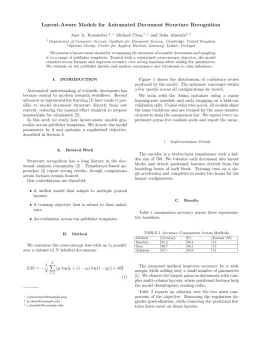
Physical Review Applied template — frequently asked questions

How do I write a paper in the Physical Review Applied format?
In DocuGuru you write your manuscript in a normal editor — no LaTeX setup required — and select the Physical Review Applied template. When you export, DocuGuru compiles the paper into the official American Physical Society format and hands you a submission-ready PDF along with the editable LaTeX source.
What reference style does Physical Review Applied use?
Physical Review Applied uses Numbered (APS) references, shown as numbered [1], [2] markers in the text. DocuGuru formats every in-text citation and the reference list in this exact style automatically. A reference appears like this: [1] A. Smith, B. Jones, and C. Lee, Physical Review Applied 12, 45 (2023).
Do I need to know LaTeX to submit to Physical Review Applied?
No. DocuGuru generates the revtex4-2 LaTeX class and compiles the PDF for you in the background, so you get a American Physical Society-ready Physical Review Applied document without writing any LaTeX. If you do want it, the LaTeX source is included in the export.
Can I import an existing draft into the Physical Review Applied template?
Yes. Paste or upload your current manuscript — Word, LaTeX, Markdown, or plain text — and DocuGuru reflows it into the Physical Review Applied format with correct headings, figures, tables, and numbered citations.
What is Physical Review Applied?
American Physical Society journal (REVTeX 4.2). It is a physics journal, published by American Physical Society.
Can I export a submission-ready Physical Review Applied PDF?
Yes — DocuGuru produces a PDF built with the official Physical Review Applied template (the revtex4-2 class) that is ready to submit to American Physical Society, together with the matching LaTeX source files.
How much does the Physical Review Applied template cost?
You can start writing in the Physical Review Applied template for free. Exporting the final submission-ready Physical Review Applied PDF and LaTeX source is part of DocuGuru's paid plans — see the app for current pricing.
Use the Physical Review Applied template