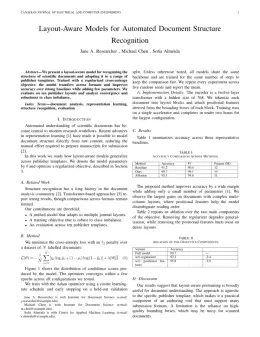
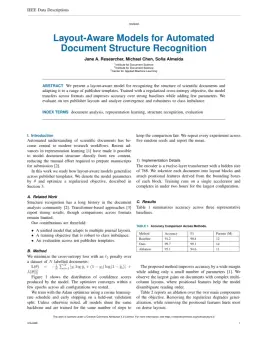
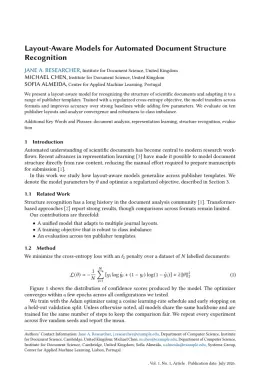
About the IEEE Transactions on Signal Processing format
IEEE Transactions on Signal Processing is a peer-reviewed journal published by IEEE, covering Blind Source Separation Techniques, Advanced Adaptive Filtering Techniques, Image and Signal Denoising Methods. Over its lifetime it has published 17,908 papers, which have received 1,004,851 citations.
| Publisher | IEEE |
|---|
| Reference style | Numbered (IEEE) Numbered — [1], [2] in the text
[1] A. Smith, B. Jones, and C. Lee, "A representative article title," IEEE Transactions on Signal Processing, vol. 12, no. 3, pp. 45–58, 2023.
Formats any DOI in IEEE Transactions on Signal Processing style. No sign-up.
|
|---|
| Abbreviation (ISO-4) | TSP |
|---|
| Publishes research in | Blind Source Separation Techniques Advanced Adaptive Filtering Techniques Image and Signal Denoising Methods Direction-of-Arrival Estimation Techniques Speech and Audio Processing |
|---|
| ISSN | 1053-587X |
|---|
| Citation impact (2-yr) | 4.89 |
|---|
| h-index | 367 |
|---|
| i10-index | 11,423 |
|---|
| Top institutions publishing here | Centre National de la Recherche Scientifique |
|---|
| Journal website | www.signalprocessingsociety.org |
|---|
| You get | A submission-ready PDF and the editable LaTeX source — ready to submit. |
|---|
Papers published in IEEE Transactions on Signal Processing per year
Citation impact of IEEE Transactions on Signal Processing by publication year
Citations each year’s papers have accumulated so far — the most recent years are still building up.
Most-cited papers in IEEE Transactions on Signal Processing
A tutorial on particle filters for online nonlinear/non-Gaussian Bayesian tracking
M.S. Arulampalam, Simon Maskell, Neil Gordon et al. · 1 Jan 2002
Increasingly, for many application areas, it is becoming important to include elements of nonlinearity and non-Gaussianity in order to model accurately the underlying dynamics of a physical system. Moreover, it is typically crucial to process data on-line as it arrives, both from the point of view of storage costs as well as for rapid adaptation…
Bidirectional recurrent neural networks
Mike Schuster, Kuldip K. Paliwal · 1 Jan 1997
In the first part of this paper, a regular recurrent neural network (RNN) is extended to a bidirectional recurrent neural network (BRNN). The BRNN can be trained without the limitation of using input information just up to a preset future frame. This is accomplished by training it simultaneously in positive and negative time direction. Structure…
$rm K$-SVD: An Algorithm for Designing Overcomplete Dictionaries for Sparse Representation
Michal Aharon, Michael Elad, Alfred M. Bruckstein⋆ · 18 Oct 2006
In recent years there has been a growing interest in the study of sparse representation of signals. Using an overcomplete dictionary that contains prototype signal-atoms, signals are described by sparse linear combinations of these atoms. Applications that use sparse representation are many and include compression, regularization in inverse problems, feature extraction, and more. Recent activity…
Matching pursuits with time-frequency dictionaries
Stéphane Mallat, Zhifeng Zhang · 1 Jan 1993
The authors introduce an algorithm, called matching pursuit, that decomposes any signal into a linear expansion of waveforms that are selected from a redundant dictionary of functions. These waveforms are chosen in order to best match the signal structures. Matching pursuits are general procedures to compute adaptive signal representations. With a dictionary of Gabor functions…
Variational Mode Decomposition
Konstantin Dragomiretskiy, Dominique Zosso · 24 Jan 2014
During the late 1990s, Huang introduced the algorithm called Empirical Mode Decomposition, which is widely used today to recursively decompose a signal into different modes of unknown but separate spectral bands. EMD is known for limitations like sensitivity to noise and sampling. These limitations could only partially be addressed by more mathematical attempts to this…