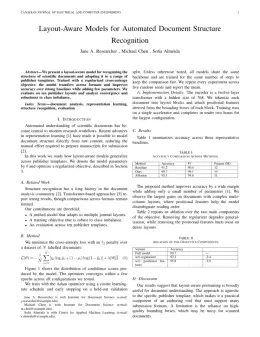
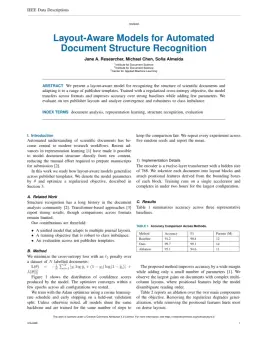
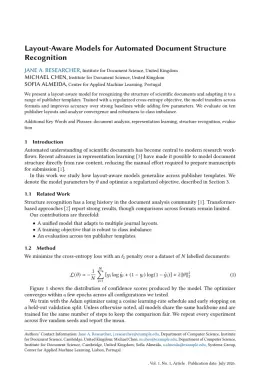
About the IEEE Transactions on Semiconductor Manufacturing format
IEEE Transactions on Semiconductor Manufacturing is a peer-reviewed journal published by IEEE, covering Industrial Vision Systems and Defect Detection, Integrated Circuits and Semiconductor Failure Analysis, Semiconductor materials and devices. Over its lifetime it has published 3,187 papers, which have received 56,109 citations.
| Publisher | IEEE |
|---|
| Reference style | Numbered (IEEE) Numbered — [1], [2] in the text
[1] A. Smith, B. Jones, and C. Lee, "A representative article title," IEEE Transactions on Semiconductor Manufacturing, vol. 12, no. 3, pp. 45–58, 2023.
Formats any DOI in IEEE Transactions on Semiconductor Manufacturing style. No sign-up.
|
|---|
| Abbreviation (ISO-4) | TSM |
|---|
| Publishes research in | Industrial Vision Systems and Defect Detection Integrated Circuits and Semiconductor Failure Analysis Semiconductor materials and devices Manufacturing Process and Optimization Advancements in Photolithography Techniques |
|---|
| ISSN | 0894-6507 |
|---|
| Citation impact (2-yr) | 1.38 |
|---|
| h-index | 102 |
|---|
| i10-index | 1,193 |
|---|
| Top institutions publishing here | Intel (United States) |
|---|
| Journal website | www.cpmt.org |
|---|
| You get | A submission-ready PDF and the editable LaTeX source — ready to submit. |
|---|
Papers published in IEEE Transactions on Semiconductor Manufacturing per year
Citation impact of IEEE Transactions on Semiconductor Manufacturing by publication year
Citations each year’s papers have accumulated so far — the most recent years are still building up.
Most-cited papers in IEEE Transactions on Semiconductor Manufacturing
Scheduling semiconductor wafer fabrication
Lawrence M. Wein · 1 Jan 1988
The impact that scheduling can have on the performance of semi-conductor wafer fabrication facilities is assessed. The performance measure considered is the mean throughput time (sometimes called cycle time, turnaround time or manufacturing interval) for a lot of wafers. A variety of input control and sequencing rules are evaluated using a simulation model of a…
Material removal mechanism in chemical mechanical polishing: theory and modeling
Jianfeng Luo, David Dornfeld · 1 May 2001
The abrasion mechanism in solid-solid contact mode of the chemical mechanical polishing (CMP) process is investigated in detail. Based on assumptions of plastic contact over wafer-abrasive and pad-abrasive interfaces, the normal distribution of abrasive size and an assumed periodic roughness of pad surface, a novel model is developed for material removal in CMP. The basic…
Fifty Years of Moore's Law
Chris A. Mack · 21 Jan 2011
The 1959 invention of the planar silicon transistor led to the development of the integrated circuit (IC) and the growth trend in IC complexity known as Moore's Law. While Moore's observation came in 1965, his original trend line showing a doubling of components per chip each year began with one component in 1959. Thus, we…
A Convolutional Neural Network for Fault Classification and Diagnosis in Semiconductor Manufacturing Processes
Ki Bum Lee, Sejune Cheon, Chang Ouk Kim · 1 Mar 2017
Many studies on the prediction of manufacturing results using sensor signals have been conducted in the field of fault detection and classification (FDC) for semiconductor manufacturing processes. However, fault diagnosis used to find clues as to root causes remains a challenging area. In particular, process monitoring using neural networks has been employed to only a…
Fault Detection Using the k-Nearest Neighbor Rule for Semiconductor Manufacturing Processes
Qin He, Jin Wang · 1 Nov 2007
It has been recognized that effective fault detection techniques can help semiconductor manufacturers reduce scrap, increase equipment uptime, and reduce the usage of test wafers. Traditional univariate statistical process control charts have long been used for fault detection. Recently, multivariate statistical fault detection methods such as principal component analysis (PCA)-based methods have drawn increasing interest…