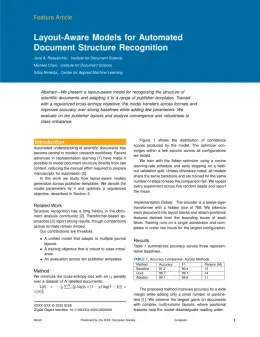
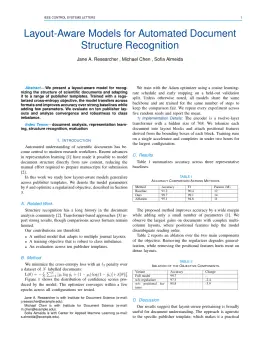
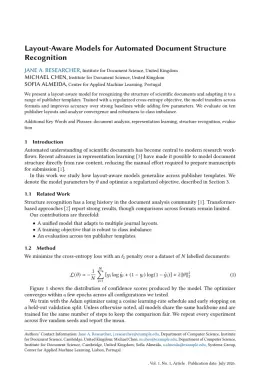
IEEE

IEEE Solid-State Circuits Magazine Template

Write in a clean editor, then format for IEEE Solid-State Circuits Magazine in one click — DocuGuru applies the official IEEE template with numbered references and exports a submission-ready PDF plus the editable LaTeX source. Free to start.

About the IEEE Solid-State Circuits Magazine format

IEEE Solid-State Circuits Magazine is a peer-reviewed journal published by IEEE, covering Diverse Scientific and Economic Studies, Educational Robotics and Engineering, Human auditory perception and evaluation. Over its lifetime it has published 2,877 papers, which have received 8,077 citations.

PublisherIEEE
Reference styleNumbered (IEEE)
Numbered — [1], [2] in the text
[1] A. Smith, B. Jones, and C. Lee, "A representative article title," IEEE Solid-State Circuits Magazine, vol. 12, no. 3, pp. 45–58, 2023.

Formats any DOI in IEEE Solid-State Circuits Magazine style. No sign-up.

Abbreviation (ISO-4)SCM
Publishes research inDiverse Scientific and Economic Studies Educational Robotics and Engineering Human auditory perception and evaluation Advancements in Semiconductor Devices and Circuit Design Ferroelectric and Negative Capacitance Devices
ISSN1943-0582
Citation impact (2-yr)0.35
h-index42
i10-index160
Top institutions publishing hereUniversity of California, Berkeley
Journal websitewww.ieeexplore.org
You getA submission-ready PDF and the editable LaTeX source — ready to submit.

Papers published in IEEE Solid-State Circuits Magazine per year

135
2014
107
2015
173
2016
178
2017
184
2018
194
2019
153
2020
184
2021
163
2022
206
2023
202
2024
209
2025

Citation impact of IEEE Solid-State Circuits Magazine by publication year

256
2014
1.4K
2015
908
2016
709
2017
526
2018
997
2019
667
2020
469
2021
272
2022
212
2023
137
2024
45
2025

Citations each year’s papers have accumulated so far — the most recent years are still building up.

Most-cited papers in IEEE Solid-State Circuits Magazine

Energy Harvesting for Autonomous Wireless Sensor Networks

Rudd Vullers, R. van Schaijk, Hubregt J. Visser et al. · 1 Jan 2010

Wireless sensor nodes (WSNs) are employed today in many different application areas, ranging from health and lifestyle to automotive, smart building, predictive maintenance (e.g., of machines and infrastructure), and active RFID tags. Currently these devices have limited lifetimes, however, since they require significant operating power. The typical power requirements of some current portable devices, including…

Emerging Memory Technologies: Recent Trends and Prospects

Shimeng Yu, Pai-Yu Chen · 1 Jan 2016

This tutorial introduces the basics of emerging nonvolatile memory (NVM) technologies including spin-transfer-torque magnetic random access memory (STTMRAM), phase-change random access memory (PCRAM), and resistive random access memory (RRAM). Emerging NVM cell characteristics are summarized, and device-level engineering trends are discussed. Emerging NVM array architectures are introduced, including the one-transistor-one-resistor (1T1R) array and the cross-point…

The StrongARM Latch [A Circuit for All Seasons]

Behzad Razavi · 1 Jan 2015

The StrongARM latch topology finds wide usage as a sense amplifier, a comparator, or simply a robust latch with high sensitivity. The term “StrongARM” commemorates the use of this circuit in Digital Equipment Corporation’s StrongARM microprocessor [1], but the basic structure was originally introduced by Toshiba’s Kobayashi et al. [2]. The StrongARM latch has become…

In-Memory Computing: Advances and Prospects

Naveen Verma, Hongyang Jia, Hossein Valavi et al. · 1 Jan 2019

IMC has the potential to address a critical and foundational challenge affecting computing platforms today -that is, the high energy and delay costs of moving data and accessing data from memory. In doing so, it takes a disruptive approach to computing systems that requires integrative research across the computing stack. This has appropriately ignited a…

Embedded Deep Neural Network Processing: Algorithmic and Processor Techniques Bring Deep Learning to IoT and Edge Devices

Marian Verhelst, Bert Moons · 1 Jan 2017

Deep learning has recently become immensely popular for image recognition, as well as for other recognition and pattern matching tasks in, e.g., speech processing, natural language processing, and so forth. The online evaluation of deep neural networks, however, comes with significant computational complexity, making it, until recently, feasible only on power-hungry server platforms in the…

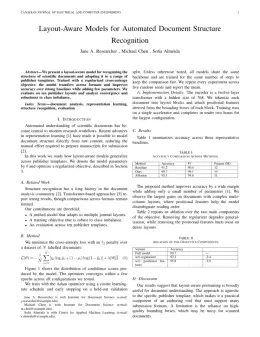
IEEE Solid-State Circuits Magazine template — frequently asked questions

How do I write a paper in the IEEE Solid-State Circuits Magazine format?
In DocuGuru you write your manuscript in a normal editor — no LaTeX setup required — and select the IEEE Solid-State Circuits Magazine template. When you export, DocuGuru compiles the paper into the official IEEE format and hands you a submission-ready PDF along with the editable LaTeX source.
What reference style does IEEE Solid-State Circuits Magazine use?
IEEE Solid-State Circuits Magazine uses Numbered (IEEE) references, shown as numbered [1], [2] markers in the text. DocuGuru formats every in-text citation and the reference list in this exact style automatically. A reference appears like this: [1] A. Smith, B. Jones, and C. Lee, "A representative article title," IEEE Solid-State Circuits Magazine, vol. 12, no. 3, pp. 45–58, 2023.
Do I need to know LaTeX to submit to IEEE Solid-State Circuits Magazine?
No. DocuGuru generates the IEEEtran LaTeX class and compiles the PDF for you in the background, so you get a IEEE-ready IEEE Solid-State Circuits Magazine document without writing any LaTeX. If you do want it, the LaTeX source is included in the export.
Can I import an existing draft into the IEEE Solid-State Circuits Magazine template?
Yes. Paste or upload your current manuscript — Word, LaTeX, Markdown, or plain text — and DocuGuru reflows it into the IEEE Solid-State Circuits Magazine format with correct headings, figures, tables, and numbered citations.
Who publishes IEEE Solid-State Circuits Magazine?
IEEE Solid-State Circuits Magazine is a engineering and computer science journal published by IEEE. DocuGuru's IEEE Solid-State Circuits Magazine template matches IEEE's official submission format.
Can I export a submission-ready IEEE Solid-State Circuits Magazine PDF?
Yes — DocuGuru produces a PDF built with the official IEEE Solid-State Circuits Magazine template (the IEEEtran class) that is ready to submit to IEEE, together with the matching LaTeX source files.
How much does the IEEE Solid-State Circuits Magazine template cost?
You can start writing in the IEEE Solid-State Circuits Magazine template for free. Exporting the final submission-ready IEEE Solid-State Circuits Magazine PDF and LaTeX source is part of DocuGuru's paid plans — see the app for current pricing.
Use the IEEE Solid-State Circuits Magazine template