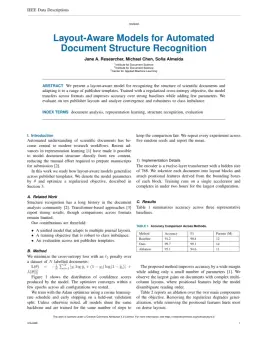
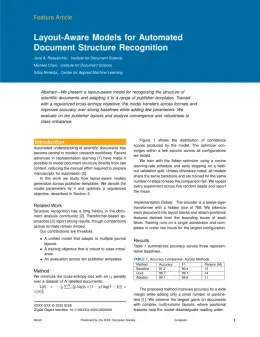
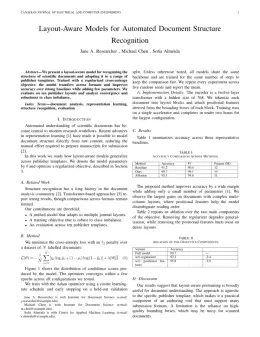
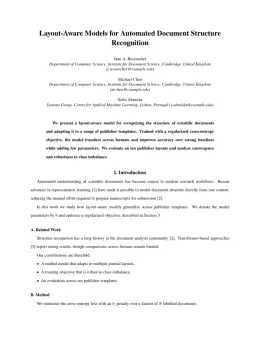
About the IEEE Robotics and Automation Letters format
IEEE Robotics and Automation Letters is a peer-reviewed journal published by IEEE, covering Robotics and Sensor-Based Localization, Robot Manipulation and Learning, Robotic Path Planning Algorithms. Over its lifetime it has published 11,175 papers, which have received 234,163 citations.
| Publisher | IEEE |
|---|
| Reference style | Numbered (IEEE) Numbered — [1], [2] in the text
[1] A. Smith, B. Jones, and C. Lee, "A representative article title," IEEE Robotics and Automation Letters, vol. 12, no. 3, pp. 45–58, 2023.
Formats any DOI in IEEE Robotics and Automation Letters style. No sign-up.
|
|---|
| Abbreviation (ISO-4) | RA-L |
|---|
| Publishes research in | Robotics and Sensor-Based Localization Robot Manipulation and Learning Robotic Path Planning Algorithms Soft Robotics and Applications Modular Robots and Swarm Intelligence |
|---|
| ISSN | 2377-3766 |
|---|
| Citation impact (2-yr) | 3.81 |
|---|
| h-index | 160 |
|---|
| i10-index | 5,342 |
|---|
| Top institutions publishing here | Harbin Institute of Technology |
|---|
| Journal website | ieeexplore.ieee.org |
|---|
| You get | A submission-ready PDF and the editable LaTeX source — ready to submit. |
|---|
Papers published in IEEE Robotics and Automation Letters per year
Citation impact of IEEE Robotics and Automation Letters by publication year
Citations each year’s papers have accumulated so far — the most recent years are still building up.
Most-cited papers in IEEE Robotics and Automation Letters
DynaSLAM: Tracking, Mapping, and Inpainting in Dynamic Scenes
Berta Bescos, Jose M. Facil, Javier Civera et al. · 26 Jul 2018
The assumption of scene rigidity is typical in SLAM algorithms. Such a strong assumption limits the use of most visual SLAM systems in populated real-world environments, which are the target of several relevant applications like service robotics or autonomous vehicles. In this letter we present DynaSLAM, a visual SLAM system that, building on ORB-SLAM2, adds…
FAST-LIO: A Fast, Robust LiDAR-Inertial Odometry Package by Tightly-Coupled Iterated Kalman Filter
Wei Xu, Fu Zhang · 8 Mar 2021
This letter presents a computationally efficient and robust LiDAR-inertial odometry framework. We fuse LiDAR feature points with IMU data using a tightly-coupled iterated extended Kalman filter to allow robust navigation in fast-motion, noisy or cluttered environments where degeneration occurs. To lower the computation load in the presence of a large number of measurements, we present…
Visual-Inertial Monocular SLAM With Map Reuse
Raul Mur-Artal, Juan D. Tardós · 17 Jan 2017
In recent years there have been excellent results in visual-inertial odometry techniques, which aim to compute the incremental motion of the sensor with high accuracy and robustness. However, these approaches lack the capability to close loops and trajectory estimation accumulates drift even if the sensor is continually revisiting the same place. In this letter, we…
A Machine Learning Approach to Visual Perception of Forest Trails for Mobile Robots
Alessandro Giusti, Jérôme Guzzi, Dan Cireşan et al. · 17 Dec 2015
We study the problem of perceiving forest or mountain trails from a single monocular image acquired from the viewpoint of a robot traveling on the trail itself. Previous literature focused on trail segmentation, and used low-level features such as image saliency or appearance contrast; we propose a different approach based on a deep neural network…
Robust and Efficient Quadrotor Trajectory Generation for Fast Autonomous Flight
Boyu Zhou, Fei Gao, Luqi Wang et al. · 10 Jul 2019
In this letter, we propose a robust and efficient quadrotor motion planning system for fast flight in three-dimensional complex environments. We adopt a kinodynamic path searching method to find a safe, kinodynamic feasible, and minimum-time initial trajectory in the discretized control space. We improve the smoothness and clearance of the trajectory by a B-spline optimization,…