IEEE

IEEE Journal on Selected Areas in Information Theory Template

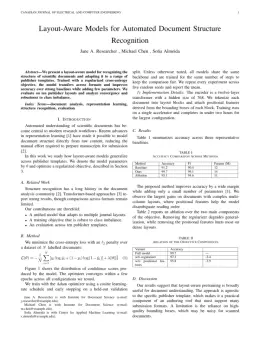
Write in a clean editor, then format for IEEE Journal on Selected Areas in Information Theory in one click — DocuGuru applies the official IEEE template with numbered references and exports a submission-ready PDF plus the editable LaTeX source. Free to start.

About the IEEE Journal on Selected Areas in Information Theory format

IEEE Journal on Selected Areas in Information Theory is a peer-reviewed journal published by IEEE, covering Wireless Communication Security Techniques, Stochastic Gradient Optimization Techniques, Error Correcting Code Techniques.

PublisherIEEE
Reference styleNumbered (IEEE)
Numbered — [1], [2] in the text
[1] A. Smith, B. Jones, and C. Lee, "A representative article title," IEEE Journal on Selected Areas in Information Theory, vol. 12, no. 3, pp. 45–58, 2023.

Formats any DOI in IEEE Journal on Selected Areas in Information Theory style. No sign-up.

Publishes research inWireless Communication Security Techniques Stochastic Gradient Optimization Techniques Error Correcting Code Techniques Privacy-Preserving Technologies in Data Cryptography and Data Security
ISSN2641-8770
Citation impact (2-yr)2.14
h-index34
i10-index116
Total citations5,321
Top institutions publishing hereStanford University
You getA submission-ready PDF and the editable LaTeX source — ready to submit.

Papers published in IEEE Journal on Selected Areas in Information Theory per year

3
2019
82
2020
108
2021
83
2022
65
2023
56
2024
39
2025

Citation impact of IEEE Journal on Selected Areas in Information Theory by publication year

20
2019
2.1K
2020
1.4K
2021
881
2022
544
2023
209
2024
40
2025

Citations each year’s papers have accumulated so far — the most recent years are still building up.

Most-cited papers in IEEE Journal on Selected Areas in Information Theory

Deep Learning Techniques for Inverse Problems in Imaging

Greg Ongie, Ajil Jalal, Christopher A. Metzler et al. · 1 May 2020

Recent work in machine learning shows that deep neural networks can be used to solve a wide variety of inverse problems arising in computational imaging. We explore the central prevailing themes of this emerging area and present a taxonomy that can be used to categorize different problems and reconstruction methods. Our taxonomy is organized along…

DeepJSCC-<i>f</i>: Deep Joint Source-Channel Coding of Images With Feedback

David Burth Kurka, Denız Gündüz · 14 Apr 2020

We consider wireless transmission of images in the presence of channel output feedback. From a Shannon theoretic perspective feedback does not improve the asymptotic end-to-end performance, and separate source coding followed by capacity-achieving channel coding, which ignores the feedback signal, achieves the optimal performance. It is well known that separation is not optimal in the…

Turbo-Aggregate: Breaking the Quadratic Aggregation Barrier in Secure Federated Learning

Jinhyun So, Başak Güler, A. Salman Avestimehr · 26 Jan 2021

Federated learning is a distributed framework for training machine learning models over the data residing at mobile devices, while protecting the privacy of individual users. A major bottleneck in scaling federated learning to a large number of users is the overhead of secure model aggregation across many users. In particular, the overhead of the state-of-the-art…

Toward Moderate Overparameterization: Global Convergence Guarantees for Training Shallow Neural Networks

Samet Oymak, Mahdi Soltanolkotabi · 29 Apr 2020

Many modern neural network architectures are trained in an overparameterized regime where the parameters of the model exceed the size of the training dataset. Sufficiently overparameterized neural network architectures in principle have the capacity to fit any set of labels including random noise. However, given the highly nonconvex nature of the training landscape it is…

Sequential (Quickest) Change Detection: Classical Results and New Directions

Liyan Xie, Shaofeng Zou, Yao Xie et al. · 14 Apr 2021

Online detection of changes in stochastic systems, referred to as sequential change detection or quickest change detection, is an important research topic in statistics, signal processing, and information theory, and has a wide range of applications. This survey starts with the basics of sequential change detection, and then moves on to generalizations and extensions of…

IEEE Journal on Selected Areas in Information Theory template — frequently asked questions

How do I write a paper in the IEEE Journal on Selected Areas in Information Theory format?
In DocuGuru you write your manuscript in a normal editor — no LaTeX setup required — and select the IEEE Journal on Selected Areas in Information Theory template. When you export, DocuGuru compiles the paper into the official IEEE format and hands you a submission-ready PDF along with the editable LaTeX source.
What reference style does IEEE Journal on Selected Areas in Information Theory use?
IEEE Journal on Selected Areas in Information Theory uses Numbered (IEEE) references, shown as numbered [1], [2] markers in the text. DocuGuru formats every in-text citation and the reference list in this exact style automatically. A reference appears like this: [1] A. Smith, B. Jones, and C. Lee, "A representative article title," IEEE Journal on Selected Areas in Information Theory, vol. 12, no. 3, pp. 45–58, 2023.
Do I need to know LaTeX to submit to IEEE Journal on Selected Areas in Information Theory?
No. DocuGuru generates the IEEEtran LaTeX class and compiles the PDF for you in the background, so you get a IEEE-ready IEEE Journal on Selected Areas in Information Theory document without writing any LaTeX. If you do want it, the LaTeX source is included in the export.
Can I import an existing draft into the IEEE Journal on Selected Areas in Information Theory template?
Yes. Paste or upload your current manuscript — Word, LaTeX, Markdown, or plain text — and DocuGuru reflows it into the IEEE Journal on Selected Areas in Information Theory format with correct headings, figures, tables, and numbered citations.
Who publishes IEEE Journal on Selected Areas in Information Theory?
IEEE Journal on Selected Areas in Information Theory is a engineering and computer science journal published by IEEE. DocuGuru's IEEE Journal on Selected Areas in Information Theory template matches IEEE's official submission format.
Can I export a submission-ready IEEE Journal on Selected Areas in Information Theory PDF?
Yes — DocuGuru produces a PDF built with the official IEEE Journal on Selected Areas in Information Theory template (the IEEEtran class) that is ready to submit to IEEE, together with the matching LaTeX source files.
How much does the IEEE Journal on Selected Areas in Information Theory template cost?
You can start writing in the IEEE Journal on Selected Areas in Information Theory template for free. Exporting the final submission-ready IEEE Journal on Selected Areas in Information Theory PDF and LaTeX source is part of DocuGuru's paid plans — see the app for current pricing.

Use the IEEE Journal on Selected Areas in Information Theory template