IEEE

IEEE Journal of Indoor and Seamless Positioning and Navigation Template

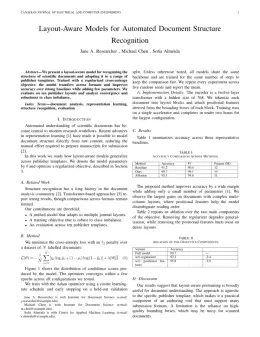
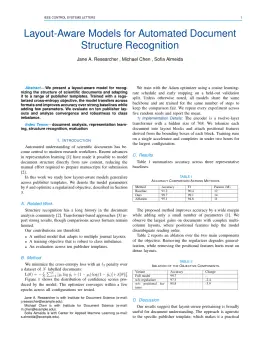
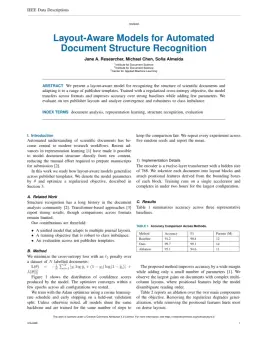
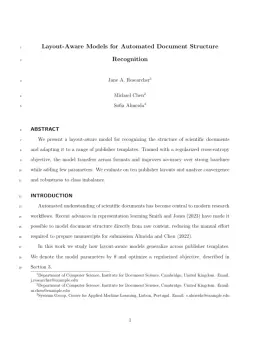
Write in a clean editor, then format for IEEE Journal of Indoor and Seamless Positioning and Navigation in one click — DocuGuru applies the official IEEE template with numbered references and exports a submission-ready PDF plus the editable LaTeX source. Free to start.

About the IEEE Journal of Indoor and Seamless Positioning and Navigation format

IEEE Journal of Indoor and Seamless Positioning and Navigation is a peer-reviewed journal published by IEEE, covering Indoor and Outdoor Localization Technologies, GNSS positioning and interference, Robotics and Sensor-Based Localization. Over its lifetime it has published 100 papers, which have received 357 citations.

PublisherIEEE
Reference styleNumbered (IEEE)
Numbered — [1], [2] in the text
[1] A. Smith, B. Jones, and C. Lee, "A representative article title," IEEE Journal of Indoor and Seamless Positioning and Navigation, vol. 12, no. 3, pp. 45–58, 2023.

Formats any DOI in IEEE Journal of Indoor and Seamless Positioning and Navigation style. No sign-up.

Publishes research inIndoor and Outdoor Localization Technologies GNSS positioning and interference Robotics and Sensor-Based Localization Underwater Vehicles and Communication Systems Speech and Audio Processing
ISSN2832-7322
Citation impact (2-yr)2.19
h-index9
i10-index9
Open accessYes — indexed in DOAJ
Top institutions publishing hereFraunhofer Institute for Integrated Circuits
You getA submission-ready PDF and the editable LaTeX source — ready to submit.

Papers published in IEEE Journal of Indoor and Seamless Positioning and Navigation per year

3
2022
28
2023
27
2024
28
2025

Citation impact of IEEE Journal of Indoor and Seamless Positioning and Navigation by publication year

0
2022
202
2023
109
2024
31
2025

Citations each year’s papers have accumulated so far — the most recent years are still building up.

Most-cited papers in IEEE Journal of Indoor and Seamless Positioning and Navigation

Bidirectional UWB Localization: A Review on an Elastic Positioning Scheme for GNSS-Deprived Zones

Cung Lian Sang, Michael Adams, Marc Hesse et al. · 1 Jan 2023

A bidirectional Ultra-Wideband (UWB) localization scheme is one of the three widely adopted design integration processes commonly used in time-based UWB positioning systems. The key property of bidirectional UWB localization is its ability to serve both navigation and tracking tasks within a single localization scheme on demand. Traditionally, navigation and tracking in wireless localization systems…

STELLAR: Siamese Multiheaded Attention Neural Networks for Overcoming Temporal Variations and Device Heterogeneity With Indoor Localization

Danish Gufran, Saideep Tiku, Sudeep Pasricha · 1 Jan 2023

Smartphone-based indoor localization has emerged as a cost-effective and accurate solution to localize mobile and IoT devices indoors. However, the challenges of device heterogeneity and temporal variations have hindered its widespread adoption and accuracy. Towards jointly addressing these challenges comprehensively, we propose STELLAR, a novel framework implementing a contrastive learning approach that leverages a Siamese…

Radar-Based Millimeter-Wave Sensing for Accurate 3-D Indoor Positioning: Potentials and Challenges

Andrey Sesyuk, Stelios Ioannou, Marios Raspopoulos · 1 Jan 2024

The 3D nature of modern smart applications has imposed significant 3D positioning accuracy requirements, especially in indoor environments. However, a major limitation of most existing indoor localization systems is their focus on estimating positions mainly in the horizontal plane, overlooking the crucial vertical dimension. This neglect presents considerable challenges in accurately determining the 3D position…

An Experimental Evaluation Based on Direction Finding Specification for Indoor Localization and Proximity Detection

Michele Girolami, Fabio Mavilia, Francesco Furfari et al. · 20 Dec 2023

Radio-frequency technologies have been largely explored to deliver reliable indoor localization systems. However, at the current stage, none of the proposed technologies represent a de-facto standard. Although RSS-based (Received Signal Strength) techniques have been extensively studied, they suffer of a number of side-effects mainly caused by the complexity of radio propagation in indoor environments. A…

Velocity-Based Channel Charting With Spatial Distribution Map Matching

Maximilian Stahlke, George Yammine, Tobias Feigl et al. · 1 Jan 2024

Radio fingerprinting (FP) technologies improve localization performance in challenging non-line-of-sight environments. However, FP is expensive as its life cycle management requires recording reference signals for initial training and when the environment changes. Instead, novel channel charting technologies are significantly cheaper. Because they implicitly assign relative coordinates to radio signals, they require few reference coordinates for…

IEEE Journal of Indoor and Seamless Positioning and Navigation template — frequently asked questions

How do I write a paper in the IEEE Journal of Indoor and Seamless Positioning and Navigation format?
In DocuGuru you write your manuscript in a normal editor — no LaTeX setup required — and select the IEEE Journal of Indoor and Seamless Positioning and Navigation template. When you export, DocuGuru compiles the paper into the official IEEE format and hands you a submission-ready PDF along with the editable LaTeX source.
What reference style does IEEE Journal of Indoor and Seamless Positioning and Navigation use?
IEEE Journal of Indoor and Seamless Positioning and Navigation uses Numbered (IEEE) references, shown as numbered [1], [2] markers in the text. DocuGuru formats every in-text citation and the reference list in this exact style automatically. A reference appears like this: [1] A. Smith, B. Jones, and C. Lee, "A representative article title," IEEE Journal of Indoor and Seamless Positioning and Navigation, vol. 12, no. 3, pp. 45–58, 2023.
Do I need to know LaTeX to submit to IEEE Journal of Indoor and Seamless Positioning and Navigation?
No. DocuGuru generates the ieeecolor LaTeX class and compiles the PDF for you in the background, so you get a IEEE-ready IEEE Journal of Indoor and Seamless Positioning and Navigation document without writing any LaTeX. If you do want it, the LaTeX source is included in the export.
Can I import an existing draft into the IEEE Journal of Indoor and Seamless Positioning and Navigation template?
Yes. Paste or upload your current manuscript — Word, LaTeX, Markdown, or plain text — and DocuGuru reflows it into the IEEE Journal of Indoor and Seamless Positioning and Navigation format with correct headings, figures, tables, and numbered citations.
What is IEEE Journal of Indoor and Seamless Positioning and Navigation?
IEEE Journal of Indoor and Seamless Positioning and Navigation, published by IEEE. It is a engineering and computer science journal, published by IEEE.
Can I export a submission-ready IEEE Journal of Indoor and Seamless Positioning and Navigation PDF?
Yes — DocuGuru produces a PDF built with the official IEEE Journal of Indoor and Seamless Positioning and Navigation template (the ieeecolor class) that is ready to submit to IEEE, together with the matching LaTeX source files.
How much does the IEEE Journal of Indoor and Seamless Positioning and Navigation template cost?
You can start writing in the IEEE Journal of Indoor and Seamless Positioning and Navigation template for free. Exporting the final submission-ready IEEE Journal of Indoor and Seamless Positioning and Navigation PDF and LaTeX source is part of DocuGuru's paid plans — see the app for current pricing.
Use the IEEE Journal of Indoor and Seamless Positioning and Navigation template