IEEE

IEEE/ACM Transactions on Audio Speech and Language Processing Template

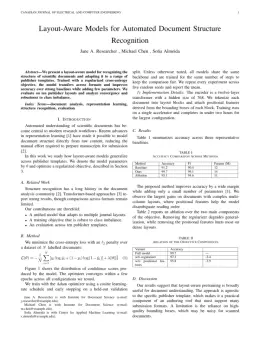
Write in a clean editor, then format for IEEE/ACM Transactions on Audio Speech and Language Processing in one click — DocuGuru applies the official IEEE template with numbered references and exports a submission-ready PDF plus the editable LaTeX source. Free to start.

About the IEEE/ACM Transactions on Audio Speech and Language Processing format

IEEE/ACM Transactions on Audio Speech and Language Processing is a peer-reviewed journal published by IEEE, covering Speech and Audio Processing, Speech Recognition and Synthesis, Music and Audio Processing.

PublisherIEEE
Reference styleNumbered (IEEE)
Numbered — [1], [2] in the text
[1] A. Smith, B. Jones, and C. Lee, "A representative article title," IEEE/ACM Transactions on Audio Speech and Language Processing, vol. 12, no. 3, pp. 45–58, 2023.

Formats any DOI in IEEE/ACM Transactions on Audio Speech and Language Processing style. No sign-up.

Publishes research inSpeech and Audio Processing Speech Recognition and Synthesis Music and Audio Processing Advanced Adaptive Filtering Techniques Topic Modeling
ISSN2329-9290
Citation impact (2-yr)10.7
h-index113
i10-index1,788
Total citations92,465
Top institutions publishing hereChinese Academy of Sciences
Journal websitedl.acm.org
You getA submission-ready PDF and the editable LaTeX source — ready to submit.

Papers published in IEEE/ACM Transactions on Audio Speech and Language Processing per year

30
2013
301
2014
325
2015
312
2016
313
2017
297
2018
234
2019
256
2020
284
2021
266
2022
341
2023
304
2024

Citation impact of IEEE/ACM Transactions on Audio Speech and Language Processing by publication year

1.1K
2013
13.4K
2014
9.7K
2015
9.1K
2016
9.8K
2017
8.2K
2018
8.9K
2019
9.1K
2020
8.4K
2021
5K
2022
5.9K
2023
3.2K
2024

Citations each year’s papers have accumulated so far — the most recent years are still building up.

Most-cited papers in IEEE/ACM Transactions on Audio Speech and Language Processing

Convolutional Neural Networks for Speech Recognition

Ossama Abdel‐Hamid, Abdelrahman Mohamed, Hui Jiang et al. · 16 Jul 2014

Recently, the hybrid deep neural network (DNN)-hidden Markov model (HMM) has been shown to significantly improve speech recognition performance over the conventional Gaussian mixture model (GMM)-HMM. The performance improvement is partially attributed to the ability of the DNN to model complex correlations in speech features. In this paper, we show that further error rate reduction…

2,287 citations Cite SaveGo to paper →
Conv-TasNet: Surpassing Ideal Time–Frequency Magnitude Masking for Speech Separation

Yi Luo, Nima Mesgarani · 7 May 2019

Single-channel, speaker-independent speech separation methods have recently seen great progress. However, the accuracy, latency, and computational cost of such methods remain insufficient. The majority of the previous methods have formulated the separation problem through the time-frequency representation of the mixed signal, which has several drawbacks, including the decoupling of the phase and magnitude of the…

2,056 citations Cite SaveGo to paper →
Supervised Speech Separation Based on Deep Learning: An Overview

DeLiang Wang, Jitong Chen · 30 May 2018

Speech separation is the task of separating target speech from background interference. Traditionally, speech separation is studied as a signal processing problem. A more recent approach formulates speech separation as a supervised learning problem, where the discriminative patterns of speech, speakers, and background noise are learned from training data. Over the past decade, many supervised…

1,560 citations Cite SaveGo to paper →
A Regression Approach to Speech Enhancement Based on Deep Neural Networks

Yong Xu, Jun Du, Li-Rong Dai et al. · 21 Oct 2014

In contrast to the conventional minimum mean square error (MMSE)-based noise reduction techniques, we propose a supervised method to enhance speech by means of finding a mapping function between noisy and clean speech signals based on deep neural networks (DNNs). In order to be able to handle a wide range of additive noises in real-world…

1,416 citations Cite SaveGo to paper →
PANNs: Large-Scale Pretrained Audio Neural Networks for Audio Pattern Recognition

Qiuqiang Kong, Yin Cao, Turab Iqbal et al. · 1 Jan 2020

Audio pattern recognition is an important research topic in the machine learning area, and includes several tasks such as audio tagging, acoustic scene classification, music classification, speech emotion classification and sound event detection. Recently, neural networks have been applied to tackle audio pattern recognition problems. However, previous systems are built on specific datasets with limited…

1,159 citations Cite SaveGo to paper →

IEEE/ACM Transactions on Audio Speech and Language Processing template — frequently asked questions

How do I write a paper in the IEEE/ACM Transactions on Audio Speech and Language Processing format?
In DocuGuru you write your manuscript in a normal editor — no LaTeX setup required — and select the IEEE/ACM Transactions on Audio Speech and Language Processing template. When you export, DocuGuru compiles the paper into the official IEEE format and hands you a submission-ready PDF along with the editable LaTeX source.
What reference style does IEEE/ACM Transactions on Audio Speech and Language Processing use?
IEEE/ACM Transactions on Audio Speech and Language Processing uses Numbered (IEEE) references, shown as numbered [1], [2] markers in the text. DocuGuru formats every in-text citation and the reference list in this exact style automatically. A reference appears like this: [1] A. Smith, B. Jones, and C. Lee, "A representative article title," IEEE/ACM Transactions on Audio Speech and Language Processing, vol. 12, no. 3, pp. 45–58, 2023.
Do I need to know LaTeX to submit to IEEE/ACM Transactions on Audio Speech and Language Processing?
No. DocuGuru generates the IEEEtran LaTeX class and compiles the PDF for you in the background, so you get a IEEE-ready IEEE/ACM Transactions on Audio Speech and Language Processing document without writing any LaTeX. If you do want it, the LaTeX source is included in the export.
Can I import an existing draft into the IEEE/ACM Transactions on Audio Speech and Language Processing template?
Yes. Paste or upload your current manuscript — Word, LaTeX, Markdown, or plain text — and DocuGuru reflows it into the IEEE/ACM Transactions on Audio Speech and Language Processing format with correct headings, figures, tables, and numbered citations.
Who publishes IEEE/ACM Transactions on Audio Speech and Language Processing?
IEEE/ACM Transactions on Audio Speech and Language Processing is a engineering and computer science journal published by IEEE. DocuGuru's IEEE/ACM Transactions on Audio Speech and Language Processing template matches IEEE's official submission format.
Can I export a submission-ready IEEE/ACM Transactions on Audio Speech and Language Processing PDF?
Yes — DocuGuru produces a PDF built with the official IEEE/ACM Transactions on Audio Speech and Language Processing template (the IEEEtran class) that is ready to submit to IEEE, together with the matching LaTeX source files.
How much does the IEEE/ACM Transactions on Audio Speech and Language Processing template cost?
You can start writing in the IEEE/ACM Transactions on Audio Speech and Language Processing template for free. Exporting the final submission-ready IEEE/ACM Transactions on Audio Speech and Language Processing PDF and LaTeX source is part of DocuGuru's paid plans — see the app for current pricing.
Use the IEEE/ACM Transactions on Audio Speech and Language Processing template