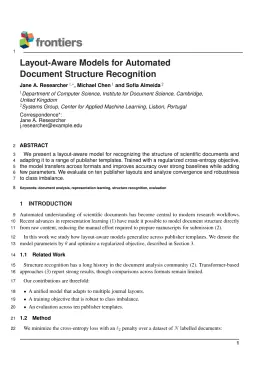
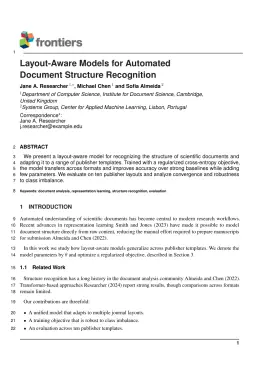
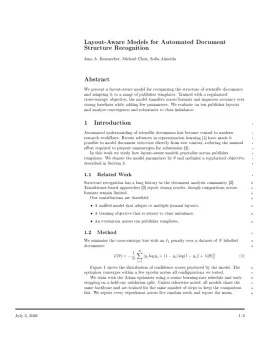
Frontiers

Frontiers in Child and Adolescent Psychiatry Template

Write in a clean editor, then format for Frontiers in Child and Adolescent Psychiatry in one click — DocuGuru applies the official Frontiers template with numbered references and exports a submission-ready PDF plus the editable LaTeX source. Free to start.

About the Frontiers in Child and Adolescent Psychiatry format

Frontiers in Child and Adolescent Psychiatry is a peer-reviewed journal published by Frontiers, covering Child and Adolescent Psychosocial and Emotional Development, Autism Spectrum Disorder Research, Attention Deficit Hyperactivity Disorder. Over its lifetime it has published 286 papers, which have received 805 citations.

PublisherFrontiers
Reference styleNumbered (Vancouver)
Numbered — [1], [2] in the text
1. Smith A, Jones B, Lee C. A representative article title. Frontiers in Child and Adolescent Psychiatry. 2023;12(3):45–58.

Formats any DOI in Frontiers in Child and Adolescent Psychiatry style. No sign-up.

Publishes research inChild and Adolescent Psychosocial and Emotional Development Autism Spectrum Disorder Research Attention Deficit Hyperactivity Disorder Family and Disability Support Research Child Nutrition and Feeding Issues
ISSN2813-4540
Citation impact (2-yr)2.1
h-index12
i10-index20
Open accessYes — indexed in DOAJ
Top institutions publishing hereManchester Metropolitan University
You getA submission-ready PDF and the editable LaTeX source — ready to submit.

Papers published in Frontiers in Child and Adolescent Psychiatry per year

9
2022
64
2023
69
2024
75
2025

Citation impact of Frontiers in Child and Adolescent Psychiatry by publication year

33
2022
316
2023
261
2024
138
2025

Citations each year’s papers have accumulated so far — the most recent years are still building up.

Most-cited papers in Frontiers in Child and Adolescent Psychiatry

Alternative psychopharmacologic treatments for pediatric catatonia: a retrospective analysis

Joshua R. Smith, Isaac Baldwin, Tasia York et al. · 20 Jun 2023

Introduction Pediatric catatonia is a highly co-morbid condition with treatment options often limited to electroconvulsive therapy (ECT) or lorazepam. However, lorazepam may not be readily available, and access to ECT is limited by restrictive legislation and stigma. This study aims to provide alternative treatment options for pediatric catatonia. Methods The study involved a single-site retrospective…

Psychological effects of psychedelics in adolescents

Nadhrah Izmi, Robin Carhart‐Harris, Hannes Kettner · 7 Jun 2024

This study aimed to investigate differences in long-term psychological effects, acute subjective effects, and side effects associated with psychedelic use in adolescents (aged 16–24), compared with adults (aged 25+). Data from two observational online survey cohorts was pooled, involving adolescents (average age 20.4 ± 2.2, N = 435) and adults (average age 36.5 ± 9.7,…

Physical activity and its benefits on adolescents' mental health through self-esteem

Catherine Laurier, Katherine Pascuzzo, Vicky Jubinville et al. · 16 Dec 2024

Background: Since the onset of the COVID-19 pandemic, the scientific community has been concerned about the high rates of psychological distress among adolescents. The pandemic not only tested adolescents' adaptation, but also disrupted key areas of their development. This demonstrates the need to study their psychological adjustment over time during this critical period to better…

Meaning making and fostering radical hope: applying positive psychology to eco-anxiety research in youth

Catherine Malboeuf‐Hurtubise, Terra Léger‐Goodes, Catherine M. Herba et al. · 27 Feb 2024

The consequences of human activity on climate change are increasingly apparent. For example, they are causing ecological degradation and affecting human and animal health. Rightly so, it is considered as the most important challenge of this century. Researchers in psychology and mental health developed an interest in the direct and indirect effects of climate and…

Cure for tantrums? Longitudinal associations between parental digital emotion regulation and children's self-regulatory skills

Veronika Konok, Marie-Andrée Binet, Á. Korom et al. · 28 Jun 2024

Introduction: Parents often use digital devices to regulate their children's negative emotions, e.g., to stop tantrums. However, this could hinder child development of self-regulatory skills. The objective of the study was to observe bidirectional longitudinal associations between parents' reliance on digital devices to regulate their child's emotions and self-regulatory tendencies (anger/frustration management, effortful control, impulsivity).…

Frontiers in Child and Adolescent Psychiatry template — frequently asked questions

How do I write a paper in the Frontiers in Child and Adolescent Psychiatry format?
In DocuGuru you write your manuscript in a normal editor — no LaTeX setup required — and select the Frontiers in Child and Adolescent Psychiatry template. When you export, DocuGuru compiles the paper into the official Frontiers format and hands you a submission-ready PDF along with the editable LaTeX source.
What reference style does Frontiers in Child and Adolescent Psychiatry use?
Frontiers in Child and Adolescent Psychiatry uses Numbered (Vancouver) references, shown as numbered [1], [2] markers in the text. DocuGuru formats every in-text citation and the reference list in this exact style automatically. A reference appears like this: 1. Smith A, Jones B, Lee C. A representative article title. Frontiers in Child and Adolescent Psychiatry. 2023;12(3):45–58.
Do I need to know LaTeX to submit to Frontiers in Child and Adolescent Psychiatry?
No. DocuGuru generates the FrontiersinVancouver LaTeX class and compiles the PDF for you in the background, so you get a Frontiers-ready Frontiers in Child and Adolescent Psychiatry document without writing any LaTeX. If you do want it, the LaTeX source is included in the export.
Can I import an existing draft into the Frontiers in Child and Adolescent Psychiatry template?
Yes. Paste or upload your current manuscript — Word, LaTeX, Markdown, or plain text — and DocuGuru reflows it into the Frontiers in Child and Adolescent Psychiatry format with correct headings, figures, tables, and numbered citations.
What is Frontiers in Child and Adolescent Psychiatry?
Frontiers journal. It is a life sciences and medicine journal, published by Frontiers.
Can I export a submission-ready Frontiers in Child and Adolescent Psychiatry PDF?
Yes — DocuGuru produces a PDF built with the official Frontiers in Child and Adolescent Psychiatry template (the FrontiersinVancouver class) that is ready to submit to Frontiers, together with the matching LaTeX source files.
How much does the Frontiers in Child and Adolescent Psychiatry template cost?
You can start writing in the Frontiers in Child and Adolescent Psychiatry template for free. Exporting the final submission-ready Frontiers in Child and Adolescent Psychiatry PDF and LaTeX source is part of DocuGuru's paid plans — see the app for current pricing.
Use the Frontiers in Child and Adolescent Psychiatry template