Frontiers

Frontiers in Sensors Template

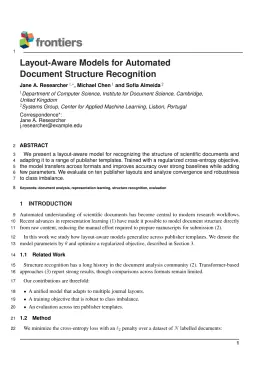
Write in a clean editor, then format for Frontiers in Sensors in one click — DocuGuru applies the official Frontiers template with author–year references and exports a submission-ready PDF plus the editable LaTeX source. Free to start.

About the Frontiers in Sensors format

Frontiers in Sensors is a peer-reviewed journal published by Frontiers, covering Advanced Chemical Sensor Technologies, Biosensors and Analytical Detection, Advanced biosensing and bioanalysis techniques. Over its lifetime it has published 144 papers, which have received 1,556 citations.

PublisherFrontiers
Reference styleAuthor–year (Harvard)
Author–year — (Smith, 2023) in the text
Smith, A., Jones, B. and Lee, C. (2023) 'A representative article title', Frontiers in Sensors, 12(3), pp. 45–58.

Formats any DOI in Frontiers in Sensors style. No sign-up.

Publishes research inAdvanced Chemical Sensor Technologies Biosensors and Analytical Detection Advanced biosensing and bioanalysis techniques Electrochemical sensors and biosensors Advanced Sensor and Energy Harvesting Materials
ISSN2673-5067
Citation impact (2-yr)1.98
h-index18
i10-index36
Article processing charge$1,900
Open accessYes — indexed in DOAJ
Top institutions publishing hereUniversidade de São Paulo
Journal websitewww.frontiersin.org
You getA submission-ready PDF and the editable LaTeX source — ready to submit.

Papers published in Frontiers in Sensors per year

3
2014
7
2020
17
2021
46
2022
14
2023
15
2024
27
2025

Citation impact of Frontiers in Sensors by publication year

3
2014
207
2020
669
2021
438
2022
105
2023
55
2024
46
2025

Citations each year’s papers have accumulated so far — the most recent years are still building up.

Most-cited papers in Frontiers in Sensors

Review: Influences of Semiconductor Metal Oxide Properties on Gas Sensing Characteristics

Bilge Saruhan, Roussin Lontio Fomekong, Svitlana Nahirniak · 20 Apr 2021

Semiconductor metal oxides (SMOxs) are widely used in gas sensors due to their excellent sensing properties, abundance, and ease of manufacture. The best examples of these sensing materials are SnO 2 and TiO 2 that have wide band gap and offer unique set of functional properties; the most important of which are electrical conductivity and…

Isothermal Amplification of Nucleic Acids: The Race for the Next “Gold Standard”

Beatriz B P P Oliveira, Bruno Veigas, Pedro V. Baptista · 28 Sep 2021

Nucleic acid amplification technologies (NAATs) have become fundamental tools in molecular diagnostics, due to their ability to detect small amounts of target molecules. Since its development, Polymerase Chain Reaction (PCR) has been the most exploited method, being stablished as the “gold standard” technique for DNA amplification. However, the requirement for different working temperatures leads to…

Grand Challenges in Nanomaterial-Based Electrochemical Sensors

Celia Ferrag, Kağan Kerman · 29 Sep 2020

Electrochemical sensors have an enormous potential in a wide variety of environmental, industrial, and medicinal applications. Apart from the immense success of glucose sensors, much more work is still needed in order to make electrochemical sensors have a widespread impact and application. For example, the current circumstances of the COVID-19 pandemic demonstrated the importance and…

MXene-based flexible sensors: A review

S. Hajian, Dinesh Maddipatla, Binu B. Narakathu et al. · 27 Oct 2022

MXenes are an emerging family of two-dimensional (2D) materials which exhibits unique characteristics such as metal-like thermal and electrical conductivity, huge surface area, biocompatibility, low toxicity, excellent electrochemical performance, remarkable chemical stability, antibacterial activity, and hydrophilicity. Initially, MXene materials were synthesized by selectively etching metal layers from MAX phases, layered transition metal carbides, and carbonitrides…

Engineered Living Materials-Based Sensing and Actuation

Shan Liu, Weinan Xu · 2 Oct 2020

The integration of functional synthetic materials and living biological entities has emerged as a new and powerful approach to create adaptive and functional structures with unprecedented performance and functionalities, and such hybrid structures are also called engineered living materials (ELMs). ELMs have the potential to realize many highly-desired properties, which are usually only found in…


Frontiers in Sensors template — frequently asked questions

How do I write a paper in the Frontiers in Sensors format?
In DocuGuru you write your manuscript in a normal editor — no LaTeX setup required — and select the Frontiers in Sensors template. When you export, DocuGuru compiles the paper into the official Frontiers format and hands you a submission-ready PDF along with the editable LaTeX source.
What reference style does Frontiers in Sensors use?
Frontiers in Sensors uses Author–year (Harvard) references, shown as author–year markers such as (Smith, 2023) in the text. DocuGuru formats every in-text citation and the reference list in this exact style automatically. A reference appears like this: Smith, A., Jones, B. and Lee, C. (2023) 'A representative article title', Frontiers in Sensors, 12(3), pp. 45–58.
Do I need to know LaTeX to submit to Frontiers in Sensors?
No. DocuGuru generates the FrontiersinHarvard LaTeX class and compiles the PDF for you in the background, so you get a Frontiers-ready Frontiers in Sensors document without writing any LaTeX. If you do want it, the LaTeX source is included in the export.
Can I import an existing draft into the Frontiers in Sensors template?
Yes. Paste or upload your current manuscript — Word, LaTeX, Markdown, or plain text — and DocuGuru reflows it into the Frontiers in Sensors format with correct headings, figures, tables, and author–year citations.
What is Frontiers in Sensors?
Frontiers journal. It is a life sciences and medicine journal, published by Frontiers.
Can I export a submission-ready Frontiers in Sensors PDF?
Yes — DocuGuru produces a PDF built with the official Frontiers in Sensors template (the FrontiersinHarvard class) that is ready to submit to Frontiers, together with the matching LaTeX source files.
How much does the Frontiers in Sensors template cost?
You can start writing in the Frontiers in Sensors template for free. Exporting the final submission-ready Frontiers in Sensors PDF and LaTeX source is part of DocuGuru's paid plans — see the app for current pricing.
Use the Frontiers in Sensors template