Copernicus Publications

Journal of Sensors and Sensor Systems Template

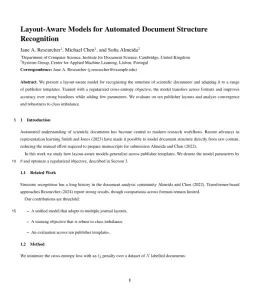
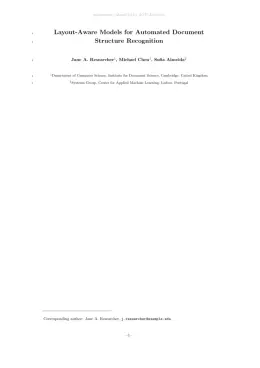
Write in a clean editor, then format for Journal of Sensors and Sensor Systems in one click — DocuGuru applies the official Copernicus Publications template with author–year references and exports a submission-ready PDF plus the editable LaTeX source. Free to start.

About the Journal of Sensors and Sensor Systems format

Journal of Sensors and Sensor Systems is a peer-reviewed journal published by Copernicus Publications, covering Gas Sensing Nanomaterials and Sensors, Analytical Chemistry and Sensors, Advanced Chemical Sensor Technologies. Over its lifetime it has published 469 papers, which have received 5,400 citations.

PublisherCopernicus Publications
Reference styleAuthor–year (Copernicus)
Author–year — (Smith, 2023) in the text
Smith, A., Jones, B., and Lee, C.: A representative article title, Journal of Sensors and Sensor Systems, 12, 45–58, 2023.

Formats any DOI in Journal of Sensors and Sensor Systems style. No sign-up.

Publishes research inGas Sensing Nanomaterials and Sensors Analytical Chemistry and Sensors Advanced Chemical Sensor Technologies Advanced MEMS and NEMS Technologies Spectroscopy and Laser Applications
ISSN2194-8771
Citation impact (2-yr)1.81
h-index30
i10-index148
Article processing charge$679
Open accessYes — indexed in DOAJ
Top institutions publishing hereTechnische Universität Dresden
Journal websitewww.journal-of-sensors-and-sensor-systems.net
You getA submission-ready PDF and the editable LaTeX source — ready to submit.

Papers published in Journal of Sensors and Sensor Systems per year

37
2014
40
2015
45
2016
38
2017
62
2018
32
2019
45
2020
31
2021
27
2022
24
2023
24
2024
29
2025

Citation impact of Journal of Sensors and Sensor Systems by publication year

532
2014
547
2015
634
2016
691
2017
1.2K
2018
415
2019
312
2020
199
2021
91
2022
103
2023
68
2024
48
2025

Citations each year’s papers have accumulated so far — the most recent years are still building up.

Most-cited papers in Journal of Sensors and Sensor Systems

Electrical impedance spectroscopy (EIS) for biological analysis and food characterization: a review

Marco Grossi, B. Riccò · 28 Aug 2017

Abstract. Electrical impedance spectroscopy (EIS), in which a sinusoidal test voltage or current is applied to the sample under test to measure its impedance over a suitable frequency range, is a powerful technique to investigate the electrical properties of a large variety of materials. In practice, the measured impedance spectra, usually fitted with an equivalent…

Sensors 4.0 – smart sensors and measurement technology enable Industry 4.0

Andreas Schütze, Nikolai Helwig, Tizian Schneider · 9 May 2018

Abstract. “Industrie 4.0” or the Industrial Internet of Things (IIoT) are two terms for the current (r)evolution seen in industrial automation and control. Everything is getting smarter and data generated at all levels of the production process are used to improve product quality, flexibility, and productivity. This would not be possible without smart sensors, which…

Validation and application of a cryogenic vacuum extraction system for soil and plant water extraction for isotope analysis

Natalie Orlowski, H. G. Frede, Nicolas Brüggemann et al. · 13 Nov 2013

Abstract. Stable isotopic analysis of water in plant, soil, and hydrological studies often requires the extraction of water from plant or soil samples. Cryogenic vacuum extraction is one of the most widely used and accurate extraction methods to obtain such water samples. Here, we present a new design of a cryogenic vacuum extraction system with…

Calibration of uncooled thermal infrared cameras

Helmut Budzier, Gerald Gerlach · 2 Jun 2015

Abstract. The calibration of uncooled thermal infrared (IR) cameras to absolute temperature measurement is a time-consuming, complicated process that significantly influences the cost of an IR camera. Temperature-measuring IR cameras display a temperature value for each pixel in the thermal image. Calibration is used to calculate a temperature-proportional output signal (IR or thermal image) from…

Field evaluation of a low-cost indoor air quality monitor to quantify exposure to pollutants in residential environments

Alejandro Moreno-Rangel, Tim Sharpe, Filbert Musau et al. · 9 May 2018

Abstract. Measurements of temporal and spatial changes to indoor contaminant concentrations are vital to understanding pollution characteristics. Whilst scientific instruments provide high temporal resolution of indoor pollutants, their cost and complexity make them unfeasible for large-scale projects. Low-cost monitors offer an opportunity to collect high-density temporal and spatial data in a broader range of households.…

Journal of Sensors and Sensor Systems template — frequently asked questions

How do I write a paper in the Journal of Sensors and Sensor Systems format?
In DocuGuru you write your manuscript in a normal editor — no LaTeX setup required — and select the Journal of Sensors and Sensor Systems template. When you export, DocuGuru compiles the paper into the official Copernicus Publications format and hands you a submission-ready PDF along with the editable LaTeX source.
What reference style does Journal of Sensors and Sensor Systems use?
Journal of Sensors and Sensor Systems uses Author–year (Copernicus) references, shown as author–year markers such as (Smith, 2023) in the text. DocuGuru formats every in-text citation and the reference list in this exact style automatically. A reference appears like this: Smith, A., Jones, B., and Lee, C.: A representative article title, Journal of Sensors and Sensor Systems, 12, 45–58, 2023.
Do I need to know LaTeX to submit to Journal of Sensors and Sensor Systems?
No. DocuGuru generates the copernicus LaTeX class and compiles the PDF for you in the background, so you get a Copernicus Publications-ready Journal of Sensors and Sensor Systems document without writing any LaTeX. If you do want it, the LaTeX source is included in the export.
Can I import an existing draft into the Journal of Sensors and Sensor Systems template?
Yes. Paste or upload your current manuscript — Word, LaTeX, Markdown, or plain text — and DocuGuru reflows it into the Journal of Sensors and Sensor Systems format with correct headings, figures, tables, and author–year citations.
What is Journal of Sensors and Sensor Systems?
Copernicus Publications journal. It is a earth and environmental sciences journal, published by Copernicus Publications.
Can I export a submission-ready Journal of Sensors and Sensor Systems PDF?
Yes — DocuGuru produces a PDF built with the official Journal of Sensors and Sensor Systems template (the copernicus class) that is ready to submit to Copernicus Publications, together with the matching LaTeX source files.
How much does the Journal of Sensors and Sensor Systems template cost?
You can start writing in the Journal of Sensors and Sensor Systems template for free. Exporting the final submission-ready Journal of Sensors and Sensor Systems PDF and LaTeX source is part of DocuGuru's paid plans — see the app for current pricing.
Use the Journal of Sensors and Sensor Systems template