Cambridge University Press

International Psychogeriatrics Template

Write in a clean editor, then format for International Psychogeriatrics in one click — DocuGuru applies the official Cambridge University Press template with numbered references and exports a submission-ready PDF plus the editable LaTeX source. Free to start.

About the International Psychogeriatrics format

International Psychogeriatrics is a peer-reviewed journal published by Cambridge University Press, covering Dementia and Cognitive Impairment Research, Geriatric Care and Nursing Homes, Health disparities and outcomes.

PublisherCambridge University Press
Reference styleNumbered
Numbered — [1], [2] in the text
[1] A. Smith, B. Jones, and C. Lee, A representative article title, International Psychogeriatrics 12 (2023) 45–58.

Formats any DOI in the closest standard style — International Psychogeriatrics has no published style definition, so this is an approximation. No sign-up.

Publishes research inDementia and Cognitive Impairment Research Geriatric Care and Nursing Homes Health disparities and outcomes Aging and Gerontology Research Schizophrenia research and treatment
ISSN1041-6102
Citation impact (2-yr)1.62
h-index159
i10-index3,058
Total citations172,101
Open accessYes
Top institutions publishing hereUNSW Sydney
Journal websitejournals.cambridge.org
You getA submission-ready PDF and the editable LaTeX source — ready to submit.

Papers published in International Psychogeriatrics per year

304
2014
259
2015
233
2016
304
2017
221
2018
401
2019
391
2020
348
2021
123
2022
479
2023
291
2024
108
2025

Citation impact of International Psychogeriatrics by publication year

9.3K
2014
9.2K
2015
7.1K
2016
9.9K
2017
6K
2018
4K
2019
7K
2020
2.1K
2021
1K
2022
1K
2023
421
2024
266
2025

Citations each year’s papers have accumulated so far — the most recent years are still building up.

Most-cited papers in International Psychogeriatrics

Clinical Dementia Rating: A Reliable and Valid Diagnostic and Staging Measure for Dementia of the Alzheimer Type

John C. Morris · 1 Dec 1997

Global staging measures for dementia of the Alzheimer type (DAT) assess the influence of cognitive loss on the ability to conduct everyday activities and represent the "ultimate test" of efficacy for antidementia drug trials. They provide information about clinically meaningful function and behavior and are less affected by the "floor" and "ceiling" effects commonly associated…

1,655 citations Cite SaveGo to paper →
Loneliness and social isolation during the COVID-19 pandemic

Tzung‐Jeng Hwang, Kiran Rabheru, Carmelle Peisah et al. · 26 May 2020

Loneliness and social isolation are associated with adverse physical and psychological consequences which are particularly prevalent in older persons. During this unprecedented time of the COVID-19 pandemic, we must follow social distancing guidelines to protect ourselves and to reduce the spread of coronavirus. At the same time, it is crucial to maintain social connections with…

1,073 citations Cite SaveGo to paper →
The Australian Imaging, Biomarkers and Lifestyle (AIBL) study of aging: methodology and baseline characteristics of 1112 individuals recruited for a longitudinal study of Alzheimer's disease

Kathryn A. Ellis, Ashley I. Bush, David Darby et al. · 27 May 2009

BACKGROUND: The Australian Imaging, Biomarkers and Lifestyle (AIBL) flagship study of aging aimed to recruit 1000 individuals aged over 60 to assist with prospective research into Alzheimer's disease (AD). This paper describes the recruitment of the cohort and gives information about the study methodology, baseline demography, diagnoses, medical comorbidities, medication use, and cognitive function of…

The Cognitive Abilities Screening Instrument (CASI): A Practical Test for Cross-Cultural Epidemiological Studies of Dementia

Evelyn L. Teng, Kazuo Hasegawa, Akira Homma et al. · 1 Mar 1994

The Cognitive Abilities Screening Instrument (CASI) has a score range of 0 to 100 and provides quantitative assessment on attention, concentration, orientation, short-term memory, long-term memory, language abilities, visual construction, list-generating fluency, abstraction, and judgment. Scores of the Mini-Mental State Examination, the Modified Mini-Mental State Test, and the Hasegawa Dementia Screening Scale can also be…

Aging, Memory, and Mild Cognitive Impairment

Ronald C. Petersen, Emre Kokmen, Stephen C. Waring et al. · 1 Dec 1997

In recent years, patients who are at high risk for developing Alzheimer's disease (AD) have become a focus of study. Several research groups have identified these patients, developed diagnostic criteria, and followed the patients longitudinally. These patients therefore constitute a clinical entity that is suitable for therapeutic interventions. In this article, we report our 5-year…

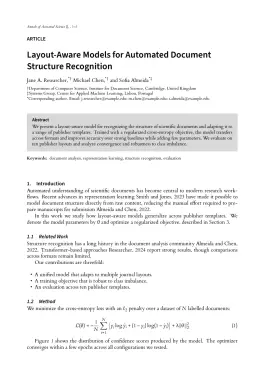
International Psychogeriatrics template — frequently asked questions

How do I write a paper in the International Psychogeriatrics format?
In DocuGuru you write your manuscript in a normal editor — no LaTeX setup required — and select the International Psychogeriatrics template. When you export, DocuGuru compiles the paper into the official Cambridge University Press format and hands you a submission-ready PDF along with the editable LaTeX source.
What reference style does International Psychogeriatrics use?
International Psychogeriatrics uses Numbered references, shown as numbered [1], [2] markers in the text. DocuGuru formats every in-text citation and the reference list in this exact style automatically. A reference appears like this: [1] A. Smith, B. Jones, and C. Lee, A representative article title, International Psychogeriatrics 12 (2023) 45–58.
Do I need to know LaTeX to submit to International Psychogeriatrics?
No. DocuGuru generates the null LaTeX class and compiles the PDF for you in the background, so you get a Cambridge University Press-ready International Psychogeriatrics document without writing any LaTeX. If you do want it, the LaTeX source is included in the export.
Can I import an existing draft into the International Psychogeriatrics template?
Yes. Paste or upload your current manuscript — Word, LaTeX, Markdown, or plain text — and DocuGuru reflows it into the International Psychogeriatrics format with correct headings, figures, tables, and numbered citations.
Who publishes International Psychogeriatrics?
International Psychogeriatrics is a multidisciplinary journal published by Cambridge University Press. DocuGuru's International Psychogeriatrics template matches Cambridge University Press's official submission format.
Can I export a submission-ready International Psychogeriatrics PDF?
Yes — DocuGuru produces a PDF built with the official International Psychogeriatrics template (the null class) that is ready to submit to Cambridge University Press, together with the matching LaTeX source files.
How much does the International Psychogeriatrics template cost?
You can start writing in the International Psychogeriatrics template for free. Exporting the final submission-ready International Psychogeriatrics PDF and LaTeX source is part of DocuGuru's paid plans — see the app for current pricing.
Use the International Psychogeriatrics template