Cambridge University Press

Data-Centric Engineering Template

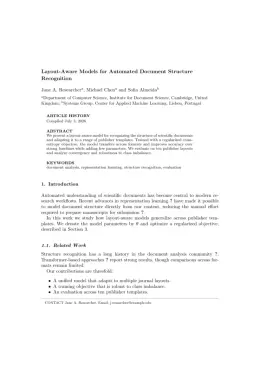
Write in a clean editor, then format for Data-Centric Engineering in one click — DocuGuru applies the official Cambridge University Press template with numbered references and exports a submission-ready PDF plus the editable LaTeX source. Free to start.

About the Data-Centric Engineering format

Data-Centric Engineering is a peer-reviewed journal published by Cambridge University Press, covering Model Reduction and Neural Networks, Probabilistic and Robust Engineering Design, Structural Health Monitoring Techniques. Over its lifetime it has published 240 papers, which have received 2,564 citations.

PublisherCambridge University Press
Reference styleNumbered
Numbered — [1], [2] in the text
[1] A. Smith, B. Jones, and C. Lee, A representative article title, Data-Centric Engineering 12 (2023) 45–58.

Formats any DOI in the closest standard style — Data-Centric Engineering has no published style definition, so this is an approximation. No sign-up.

Publishes research inModel Reduction and Neural Networks Probabilistic and Robust Engineering Design Structural Health Monitoring Techniques Infrastructure Maintenance and Monitoring Advanced Multi-Objective Optimization Algorithms
ISSN2632-6736
Citation impact (2-yr)3.98
h-index24
i10-index62
Article processing charge$1,533
Open accessYes — indexed in DOAJ
Top institutions publishing hereUniversity of Cambridge
Journal websitewww.cambridge.org
You getA submission-ready PDF and the editable LaTeX source — ready to submit.

Papers published in Data-Centric Engineering per year

21
2020
20
2021
36
2022
30
2023
50
2024
55
2025

Citation impact of Data-Centric Engineering by publication year

818
2020
426
2021
432
2022
319
2023
336
2024
158
2025

Citations each year’s papers have accumulated so far — the most recent years are still building up.

Most-cited papers in Data-Centric Engineering

Construction with digital twin information systems

Rafael Sacks, Ioannis Brilakis, Ergo Pikas et al. · 1 Jan 2020

Abstract The concept of a “digital twin” as a model for data-driven management and control of physical systems has emerged over the past decade in the domains of manufacturing, production, and operations. In the context of buildings and civil infrastructure, the notion of a digital twin remains ill-defined, with little or no consensus among researchers…

Universal Digital Twin - A Dynamic Knowledge Graph

Jethro Akroyd, Sebastian Mosbach, Amit Bhave et al. · 1 Jan 2021

Abstract This paper introduces a dynamic knowledge-graph approach for digital twins and illustrates how this approach is by design naturally suited to realizing the vision of a Universal Digital Twin. The dynamic knowledge graph is implemented using technologies from the Semantic Web. It is composed of concepts and instances that are defined using ontologies, and…

Digital twin of an urban-integrated hydroponic farm

Melanie Jans-Singh, Kathryn Leeming, Ruchi Choudhary et al. · 1 Jan 2020

Abstract This paper presents the development process of a digital twin of a unique hydroponic underground farm in London, Growing Underground (GU). Growing 12x more per unit area than traditional greenhouse farming in the UK, the farm also consumes 4x more energy per unit area. Key to the ongoing operational success of this farm and…

Digital twinning of self-sensing structures using the statistical finite element method

Eky Febrianto, Liam Butler, Mark Girolami et al. · 1 Jan 2022

Abstract The monitoring of infrastructure assets using sensor networks is becoming increasingly prevalent. A digital twin in the form of a finite element (FE) model, as commonly used in design and construction, can help make sense of the copious amount of collected sensor data. This paper demonstrates the application of the statistical finite element method…

Poisson CNN: Convolutional neural networks for the solution of the Poisson equation on a Cartesian mesh

Ali Girayhan Özbay, Arash Hamzehloo, Sylvain Laizet et al. · 1 Jan 2021

Abstract The Poisson equation is commonly encountered in engineering, for instance, in computational fluid dynamics (CFD) where it is needed to compute corrections to the pressure field to ensure the incompressibility of the velocity field. In the present work, we propose a novel fully convolutional neural network (CNN) architecture to infer the solution of the…

Data-Centric Engineering template — frequently asked questions

How do I write a paper in the Data-Centric Engineering format?
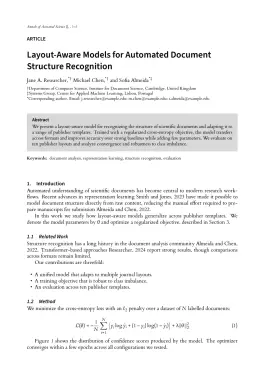
In DocuGuru you write your manuscript in a normal editor — no LaTeX setup required — and select the Data-Centric Engineering template. When you export, DocuGuru compiles the paper into the official Cambridge University Press format and hands you a submission-ready PDF along with the editable LaTeX source.
What reference style does Data-Centric Engineering use?
Data-Centric Engineering uses Numbered references, shown as numbered [1], [2] markers in the text. DocuGuru formats every in-text citation and the reference list in this exact style automatically. A reference appears like this: [1] A. Smith, B. Jones, and C. Lee, A representative article title, Data-Centric Engineering 12 (2023) 45–58.
Do I need to know LaTeX to submit to Data-Centric Engineering?
No. DocuGuru generates the null LaTeX class and compiles the PDF for you in the background, so you get a Cambridge University Press-ready Data-Centric Engineering document without writing any LaTeX. If you do want it, the LaTeX source is included in the export.
Can I import an existing draft into the Data-Centric Engineering template?
Yes. Paste or upload your current manuscript — Word, LaTeX, Markdown, or plain text — and DocuGuru reflows it into the Data-Centric Engineering format with correct headings, figures, tables, and numbered citations.
What is Data-Centric Engineering?
Data-Centric Engineering, a Cambridge University Press open-access journal. It is a multidisciplinary journal, published by Cambridge University Press.
Can I export a submission-ready Data-Centric Engineering PDF?
Yes — DocuGuru produces a PDF built with the official Data-Centric Engineering template (the null class) that is ready to submit to Cambridge University Press, together with the matching LaTeX source files.
How much does the Data-Centric Engineering template cost?
You can start writing in the Data-Centric Engineering template for free. Exporting the final submission-ready Data-Centric Engineering PDF and LaTeX source is part of DocuGuru's paid plans — see the app for current pricing.
Use the Data-Centric Engineering template