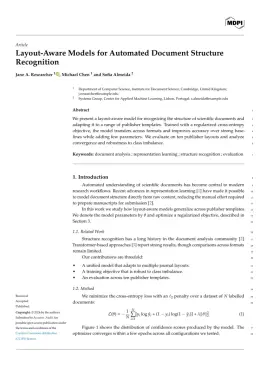
Cambridge University Press

Natural Language Processing Template

Write in a clean editor, then format for Natural Language Processing in one click — DocuGuru applies the official Cambridge University Press template with numbered references and exports a submission-ready PDF plus the editable LaTeX source. Free to start.

About the Natural Language Processing format

Natural Language Processing is a peer-reviewed journal published by Cambridge University Press, covering Natural Language Processing Techniques, Topic Modeling, Hate Speech and Cyberbullying Detection. Over its lifetime it has published 91 papers, which have received 292 citations.

PublisherCambridge University Press
Reference styleNumbered
Numbered — [1], [2] in the text
[1] A. Smith, B. Jones, and C. Lee, A representative article title, Natural Language Processing 12 (2023) 45–58.

Formats any DOI in the closest standard style — Natural Language Processing has no published style definition, so this is an approximation. No sign-up.

Publishes research inNatural Language Processing Techniques Topic Modeling Hate Speech and Cyberbullying Detection Sentiment Analysis and Opinion Mining Advanced Text Analysis Techniques
ISSN2977-0424
Citation impact (2-yr)3.21
h-index8
i10-index7
Top institutions publishing hereUniversity of Luxembourg
Journal websitewww.cambridge.org
You getA submission-ready PDF and the editable LaTeX source — ready to submit.

Papers published in Natural Language Processing per year

51
2024
19
2025
15
2026

Citation impact of Natural Language Processing by publication year

214
2024
53
2025
4
2026

Citations each year’s papers have accumulated so far — the most recent years are still building up.

Most-cited papers in Natural Language Processing

Maximizing RAG efficiency: A comparative analysis of RAG methods

Tolga Şakar, Hakan Emekci · 30 Oct 2024

Abstract This paper addresses the optimization of retrieval-augmented generation (RAG) processes by exploring various methodologies, including advanced RAG methods. The research, driven by the need to enhance RAG processes as highlighted by recent studies, involved a grid-search optimization of 23,625 iterations. We evaluated multiple RAG methods across different vectorstores, embedding models, and large language models,…

Natural language processing applications for low-resource languages

Partha Pakray, Alexander Gelbukh, Sivaji Bandyopadhyay · 28 Feb 2025

Abstract Natural language processing (NLP) has significantly advanced our ability to model and interact with human language through technology. However, these advancements have disproportionately benefited high-resource languages with abundant data for training complex models. Low-resource languages, often spoken by smaller or marginalized communities, need help realizing the full potential of NLP applications. The primary challenges…

Hate speech detection in low-resourced Indian languages: An analysis of transformer-based monolingual and multilingual models with cross-lingual experiments

Koyel Ghosh, Apurbalal Senapati · 27 Aug 2024

Abstract Warning: This paper is based on hate speech detection and may contain examples of abusive/ offensive phrases. Cyberbullying, online harassment, etc., via offensive comments are pervasive across different social media platforms like ™Twitter, ™Facebook, ™YouTube, etc. Hateful comments must be detected and eradicated to prevent harassment and violence on social media. In the Natural…

A survey of context in neural machine translation and its evaluation

Sheila Castilho, Rebecca Knowles · 17 May 2024

Abstract The question of context in neural machine translation often focuses on topics related to document-level translation or intersentential context. However, there is a wide range of other aspects that can be considered under the umbrella of context. In this work, we survey ways that researchers have incorporated context into neural machine translation systems and…

Sentiment analysis of code-mixed Dravidian languages leveraging pretrained model and word-level language tag

Supriya Chanda, Anshika Mishra, Sukomal Pal · 11 Sep 2024

Abstract The exponential growth of social media data in the era of Web 2.0 has necessitated advanced techniques for sentiment analysis. While sentiment analysis in monolingual datasets has received significant attention that in code-mixed datasets still need to be studied more. Code-mixed data often contain a mixture of monolingual content (might be in transliterated form),…

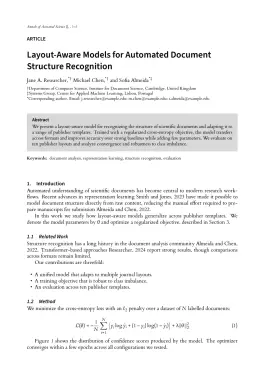
Natural Language Processing template — frequently asked questions

How do I write a paper in the Natural Language Processing format?
In DocuGuru you write your manuscript in a normal editor — no LaTeX setup required — and select the Natural Language Processing template. When you export, DocuGuru compiles the paper into the official Cambridge University Press format and hands you a submission-ready PDF along with the editable LaTeX source.
What reference style does Natural Language Processing use?
Natural Language Processing uses Numbered references, shown as numbered [1], [2] markers in the text. DocuGuru formats every in-text citation and the reference list in this exact style automatically. A reference appears like this: [1] A. Smith, B. Jones, and C. Lee, A representative article title, Natural Language Processing 12 (2023) 45–58.
Do I need to know LaTeX to submit to Natural Language Processing?
No. DocuGuru generates the null LaTeX class and compiles the PDF for you in the background, so you get a Cambridge University Press-ready Natural Language Processing document without writing any LaTeX. If you do want it, the LaTeX source is included in the export.
Can I import an existing draft into the Natural Language Processing template?
Yes. Paste or upload your current manuscript — Word, LaTeX, Markdown, or plain text — and DocuGuru reflows it into the Natural Language Processing format with correct headings, figures, tables, and numbered citations.
What is Natural Language Processing?
Natural Language Processing, a Cambridge University Press journal (cup-journal.cls, biber). It is a multidisciplinary journal, published by Cambridge University Press.
Can I export a submission-ready Natural Language Processing PDF?
Yes — DocuGuru produces a PDF built with the official Natural Language Processing template (the null class) that is ready to submit to Cambridge University Press, together with the matching LaTeX source files.
How much does the Natural Language Processing template cost?
You can start writing in the Natural Language Processing template for free. Exporting the final submission-ready Natural Language Processing PDF and LaTeX source is part of DocuGuru's paid plans — see the app for current pricing.
Use the Natural Language Processing template