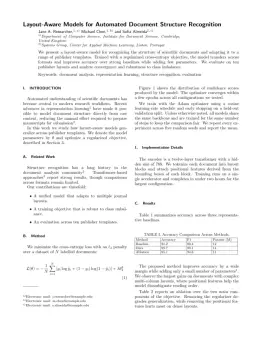
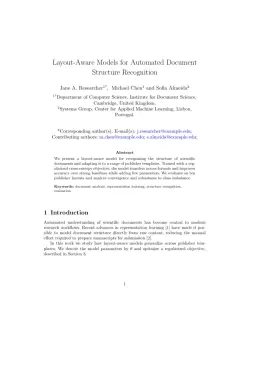
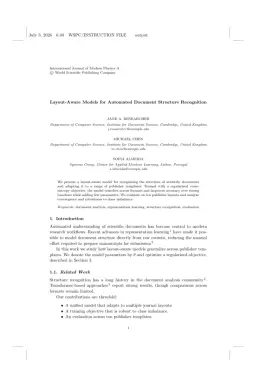
About the Biophysics Reviews format
Biophysics Reviews is a peer-reviewed journal published by AIP Publishing, covering 3D Printing in Biomedical Research, Cellular Mechanics and Interactions, Protein Structure and Dynamics. Over its lifetime it has published 179 papers, which have received 1,866 citations.
| Publisher | AIP Publishing |
|---|
| Reference style | Numbered (AIP) Numbered — [1], [2] in the text
[1] A. Smith, B. Jones, and C. Lee, Biophysics Reviews 12, 45 (2023).
Formats any DOI in Biophysics Reviews style. No sign-up.
|
|---|
| Publishes research in | 3D Printing in Biomedical Research Cellular Mechanics and Interactions Protein Structure and Dynamics Cell Image Analysis Techniques Tissue Engineering and Regenerative Medicine |
|---|
| ISSN | 2688-4089 |
|---|
| Citation impact (2-yr) | 3.44 |
|---|
| h-index | 24 |
|---|
| i10-index | 62 |
|---|
| Top institutions publishing here | Harvard University |
|---|
| Journal website | pubs.aip.org |
|---|
| You get | A submission-ready PDF and the editable LaTeX source — ready to submit. |
|---|
Papers published in Biophysics Reviews per year
Citation impact of Biophysics Reviews by publication year
Citations each year’s papers have accumulated so far — the most recent years are still building up.
Most-cited papers in Biophysics Reviews
Integrating mechanism-based modeling with biomedical imaging to build practical digital twins for clinical oncology
Chengyue Wu, Guillermo Lorenzo, David A. Hormuth et al. · 17 May 2022
Digital twins employ mathematical and computational models to virtually represent a physical object (e.g., planes and human organs), predict the behavior of the object, and enable decision-making to optimize the future behavior of the object. While digital twins have been widely used in engineering for decades, their applications to oncology are only just emerging. Due…
Mechanisms of ligand binding
Enrico Di · 16 Nov 2020
Many processes in chemistry and biology involve interactions of a ligand with its molecular target. Interest in the mechanism governing such interactions has dominated theoretical and experimental analysis for over a century. The interpretation of molecular recognition has evolved from a simple rigid body association of the ligand with its target to appreciation of the…
Beyond CFD: Emerging methodologies for predictive simulation in cardiovascular health and disease
Erica L. Schwarz, Luca Pegolotti, Martin R. Pfaller et al. · 13 Jan 2023
Physics-based computational models of the cardiovascular system are increasingly used to simulate hemodynamics, tissue mechanics, and physiology in evolving healthy and diseased states. While predictive models using computational fluid dynamics (CFD) originated primarily for use in surgical planning, their application now extends well beyond this purpose. In this review, we describe an increasingly wide range…
Polyphasic linkage and the impact of ligand binding on the regulation of biomolecular condensates
Kiersten M. Ruff, Furqan Dar, Rohit V. Pappu · 1 Jun 2021
Cellular matter can be spatially and temporally organized into membraneless biomolecular condensates. The current thinking is that these condensates form and dissolve via phase transitions driven by one or more condensate-specific multivalent macromolecules known as scaffolds. Cells likely regulate condensate formation and dissolution by exerting control over the concentrations of regulatory molecules, which we refer…
Live cell microscopy: From image to insight
Andreas P. Cuny, Fabian P. Schlottmann, Jennifer C. Ewald et al. · 21 Apr 2022
Live-cell microscopy is a powerful tool that can reveal cellular behavior as well as the underlying molecular processes. A key advantage of microscopy is that by visualizing biological processes, it can provide direct insights. Nevertheless, live-cell imaging can be technically challenging and prone to artifacts. For a successful experiment, many careful decisions are required at…