ACM

ACM Transactions on Storage Template

Write in a clean editor, then format for ACM Transactions on Storage in one click — DocuGuru applies the official ACM template with numbered references and exports a submission-ready PDF plus the editable LaTeX source. Free to start.

About the ACM Transactions on Storage format

ACM Transactions on Storage is a peer-reviewed journal published by ACM, covering Advanced Data Storage Technologies, Caching and Content Delivery, Parallel Computing and Optimization Techniques. Over its lifetime it has published 619 papers, which have received 15,001 citations.

PublisherACM
Reference styleNumbered (ACM)
Numbered — [1], [2] in the text
[1] Ada Smith, Ben Jones, and Cara Lee. 2023. A representative article title. ACM Transactions on Storage 12, 3, Article 45 (2023).

Formats any DOI in ACM Transactions on Storage style. No sign-up.

Publishes research inAdvanced Data Storage Technologies Caching and Content Delivery Parallel Computing and Optimization Techniques Cloud Computing and Resource Management Distributed systems and fault tolerance
ISSN1553-3077
Citation impact (2-yr)2.04
h-index61
i10-index269
Top institutions publishing hereHuazhong University of Science and Technology
Journal websiteportal.acm.org
You getA submission-ready PDF and the editable LaTeX source — ready to submit.

Papers published in ACM Transactions on Storage per year

23
2014
21
2015
28
2016
44
2017
40
2018
35
2019
26
2020
32
2021
46
2022
35
2023
31
2024
49
2025

Citation impact of ACM Transactions on Storage by publication year

700
2014
428
2015
542
2016
1.1K
2017
573
2018
312
2019
398
2020
661
2021
535
2022
301
2023
148
2024
57
2025

Citations each year’s papers have accumulated so far — the most recent years are still building up.

Most-cited papers in ACM Transactions on Storage

Write off-loading

Dushyanth Narayanan, Austin Donnelly, Antony Rowstron · 1 Nov 2008

In enterprise data centers power usage is a problem impacting server density and the total cost of ownership. Storage uses a significant fraction of the power budget and there are no widely deployed power-saving solutions for enterprise storage systems. The traditional view is that enterprise workloads make spinning disks down ineffective because idle periods are…

A study of practical deduplication

Dutch T. Meyer, William J. Bolosky · 1 Jan 2012

We collected file system content data from 857 desktop computers at Microsoft over a span of 4 weeks. We analyzed the data to determine the relative efficacy of data deduplication, particularly considering whole-file versus block-level elimination of redundancy. We found that whole-file deduplication achieves about three quarters of the space savings of the most aggressive…

BTRFS

Ohad Rodeh, Josef Bacik, Chris Mason · 1 Aug 2013

BTRFS is a Linux filesystem that has been adopted as the default filesystem in some popular versions of Linux. It is based on copy-on-write, allowing for efficient snapshots and clones. It uses B-trees as its main on-disk data structure. The design goal is to work well for many use cases and workloads. To this end,…

DepSky

Alysson Bessani, Miguel Correia, Bruno Quaresma et al. · 1 Nov 2013

The increasing popularity of cloud storage services has lead companies that handle critical data to think about using these services for their storage needs. Medical record databases, large biomedical datasets, historical information about power systems and financial data are some examples of critical data that could be moved to the cloud. However, the reliability and…

A five-year study of file-system metadata

Nitin Agrawal, William J. Bolosky, John R. Douceur et al. · 1 Oct 2007

For five years, we collected annual snapshots of file-system metadata from over 60,000 Windows PC file systems in a large corporation. In this article, we use these snapshots to study temporal changes in file size, file age, file-type frequency, directory size, namespace structure, file-system population, storage capacity and consumption, and degree of file modification. We…

ACM Transactions on Storage template — frequently asked questions

How do I write a paper in the ACM Transactions on Storage format?
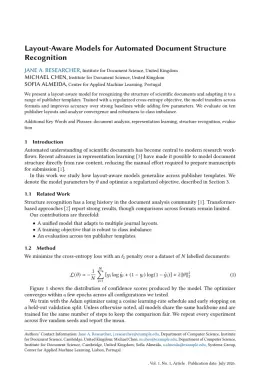
In DocuGuru you write your manuscript in a normal editor — no LaTeX setup required — and select the ACM Transactions on Storage template. When you export, DocuGuru compiles the paper into the official ACM format and hands you a submission-ready PDF along with the editable LaTeX source.
What reference style does ACM Transactions on Storage use?
ACM Transactions on Storage uses Numbered (ACM) references, shown as numbered [1], [2] markers in the text. DocuGuru formats every in-text citation and the reference list in this exact style automatically. A reference appears like this: [1] Ada Smith, Ben Jones, and Cara Lee. 2023. A representative article title. ACM Transactions on Storage 12, 3, Article 45 (2023).
Do I need to know LaTeX to submit to ACM Transactions on Storage?
No. DocuGuru generates the acmart LaTeX class and compiles the PDF for you in the background, so you get a ACM-ready ACM Transactions on Storage document without writing any LaTeX. If you do want it, the LaTeX source is included in the export.
Can I import an existing draft into the ACM Transactions on Storage template?
Yes. Paste or upload your current manuscript — Word, LaTeX, Markdown, or plain text — and DocuGuru reflows it into the ACM Transactions on Storage format with correct headings, figures, tables, and numbered citations.
What is ACM Transactions on Storage?
ACM journal. It is a engineering and computer science journal, published by ACM.
Can I export a submission-ready ACM Transactions on Storage PDF?
Yes — DocuGuru produces a PDF built with the official ACM Transactions on Storage template (the acmart class) that is ready to submit to ACM, together with the matching LaTeX source files.
How much does the ACM Transactions on Storage template cost?
You can start writing in the ACM Transactions on Storage template for free. Exporting the final submission-ready ACM Transactions on Storage PDF and LaTeX source is part of DocuGuru's paid plans — see the app for current pricing.
Use the ACM Transactions on Storage template