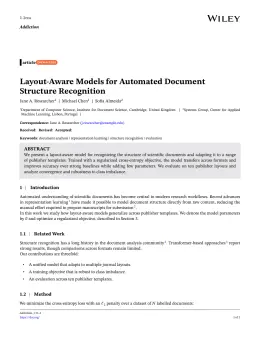
About the Social Science Quarterly format
Social Science Quarterly is a peer-reviewed journal published by Wiley, covering Electoral Systems and Political Participation, Social Media and Politics, Social and Intergroup Psychology.
| Publisher | Wiley |
|---|
| Reference style | Author–year (Chicago) Author–year — (Smith, 2023) in the text
Smith, Ada, Ben Jones, and Cara Lee. 2023. "A Representative Article Title." Social Science Quarterly 12 (3): 45–58.
Formats any DOI in Social Science Quarterly style. No sign-up.
|
|---|
| Publishes research in | Electoral Systems and Political Participation Social Media and Politics Social and Intergroup Psychology Gender Politics and Representation Urban, Neighborhood, and Segregation Studies |
|---|
| ISSN | 0038-4941 |
|---|
| Citation impact (2-yr) | 1.46 |
|---|
| h-index | 128 |
|---|
| i10-index | 1,658 |
|---|
| Total citations | 110,661 |
|---|
| Article processing charge | $2,730 |
|---|
| Top institutions publishing here | University of Oklahoma |
|---|
| Journal website | onlinelibrary.wiley.com |
|---|
| You get | A submission-ready PDF and the editable LaTeX source — ready to submit. |
|---|
Papers published in Social Science Quarterly per year
Citation impact of Social Science Quarterly by publication year
Citations each year’s papers have accumulated so far — the most recent years are still building up.
Most-cited papers in Social Science Quarterly
Social Vulnerability to Environmental Hazards<sup>*</sup>
Susan L. Cutter, Bryan Boruff, W. Lynn Shirley · 19 May 2003
Objective. County‐level socioeconomic and demographic data were used to construct an index of social vulnerability to environmental hazards, called the Social Vulnerability Index (SoVI) for the United States based on 1990 data. Methods. Using a factor analytic approach, 42 variables were reduced to 11 independent factors that accounted for about 76 percent of the variance.…
The Standardized World Income Inequality Database*
Frederick Solt · 31 May 2016
Objective Since 2008, the Standardized World Income Inequality Database (SWIID) has provided income inequality data that seek to maximize comparability while providing the broadest possible coverage of countries and years. This article describes the current SWIID's construction, highlighting differences from its original version, and reevaluates the SWIID's utility to cross‐national income inequality research in light…
Measuring Income Inequality Across Countries and Over Time: The Standardized World Income Inequality Database
Frederick Solt · 1 May 2020
Objective This article documents wide‐ranging revisions to the Standardized World Income Inequality Database (SWIID), which seeks to maximize the comparability of income inequality estimates for the broadest possible coverage of countries and years. Methods Two k ‐fold cross‐validations, by observation and by country, are used to evaluate the SWIID's success in predicting the Luxembourg Income…
Standardizing the World Income Inequality Database<sup>*</sup>
Frederick Solt · 13 Apr 2009
Objective. Cross‐national research on the causes and consequences of income inequality has been hindered by the limitations of existing inequality data sets: greater coverage across countries and over time is available from these sources only at the cost of significantly reduced comparability across observations. The goal of the Standardized World Income Inequality Database (SWIID) is…
Cross‐National Gender Variation in Environmental Behaviors<sup>*</sup>
Lori M. Hunter, Alison Hatch, Aaron Johnson · 23 Jul 2004
Objective. This article presents a cross‐national examination of gender variations in environmental behaviors. Research on environmental concern reveals modest distinctions between men and women, with women typically displaying higher levels of environmental concern and behavioral adjustments relative to men. Additionally, some prior research suggests that women appear more engaged in household‐oriented (private) pro‐environment behaviors (e.g.,…