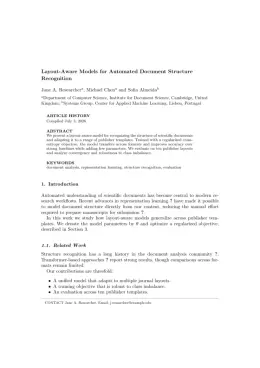
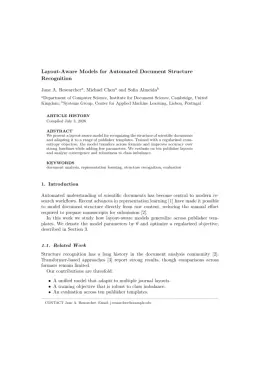
Wiley

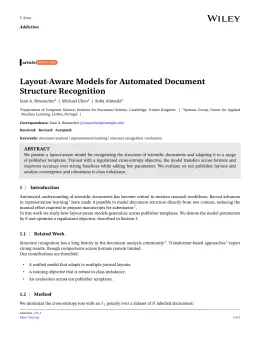
Advanced Materials Template

Write in a clean editor, then format for Advanced Materials in one click — DocuGuru applies the official Wiley template with author–year references and exports a submission-ready PDF plus the editable LaTeX source. Free to start.

About the Advanced Materials format

Advanced Materials is a peer-reviewed journal published by Wiley, covering Conducting polymers and applications, Advanced Sensor and Energy Harvesting Materials, Perovskite Materials and Applications. Over its lifetime it has published 44,621 papers, which have received 4,785,822 citations.

PublisherWiley
Reference styleAuthor–year (Chicago)
Author–year — (Smith, 2023) in the text
Smith, Ada, Ben Jones, and Cara Lee. 2023. "A Representative Article Title." Advanced Materials 12 (3): 45–58.

Formats any DOI in Advanced Materials style. No sign-up.

Publishes research inConducting polymers and applications Advanced Sensor and Energy Harvesting Materials Perovskite Materials and Applications Organic Electronics and Photovoltaics Advancements in Battery Materials
ISSN0935-9648
Citation impact (2-yr)20.87
h-index743
i10-index30,878
Article processing charge$5,250
Top institutions publishing hereChinese Academy of Sciences
Journal websitewww.advmat.de
You getA submission-ready PDF and the editable LaTeX source — ready to submit.

Papers published in Advanced Materials per year

1.3K
2014
1.5K
2015
1.6K
2016
2.1K
2017
2.1K
2018
1.8K
2019
1.8K
2020
2.3K
2021
2.3K
2022
3.2K
2023
3.7K
2024
4.3K
2025

Citation impact of Advanced Materials by publication year

219K
2014
249.6K
2015
281.7K
2016
303K
2017
361.5K
2018
282K
2019
228.8K
2020
257.8K
2021
190.1K
2022
196.9K
2023
144.4K
2024
58.5K
2025

Citations each year’s papers have accumulated so far — the most recent years are still building up.

Most-cited papers in Advanced Materials

Two‐Dimensional Nanocrystals Produced by Exfoliation of Ti<sub>3</sub>AlC<sub>2</sub>

Michael Naguib, Murat Kurtoglu, Volker Presser et al. · 22 Aug 2011

2D Ti3C2 nanosheets, multilayer structures, and conical scrolls produced by room temperature exfoliation of Ti3AlC2 in HF are reported. Since Ti3AlC2 is a member of a 60+ group of layered ternary carbides and nitrides, this discovery opens a door to the synthesis of a large number of other 2D crystals.

11,574 citations Cite SaveGo to paper →
Graphene and Graphene Oxide: Synthesis, Properties, and Applications

Yanwu Zhu, Shanthi Murali, Weiwei Cai et al. · 29 Jun 2010

There is intense interest in graphene in fields such as physics, chemistry, and materials science, among others. Interest in graphene's exceptional physical properties, chemical tunability, and potential for applications has generated thousands of publications and an accelerating pace of research, making review of such research timely. Here is an overview of the synthesis, properties, and…

10,465 citations Cite SaveGo to paper →
One‐Dimensional Nanostructures: Synthesis, Characterization, and Applications

Yan Xia, Pengfei Yang, Yugang Sun et al. · 4 Mar 2003

Abstract This article provides a comprehensive review of current research activities that concentrate on one‐dimensional (1D) nanostructures—wires, rods, belts, and tubes—whose lateral dimensions fall anywhere in the range of 1 to 100 nm. We devote the most attention to 1D nanostructures that have been synthesized in relatively copious quantities using chemical methods. We begin this…

8,509 citations Cite SaveGo to paper →
25th Anniversary Article: MXenes: A New Family of Two‐Dimensional Materials

Michael Naguib, Vadym N. Mochalin, Michel W. Barsoum et al. · 19 Dec 2013

Recently a new, large family of two-dimensional (2D) early transition metal carbides and carbonitrides, called MXenes, was discovered. MXenes are produced by selective etching of the A element from the MAX phases, which are metallically conductive, layered solids connected by strong metallic, ionic, and covalent bonds, such as Ti2 AlC, Ti3 AlC2 , and Ta4…

6,316 citations Cite SaveGo to paper →
30 Years of Lithium‐Ion Batteries

Matthew Li, Jun Lü, Zhongwei Chen et al. · 14 Jun 2018

Over the past 30 years, significant commercial and academic progress has been made on Li-based battery technologies. From the early Li-metal anode iterations to the current commercial Li-ion batteries (LIBs), the story of the Li-based battery is full of breakthroughs and back tracing steps. This review will discuss the main roles of material science in…

5,967 citations Cite SaveGo to paper →

Advanced Materials template — frequently asked questions

How do I write a paper in the Advanced Materials format?
In DocuGuru you write your manuscript in a normal editor — no LaTeX setup required — and select the Advanced Materials template. When you export, DocuGuru compiles the paper into the official Wiley format and hands you a submission-ready PDF along with the editable LaTeX source.
What reference style does Advanced Materials use?
Advanced Materials uses Author–year (Chicago) references, shown as author–year markers such as (Smith, 2023) in the text. DocuGuru formats every in-text citation and the reference list in this exact style automatically. A reference appears like this: Smith, Ada, Ben Jones, and Cara Lee. 2023. "A Representative Article Title." Advanced Materials 12 (3): 45–58.
Do I need to know LaTeX to submit to Advanced Materials?
No. DocuGuru generates the USG LaTeX class and compiles the PDF for you in the background, so you get a Wiley-ready Advanced Materials document without writing any LaTeX. If you do want it, the LaTeX source is included in the export.
Can I import an existing draft into the Advanced Materials template?
Yes. Paste or upload your current manuscript — Word, LaTeX, Markdown, or plain text — and DocuGuru reflows it into the Advanced Materials format with correct headings, figures, tables, and author–year citations.
What is Advanced Materials?
Wiley journal (USG class). It is a multidisciplinary journal, published by Wiley.
Can I export a submission-ready Advanced Materials PDF?
Yes — DocuGuru produces a PDF built with the official Advanced Materials template (the USG class) that is ready to submit to Wiley, together with the matching LaTeX source files.
How much does the Advanced Materials template cost?
You can start writing in the Advanced Materials template for free. Exporting the final submission-ready Advanced Materials PDF and LaTeX source is part of DocuGuru's paid plans — see the app for current pricing.
Use the Advanced Materials template