Wiley

Journal of Field Robotics Template

Write in a clean editor, then format for Journal of Field Robotics in one click — DocuGuru applies the official Wiley template with author–year references and exports a submission-ready PDF plus the editable LaTeX source. Free to start.

About the Journal of Field Robotics format

Journal of Field Robotics is a peer-reviewed journal published by Wiley, covering Robotics and Sensor-Based Localization, Robotic Path Planning Algorithms, Underwater Vehicles and Communication Systems.

PublisherWiley
Reference styleAuthor–year (Chicago)
Author–year — (Smith, 2023) in the text
Smith, Ada, Ben Jones, and Cara Lee. 2023. "A Representative Article Title." Journal of Field Robotics 12 (3): 45–58.

Formats any DOI in Journal of Field Robotics style. No sign-up.

Publishes research inRobotics and Sensor-Based Localization Robotic Path Planning Algorithms Underwater Vehicles and Communication Systems Modular Robots and Swarm Intelligence Robotic Locomotion and Control
ISSN1556-4959
Citation impact (2-yr)3.49
h-index130
i10-index980
Total citations76,912
Article processing charge$4,430
Top institutions publishing hereCarnegie Mellon University
Journal websiteonlinelibrary.wiley.com
You getA submission-ready PDF and the editable LaTeX source — ready to submit.

Papers published in Journal of Field Robotics per year

69
2014
82
2015
86
2016
108
2017
91
2018
81
2019
81
2020
58
2021
101
2022
139
2023
226
2024
282
2025

Citation impact of Journal of Field Robotics by publication year

4.9K
2014
4.8K
2015
2.5K
2016
4.9K
2017
4.3K
2018
5.5K
2019
3.2K
2020
1.4K
2021
2.1K
2022
2.3K
2023
1.5K
2024
589
2025

Citations each year’s papers have accumulated so far — the most recent years are still building up.

Most-cited papers in Journal of Field Robotics

Stanley: The robot that won the DARPA Grand Challenge

Sebastian Thrun, Mike Montemerlo, Hendrik Dahlkamp et al. · 1 Sep 2006

Abstract This article describes the robot Stanley, which won the 2005 DARPA Grand Challenge. Stanley was developed for high‐speed desert driving without manual intervention. The robot's software system relied predominately on state‐of‐the‐art artificial intelligence technologies, such as machine learning and probabilistic reasoning. This paper describes the major components of this architecture, and discusses the results…

2,117 citations Cite SaveGo to paper →
A survey of deep learning techniques for autonomous driving

Sorin Grigorescu, Bogdan Trăsnea, Tiberiu Cocias et al. · 14 Nov 2019

Abstract The last decade witnessed increasingly rapid progress in self‐driving vehicle technology, mainly backed up by advances in the area of deep learning and artificial intelligence (AI). The objective of this paper is to survey the current state‐of‐the‐art on deep learning technologies used in autonomous driving. We start by presenting AI‐based self‐driving architectures, convolutional and…

1,738 citations Cite SaveGo to paper →
Autonomous driving in urban environments: Boss and the Urban Challenge

Chris Urmson, Joshua Anhalt, Drew Bagnell et al. · 23 Jul 2008

Abstract Boss is an autonomous vehicle that uses on‐board sensors (global positioning system, lasers, radars, and cameras) to track other vehicles, detect static obstacles, and localize itself relative to a road model. A three‐layer planning system combines mission, behavioral, and motion planning to drive in urban environments. The mission planning layer considers which street to…

1,514 citations Cite SaveGo to paper →
Junior: The Stanford entry in the Urban Challenge

Michael Montemerlo, Jan Becker, Suhrid Bhat et al. · 25 Aug 2008

Abstract This article presents the architecture of Junior, a robotic vehicle capable of navigating urban environments autonomously. In doing so, the vehicle is able to select its own routes, perceive and interact with other traffic, and execute various urban driving skills including lane changes, U‐turns, parking, and merging into moving traffic. The vehicle successfully finished…

1,009 citations Cite SaveGo to paper →
RTAB‐Map as an open‐source lidar and visual simultaneous localization and mapping library for large‐scale and long‐term online operation

Mathieu Labbé, François Michaud · 27 Oct 2018

Abstract Distributed as an open‐source library since 2013, real‐time appearance‐based mapping (RTAB‐Map) started as an appearance‐based loop closure detection approach with memory management to deal with large‐scale and long‐term online operation. It then grew to implement simultaneous localization and mapping (SLAM) on various robots and mobile platforms. As each application brings its own set of…

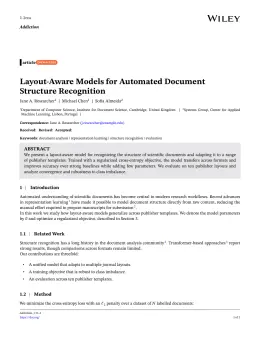
Journal of Field Robotics template — frequently asked questions

How do I write a paper in the Journal of Field Robotics format?
In DocuGuru you write your manuscript in a normal editor — no LaTeX setup required — and select the Journal of Field Robotics template. When you export, DocuGuru compiles the paper into the official Wiley format and hands you a submission-ready PDF along with the editable LaTeX source.
What reference style does Journal of Field Robotics use?
Journal of Field Robotics uses Author–year (Chicago) references, shown as author–year markers such as (Smith, 2023) in the text. DocuGuru formats every in-text citation and the reference list in this exact style automatically. A reference appears like this: Smith, Ada, Ben Jones, and Cara Lee. 2023. "A Representative Article Title." Journal of Field Robotics 12 (3): 45–58.
Do I need to know LaTeX to submit to Journal of Field Robotics?
No. DocuGuru generates the USG LaTeX class and compiles the PDF for you in the background, so you get a Wiley-ready Journal of Field Robotics document without writing any LaTeX. If you do want it, the LaTeX source is included in the export.
Can I import an existing draft into the Journal of Field Robotics template?
Yes. Paste or upload your current manuscript — Word, LaTeX, Markdown, or plain text — and DocuGuru reflows it into the Journal of Field Robotics format with correct headings, figures, tables, and author–year citations.
Who publishes Journal of Field Robotics?
Journal of Field Robotics is a multidisciplinary journal published by Wiley. DocuGuru's Journal of Field Robotics template matches Wiley's official submission format.
Can I export a submission-ready Journal of Field Robotics PDF?
Yes — DocuGuru produces a PDF built with the official Journal of Field Robotics template (the USG class) that is ready to submit to Wiley, together with the matching LaTeX source files.
How much does the Journal of Field Robotics template cost?
You can start writing in the Journal of Field Robotics template for free. Exporting the final submission-ready Journal of Field Robotics PDF and LaTeX source is part of DocuGuru's paid plans — see the app for current pricing.
Use the Journal of Field Robotics template