
8,948 citations
Cite
SaveGo to paper →
Wiley
Terra Nova Template
Write in a clean editor, then format for Terra Nova in one click — DocuGuru applies the official Wiley template with author–year references and exports a submission-ready PDF plus the editable LaTeX source. Free to start.
About the Terra Nova format
Terra Nova is a peer-reviewed journal published by Wiley, covering Geological and Geochemical Analysis, earthquake and tectonic studies, Geology and Paleoclimatology Research. Over its lifetime it has published 3,011 papers, which have received 97,303 citations.
| Publisher | Wiley |
|---|---|
| Reference style | Author–year (Chicago) Author–year — (Smith, 2023) in the text Smith, Ada, Ben Jones, and Cara Lee. 2023. "A Representative Article Title." Terra Nova 12 (3): 45–58.
Formats any DOI in Terra Nova style. No sign-up. |
| Publishes research in | Geological and Geochemical Analysis earthquake and tectonic studies Geology and Paleoclimatology Research High-pressure geophysics and materials Paleontology and Stratigraphy of Fossils |
| ISSN | 0954-4879 |
| Citation impact (2-yr) | 1.04 |
| h-index | 126 |
| i10-index | 1,640 |
| Article processing charge | $3,760 |
| Top institutions publishing here | Centre National de la Recherche Scientifique |
| Journal website | onlinelibrary.wiley.com |
| You get | A submission-ready PDF and the editable LaTeX source — ready to submit. |
Papers published in Terra Nova per year
Citation impact of Terra Nova by publication year
Citations each year’s papers have accumulated so far — the most recent years are still building up.
Most-cited papers in Terra Nova
The gradual discovery that late Neoproterozoic ice sheets extended to sea level near the equator poses a palaeoenvironmental conundrum. Was the Earth's orbital obliquity > 60° (making the tropics colder than the poles) for 4.0 billion years following the lunar‐forming impact, or did climate cool globally for some reason to the point at which runaway…
1,594 citations
Cite
SaveGo to paper →
The Variscan belt of western Europe is part of a large Palaeozoic mountain system, 1000 km broad and 8000 km long, which extended from the Caucasus to the Appalachian and Ouachita mountains of northern America at the end of the Carboniferous. This system, built between 480 and 250 Ma, resulted from the diachronic collision of…
835 citations
Cite
SaveGo to paper →
ABSTRACT In W‐dipping subduction zones there is a general eastward progression of the back‐arc basin‐accretionary wedge‐foredeep complex. With the forward progression, early stages of the complex are revealed by slices of upper crust and sedimentary cover abandoned to the west left floating above a new section of mantle. A major shear zone should form at…
690 citations
Cite
SaveGo to paper →
The Re–Os (rhenium–osmium) chronometer applied to molybdenite (MoS 2 ) is now demonstrated to be remarkably robust, surviving intense deformation and high‐grade thermal metamorphism. Successful dating of molybdenite is dependent on proper preparation of the mineral separate and analysis of a critical quantity of molybdenite, unique to each sample, such that recognized spatial decoupling of…
583 citations
Cite
SaveGo to paper →
Related journal templates

Terra Nova template — frequently asked questions
How do I write a paper in the Terra Nova format?
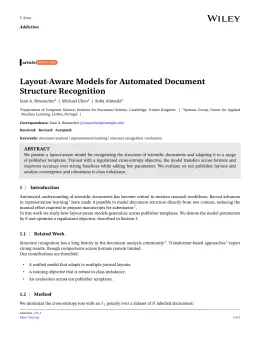
In DocuGuru you write your manuscript in a normal editor — no LaTeX setup required — and select the Terra Nova template. When you export, DocuGuru compiles the paper into the official Wiley format and hands you a submission-ready PDF along with the editable LaTeX source.
What reference style does Terra Nova use?
Terra Nova uses Author–year (Chicago) references, shown as author–year markers such as (Smith, 2023) in the text. DocuGuru formats every in-text citation and the reference list in this exact style automatically. A reference appears like this: Smith, Ada, Ben Jones, and Cara Lee. 2023. "A Representative Article Title." Terra Nova 12 (3): 45–58.
Do I need to know LaTeX to submit to Terra Nova?
No. DocuGuru generates the USG LaTeX class and compiles the PDF for you in the background, so you get a Wiley-ready Terra Nova document without writing any LaTeX. If you do want it, the LaTeX source is included in the export.
Can I import an existing draft into the Terra Nova template?
Yes. Paste or upload your current manuscript — Word, LaTeX, Markdown, or plain text — and DocuGuru reflows it into the Terra Nova format with correct headings, figures, tables, and author–year citations.
What is Terra Nova?
Wiley journal (USG class). It is a multidisciplinary journal, published by Wiley.
Can I export a submission-ready Terra Nova PDF?
Yes — DocuGuru produces a PDF built with the official Terra Nova template (the USG class) that is ready to submit to Wiley, together with the matching LaTeX source files.
How much does the Terra Nova template cost?
You can start writing in the Terra Nova template for free. Exporting the final submission-ready Terra Nova PDF and LaTeX source is part of DocuGuru's paid plans — see the app for current pricing.