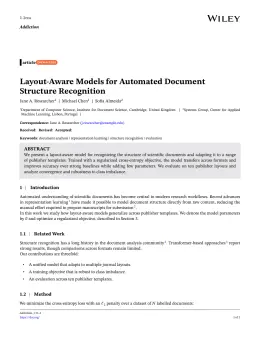
About the Economic Notes format
Economic Notes is a peer-reviewed journal published by Wiley, covering Banking stability, regulation, efficiency, Monetary Policy and Economic Impact, Global Financial Crisis and Policies.
| Publisher | Wiley |
|---|
| Reference style | Author–year (Chicago) Author–year — (Smith, 2023) in the text
Smith, Ada, Ben Jones, and Cara Lee. 2023. "A Representative Article Title." Economic Notes 12 (3): 45–58.
Formats any DOI in Economic Notes style. No sign-up.
|
|---|
| Publishes research in | Banking stability, regulation, efficiency Monetary Policy and Economic Impact Global Financial Crisis and Policies Corporate Finance and Governance Credit Risk and Financial Regulations |
|---|
| ISSN | 0391-5026 |
|---|
| Citation impact (2-yr) | 1 |
|---|
| h-index | 43 |
|---|
| i10-index | 168 |
|---|
| Total citations | 8,352 |
|---|
| Article processing charge | $2,630 |
|---|
| Top institutions publishing here | Bank of Italy |
|---|
| Journal website | onlinelibrary.wiley.com |
|---|
| You get | A submission-ready PDF and the editable LaTeX source — ready to submit. |
|---|
Papers published in Economic Notes per year
Citation impact of Economic Notes by publication year
Citations each year’s papers have accumulated so far — the most recent years are still building up.
Most-cited papers in Economic Notes
Expected Shortfall: A Natural Coherent Alternative to Value at Risk
Carlo Acerbi, Dirk Tasche · 1 Jul 2002
We discuss the coherence properties of expected shortfall (ES) as a financial risk measure. This statistic arises in a natural way from the estimation of the ‘average of the 100% worst losses’ in a sample of returns to a portfolio. Here p is some fixed confidence level. We also compare several alternative representations of ES…
The Procyclical Role of Rating Agencies: Evidence from the East Asian Crisis
Giovanni Ferri, Li-Gang Liu, Joseph E. Stiglitz · 1 Nov 1999
We demonstrate that credit rating agencies aggravated the East Asian crisis. In fact, having failed to predict the emergence of the crisis, rating agencies became excessively conservative. They downgraded East Asian crisis countries more than the worsening in these countries' economic fundamentals would justify. This unduly exacerbated, for these countries, the cost of borrowing abroad…
Information Technology and Productivity Changes in the Banking Industry
Luca Casolaro, Giorgio Gobbi · 1 Feb 2007
This paper analyses the effects of investment in information technologies (IT) in the financial sector using micro‐data from a panel of 600 Italian banks over the period 1989–2000. Stochastic cost and profit functions are estimated allowing for individual banks’ displacements from the best practice frontier and for non‐neutral technological change. The results show that both…
Patents and R&D as Real Options
Eduardo S. Schwartz · 1 Feb 2004
This article develops and implements a simulation approach to value patents and patent‐protected R&D projects based on the Real Options approach. It takes into account uncertainty in the cost‐to‐completion of the project, uncertainty in the cash flows to be generated from the project, and the possibility of catastrophic events that could put an end to…
Default Recovery Rates in Credit Risk Modelling: A Review of the Literature and Empirical Evidence
Edward I. Altman, Andrea Resti, Andrea Sironi · 1 Jul 2004
Evidence from many countries in recent years suggests that collateral values and recovery rates (RRs) on corporate defaults can be volatile and, moreover, that they tend to go down just when the number of defaults goes up in economic downturns. This link between RRs and default rates has traditionally been neglected by credit risk models,…