Wiley

Ecological Solutions and Evidence Template

Write in a clean editor, then format for Ecological Solutions and Evidence in one click — DocuGuru applies the official Wiley template with author–year references and exports a submission-ready PDF plus the editable LaTeX source. Free to start.

About the Ecological Solutions and Evidence format

Ecological Solutions and Evidence is a peer-reviewed journal published by Wiley, covering Wildlife Ecology and Conservation, Ecology and Vegetation Dynamics Studies, Species Distribution and Climate Change.

PublisherWiley
Reference styleAuthor–year (Chicago)
Author–year — (Smith, 2023) in the text
Smith, Ada, Ben Jones, and Cara Lee. 2023. "A Representative Article Title." Ecological Solutions and Evidence 12 (3): 45–58.

Formats any DOI in Ecological Solutions and Evidence style. No sign-up.

Publishes research inWildlife Ecology and Conservation Ecology and Vegetation Dynamics Studies Species Distribution and Climate Change Plant and animal studies Rangeland and Wildlife Management
ISSN2688-8319
Citation impact (2-yr)2.35
h-index33
i10-index150
Total citations4,944
Article processing charge$2,010
Open accessYes
Top institutions publishing hereUniversity of Toronto
Journal websitebesjournals.onlinelibrary.wiley.com
You getA submission-ready PDF and the editable LaTeX source — ready to submit.

Papers published in Ecological Solutions and Evidence per year

2
2019
28
2020
84
2021
86
2022
101
2023
115
2024
184
2025

Citation impact of Ecological Solutions and Evidence by publication year

19
2019
628
2020
1.5K
2021
1K
2022
759
2023
673
2024
248
2025

Citations each year’s papers have accumulated so far — the most recent years are still building up.

Most-cited papers in Ecological Solutions and Evidence

Laser scanning reveals potential underestimation of biomass carbon in temperate forest

Kim Calders, Hans Verbeeck, Andrew Burt et al. · 1 Oct 2022

Abstract Quantifying climate mitigation benefits of biosphere protection or restoration requires accurate assessment of forest above‐ground biomass (AGB). This is usually estimated using tree size‐to‐mass allometric models calibrated with harvested biomass data. Using three‐dimensional laser measurements across the full range of tree size and shape in a typical UK temperate forest, we show that its…

Species data for understanding biodiversity dynamics: The what, where and when of species occurrence data collection

Tanja K. Petersen, James D. M. Speed, Vidar Grøtan et al. · 1 Jan 2021

Abstract 1. The availability and quantity of observational species occurrence records have greatly increased due to technological advancements and the rise of online portals, such as the Global Biodiversity Information Facility (GBIF), coalescing occurrence records from multiple datasets. It is well‐established that such records are biased in time, space and taxonomy, but whether these datasets…

Improved forest management as a natural climate solution: A review

Lilli Kaarakka, Meredith W. Cornett, Grant M. Domke et al. · 1 Jul 2021

Abstract Natural climate solutions (NCS), a set of land management, conservation and restoration practices aimed at mitigating climate change, have been introduced as cost‐effective strategies to increase carbon (C) sequestration in terrestrial ecosystems. Improved forest management (IFM) has been identified as one NCS for working forests with substantial climate change mitigation potential. However, there is…

Benefits of increased cover crop diversity for predators and biological pest control depend on the landscape context

Léa Beaumelle, Arthur Auriol, Marie Grasset et al. · 1 Jul 2021

Abstract Increasing plant diversity in agricultural systems is a promising way to balance food production and biodiversity conservation. Biological pest control, a crucial ecosystem service delivered by natural enemies, could particularly benefit from increased plant diversity at the local scale. Such positive effects however often depend on the landscape context that shapes the pool of…

Conservation and people: Towards an ethical code of conduct for the use of camera traps in wildlife research

Koustubh Sharma, Matthias Fiechter, Todd George et al. · 24 Nov 2020

Abstract 1. Camera trapping is a widely employed tool in wildlife research, used to estimate animal abundances, understand animal movement, assess species richness and understand animal behaviour. In addition to images of wild animals, research cameras often record human images, inadvertently capturing behaviours ranging from innocuous actions to potentially serious crimes. 2. With the increasing…

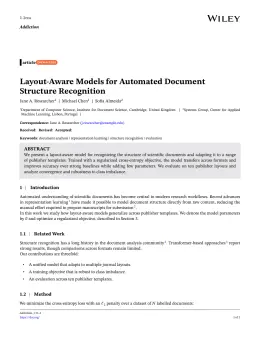
Ecological Solutions and Evidence template — frequently asked questions

How do I write a paper in the Ecological Solutions and Evidence format?
In DocuGuru you write your manuscript in a normal editor — no LaTeX setup required — and select the Ecological Solutions and Evidence template. When you export, DocuGuru compiles the paper into the official Wiley format and hands you a submission-ready PDF along with the editable LaTeX source.
What reference style does Ecological Solutions and Evidence use?
Ecological Solutions and Evidence uses Author–year (Chicago) references, shown as author–year markers such as (Smith, 2023) in the text. DocuGuru formats every in-text citation and the reference list in this exact style automatically. A reference appears like this: Smith, Ada, Ben Jones, and Cara Lee. 2023. "A Representative Article Title." Ecological Solutions and Evidence 12 (3): 45–58.
Do I need to know LaTeX to submit to Ecological Solutions and Evidence?
No. DocuGuru generates the USG LaTeX class and compiles the PDF for you in the background, so you get a Wiley-ready Ecological Solutions and Evidence document without writing any LaTeX. If you do want it, the LaTeX source is included in the export.
Can I import an existing draft into the Ecological Solutions and Evidence template?
Yes. Paste or upload your current manuscript — Word, LaTeX, Markdown, or plain text — and DocuGuru reflows it into the Ecological Solutions and Evidence format with correct headings, figures, tables, and author–year citations.
Who publishes Ecological Solutions and Evidence?
Ecological Solutions and Evidence is a multidisciplinary journal published by Wiley. DocuGuru's Ecological Solutions and Evidence template matches Wiley's official submission format.
Can I export a submission-ready Ecological Solutions and Evidence PDF?
Yes — DocuGuru produces a PDF built with the official Ecological Solutions and Evidence template (the USG class) that is ready to submit to Wiley, together with the matching LaTeX source files.
How much does the Ecological Solutions and Evidence template cost?
You can start writing in the Ecological Solutions and Evidence template for free. Exporting the final submission-ready Ecological Solutions and Evidence PDF and LaTeX source is part of DocuGuru's paid plans — see the app for current pricing.
Use the Ecological Solutions and Evidence template