
2,147 citations
Cite
SaveGo to paper →
Wiley
Journal of Polymer Science Template
Write in a clean editor, then format for Journal of Polymer Science in one click — DocuGuru applies the official Wiley template with author–year references and exports a submission-ready PDF plus the editable LaTeX source. Free to start.
About the Journal of Polymer Science format
Journal of Polymer Science is a peer-reviewed journal published by Wiley, covering Polymer crystallization and properties, Advanced Polymer Synthesis and Characterization, Polymer Nanocomposites and Properties. Over its lifetime it has published 4,607 papers, which have received 164,560 citations.
| Publisher | Wiley |
|---|---|
| Reference style | Author–year (Chicago) Author–year — (Smith, 2023) in the text Smith, Ada, Ben Jones, and Cara Lee. 2023. "A Representative Article Title." Journal of Polymer Science 12 (3): 45–58.
Formats any DOI in Journal of Polymer Science style. No sign-up. |
| Publishes research in | Polymer crystallization and properties Advanced Polymer Synthesis and Characterization Polymer Nanocomposites and Properties Polymer Science and PVC Synthesis and properties of polymers |
| ISSN | 0022-3832 |
| h-index | 161 |
| i10-index | 2,851 |
| Article processing charge | $3,970 |
| Top institutions publishing here | DuPont (United States) |
| Journal website | onlinelibrary.wiley.com |
| You get | A submission-ready PDF and the editable LaTeX source — ready to submit. |
Papers published in Journal of Polymer Science per year
Citation impact of Journal of Polymer Science by publication year
Citations each year’s papers have accumulated so far — the most recent years are still building up.
Most-cited papers in Journal of Polymer Science
2,044 citations
Cite
SaveGo to paper →
Abstract An attractive force appears between particles suspended in solutions of macromolecules when there is neither direct interaction between two particles nor energetic interaction between particles and solute macromolecules. The magnitude of this force is of the order of the osmotic pressure of the solution of macromolecules and the range is of the order of…
2,008 citations
Cite
SaveGo to paper →
Abstract A criterion for tearing of test‐pieces cut from thin sheets of a natural rubber vulcanizate, similar in form to the Griffith criterion for spreading of a crack, is formulated. This criterion involves a characteristic energy for tearing which is independent of the shape of the test‐piece and of the disposition of the cut. It…
1,548 citations
Cite
SaveGo to paper →
Abstract From data in the literature on relative rates of copolymerization it has been possible to evaluate two constants, Q and e, characteristic of an individual monomer, which appear to account satisfactorily for its behavior in copolymerization. The constant Q describes the “general monomer reactivity” and is apparently related to possibilities for stabilization in a…
903 citations
Cite
SaveGo to paper →
Related journal templates
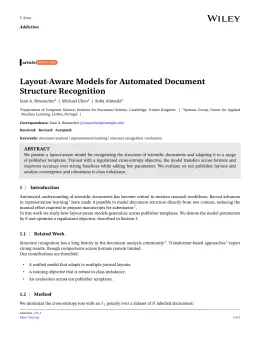

Journal of Polymer Science template — frequently asked questions
How do I write a paper in the Journal of Polymer Science format?
In DocuGuru you write your manuscript in a normal editor — no LaTeX setup required — and select the Journal of Polymer Science template. When you export, DocuGuru compiles the paper into the official Wiley format and hands you a submission-ready PDF along with the editable LaTeX source.
What reference style does Journal of Polymer Science use?
Journal of Polymer Science uses Author–year (Chicago) references, shown as author–year markers such as (Smith, 2023) in the text. DocuGuru formats every in-text citation and the reference list in this exact style automatically. A reference appears like this: Smith, Ada, Ben Jones, and Cara Lee. 2023. "A Representative Article Title." Journal of Polymer Science 12 (3): 45–58.
Do I need to know LaTeX to submit to Journal of Polymer Science?
No. DocuGuru generates the USG LaTeX class and compiles the PDF for you in the background, so you get a Wiley-ready Journal of Polymer Science document without writing any LaTeX. If you do want it, the LaTeX source is included in the export.
Can I import an existing draft into the Journal of Polymer Science template?
Yes. Paste or upload your current manuscript — Word, LaTeX, Markdown, or plain text — and DocuGuru reflows it into the Journal of Polymer Science format with correct headings, figures, tables, and author–year citations.
What is Journal of Polymer Science?
Wiley journal (USG class). It is a multidisciplinary journal, published by Wiley.
Can I export a submission-ready Journal of Polymer Science PDF?
Yes — DocuGuru produces a PDF built with the official Journal of Polymer Science template (the USG class) that is ready to submit to Wiley, together with the matching LaTeX source files.
How much does the Journal of Polymer Science template cost?
You can start writing in the Journal of Polymer Science template for free. Exporting the final submission-ready Journal of Polymer Science PDF and LaTeX source is part of DocuGuru's paid plans — see the app for current pricing.